For a long time, I looked at new crypto infrastructure through a surprisingly simple lens. If a project introduced a clever idea, published a detailed roadmap, and solved a technical problem that others hadn't addressed, I assumed the hardest part was already behind it. Oh, that felt reasonable at the time. But the more I watched different protocols launch, the more I realized I had been focusing almost entirely on creation while paying very little attention to everything that comes after it.
Yeah, that shift changed the way I evaluate projects today.
Now I find myself asking a much simpler question: what happens after something is created?
A bridge, a marketplace, an AI strategy, or an automated system can all exist on paper. They can even function perfectly during demonstrations. But existence alone doesn't create value. A road only becomes important because people keep traveling across it. A marketplace only matters because buyers and sellers continue returning. The same principle applies to blockchain infrastructure. Building something is only the beginning. Whether it continues moving inside a living economy is the part that actually matters.
That perspective is one reason Newton Protocol caught my attention.
At first glance, it's easy to describe Newton Protocol as infrastructure for AI-driven strategies, automated trading, and a marketplace where developers can build and exchange intelligent systems. That's the surface-level explanation. Okay, but surface-level descriptions rarely tell me whether something deserves long-term attention.
What interested me after looking deeper wasn't simply what the protocol intends to build. It was the structure behind it.
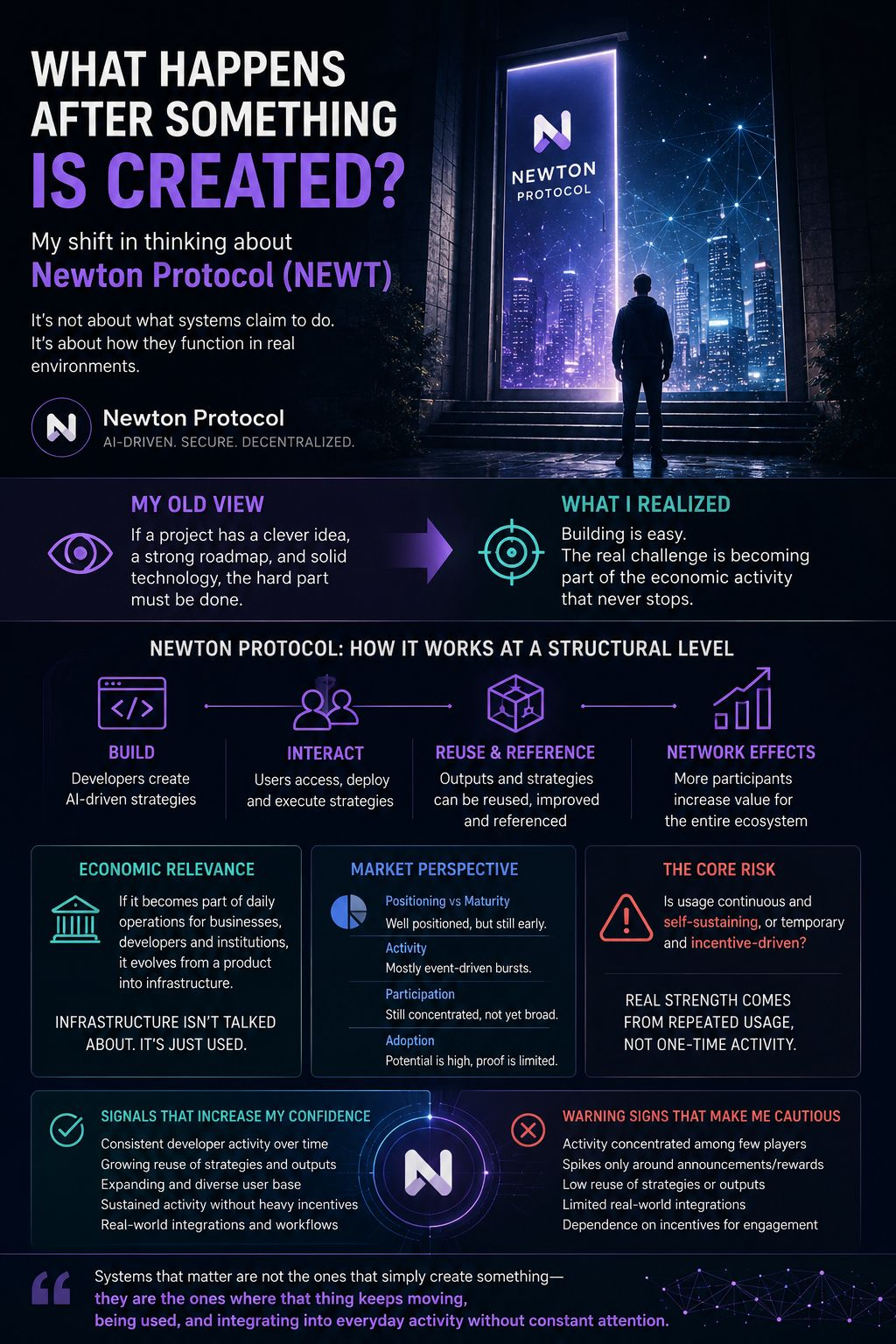
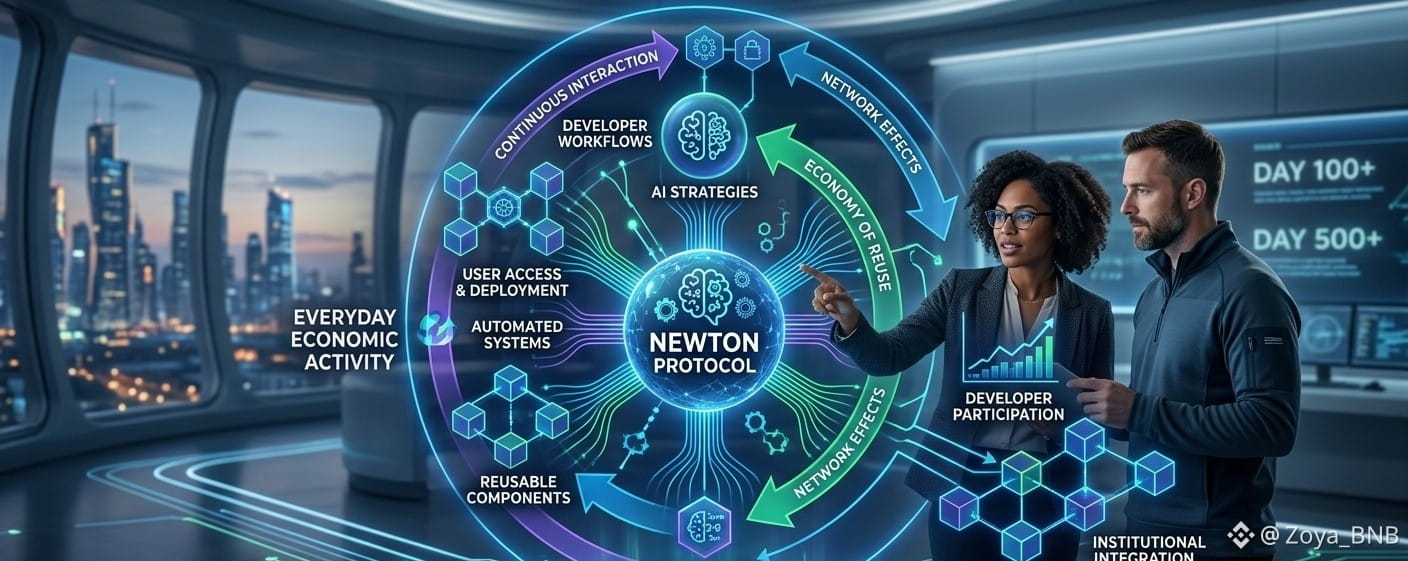
Instead of treating AI as isolated software, Newton Protocol attempts to create an environment where different participants can continuously interact. Developers create strategies. Users access and deploy them. Automated systems execute within a secure framework. Those outputs don't necessarily disappear after one interaction—they can become references for future activity, encouraging a cycle where new participants build on existing work rather than constantly starting from zero.
That distinction feels important.
A single successful AI strategy has limited value if it remains isolated. But when strategies become reusable, discoverable, and capable of interacting with a broader ecosystem, the system starts behaving less like a collection of individual tools and more like shared infrastructure. It's similar to how a railway network becomes increasingly valuable as more stations connect to it. Every additional connection improves the usefulness of the whole network, not just one destination.
Of course, network effects are easy to talk about and much harder to achieve.
Every infrastructure project promises growth through participation, yet many struggle because activity arrives only during periods of excitement. Temporary incentives attract attention, but they don't necessarily create habits. Markets often mistake bursts of activity for durable demand, even though the two are completely different.
That's why I try to separate potential from proof.
Newton Protocol appears well positioned around the growing intersection of AI and blockchain, but positioning isn't the same as maturity. The vision aligns with trends that are becoming increasingly relevant, yet relevance alone doesn't guarantee sustained adoption. A protocol becomes meaningful only when developers repeatedly choose to build on it, users consistently return because it solves ongoing problems, and automated systems continue operating without needing constant promotional campaigns to stay active.
That brings me back to the question I now ask almost automatically.
What happens after something is created?
Does an AI strategy continue interacting with users? Does it generate additional activity? Do developers improve existing work instead of abandoning it? Do institutions eventually find operational reasons to integrate the system into their workflows? Or does everything slow down once incentives disappear?
Those answers determine whether a protocol becomes infrastructure or simply another interesting experiment.
From a broader economic perspective, that's the difference between a product and a platform embedded into everyday activity. Real infrastructure quietly becomes part of normal operations. Businesses rely on it. Developers expect it to exist. Markets build around it. People stop talking about the technology itself because they're too busy using it.
Newton Protocol has the opportunity to move toward that direction, but opportunity should never be confused with certainty.
My confidence would increase if I saw consistent developer participation over long periods, growing reuse of existing AI strategies, expanding interaction across different types of users, and evidence that activity continues even when external incentives become less attractive. Those signals would suggest that the protocol is creating genuine economic behavior rather than temporary engagement.
At the same time, I would become more cautious if most activity remained concentrated among a small number of participants, if usage spiked only around announcements or rewards, or if the marketplace failed to produce ongoing interactions between builders and users. Those patterns often indicate that interest is being manufactured rather than sustained.
So my framework has become much simpler than it used to be.
I no longer judge systems by what they create on day one. I pay much more attention to what happens on day one hundred, day five hundred, and beyond. The systems that ultimately matter are rarely the ones that simply produce something impressive once. They're the ones where that creation keeps moving, keeps being reused, keeps connecting new participants, and quietly integrates itself into everyday economic activity without constantly demanding attention.