
Newton Protocol (NEWT) made me stop for the wrong reason first.
Not because I was excited.
Because I was tired.
Look, crypto has been throwing the same words at us for years with different packaging. AI. Agents. Automation. Trading systems. Developer marketplaces. Secure infrastructure. Every cycle finds a new mask, and everyone acts like this time the mask is the product.
I have seen enough of that.
I have clicked enough fake dashboards. Signed enough dumb approvals. Watched enough “decentralized” systems quietly depend on one server under the hood. Sat through enough airdrops where half the supply went to bots and the real users got leftovers. Used enough bridges that made me feel like I was sending money into fog. Paid gas for transactions that failed because some part of the stack was held together with hope.
So when I first looked at Newton, I did not think, “This is the future.”
Honestly, I thought, “Okay, what is broken here?”
That is usually the only sane way to look at crypto now.
The thing is, Newton gets more interesting when you stop staring at the AI part. The AI part is loud. It is easy to market. It gives people something to tweet about. AI agents managing strategies, automated trading, developers building models, users delegating actions. Fine. We have heard that before.
But the real issue is not whether an agent can do something.
The issue is whether it should be allowed to do it.
That is the mess.
Crypto wallets are still too primitive for the amount of value they carry. You connect. You approve. You sign. You hope the contract is clean. You hope the front end is not compromised. You hope you did not miss some little permission that turns into a problem later.
Now imagine giving that same environment to an automated agent.
That is not innovation by itself.
That is a loaded gun with faster reflexes.
A human can make one bad move. An agent can make a thousand before you notice. It can follow bad instructions perfectly. It can interact with the wrong contract. It can burn through limits that were never properly set. It can turn one vague permission into a full-blown loss.
So Newton’s better idea is not “AI will trade for you.”
Its better idea is guardrails.
Not the pretty kind written in docs.
Actual guardrails.
Rules before execution. Limits before damage. Permissions that mean something before money moves.
That matters because most of crypto’s trauma comes from things happening too late. We find out a bridge was weak after funds are stuck. We find out an airdrop was farmed after real users are diluted. We find out approvals were dangerous after wallets get drained. We find out a vault manager had too much freedom after depositors are already exposed.
Everything is obvious after the loss.
Newton is trying to move some of that logic earlier.
Before the transaction.
Before the agent acts.
Before the vault changes exposure.
Before the automated strategy touches funds.
That is not flashy. It is just necessary.
And honestly, that is why I take it more seriously than most AI crypto projects. The space does not need another chatbot with a token. It does not need another trading bot pretending to be infrastructure. It needs plumbing that actually works. It needs systems that can say, “No, this action breaks the rules,” and block it before everyone is sitting in Discord trying to understand what happened.
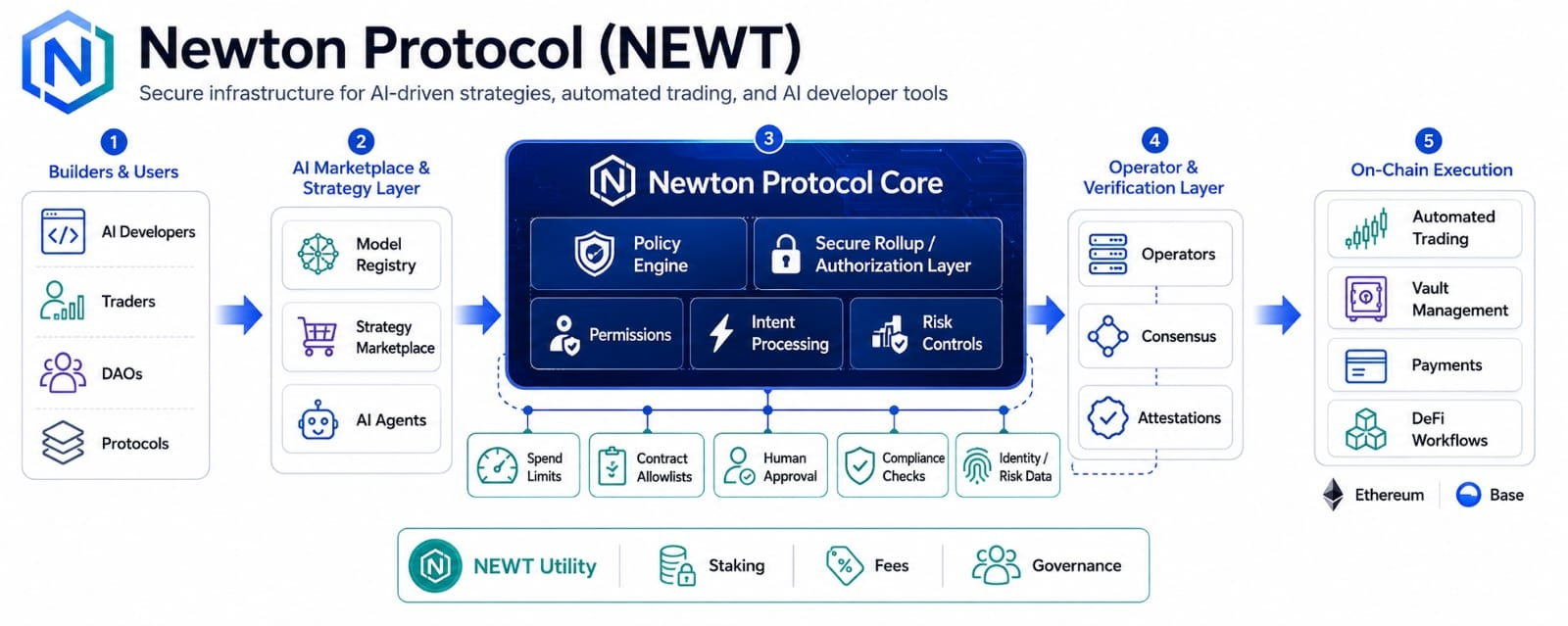
Under the hood, Newton is trying to build a permission and authorization layer for automated onchain activity. A user, protocol, vault, or developer can define what an agent or system is allowed to do. How much it can spend. Which contracts it can touch. What kind of strategy it can run. When it needs approval. What rules it cannot cross.
That sounds boring until you have lived through enough chaos.
Then boring starts to look valuable.
The crypto market loves speed, but speed without control is how people get wrecked. Fast settlement is great until the wrong thing settles. Automation is great until the wrong action gets automated. AI agents are exciting until one of them has more wallet access than it should.
Newton sits right there, in that uncomfortable space.
It is not trying to make agents sound smarter. It is trying to make them less dangerous.
That is a better angle.
I also like that the idea stretches beyond just trading. Vaults need this. DAOs need this. Payment systems need this. Stablecoins probably need this. Any place where money moves based on rules needs some way to enforce those rules before execution.
Because right now, too much of crypto still runs on trust dressed up as decentralization.
A vault can say it has limits.
A DAO can say funds will only be used a certain way.
A protocol can say an agent has restricted access.
But unless those rules are enforced under the hood, they are just promises.
And promises in crypto are cheap.
We have all learned that.
Newton’s challenge is that none of this is easy to build. This kind of infrastructure has to be reliable. It has to be integrated by other teams. It has to be secure enough that people do not treat it like another risk layer. It has to make sense for developers without becoming a headache. It has to prove that the token is not just sitting next to the system for decoration.
That part still matters.
NEWT can have staking, fees, governance, operator incentives, and all the usual protocol design around it, but the market has seen enough token utility slides. Real demand is different. Real usage is different. If teams do not actually need Newton, then the idea stays clean and the product stays optional.
That is the hard part.
And I do not think anyone should pretend otherwise.
But I would rather watch a project trying to solve a boring, painful problem than another one selling fantasy. Crypto has enough fantasy. It has enough narratives. It has enough people pretending every new agent will become a money printer.
What it does not have enough of is infrastructure that protects users before things go wrong.
Newton feels like it is aiming at that layer.
Not perfectly.
Not instantly.
Maybe not in a way the market understands right away.
But the problem is real. Anyone who has spent enough time onchain knows it. We have all felt that small pause before signing a transaction. We have all wondered if an approval was safe. We have all watched bots farm systems meant for humans. We have all seen automation break trust faster than manual mistakes ever could.
So when Newton talks about secure rollups, AI-driven strategies, automated trading, permissions, and a marketplace for developers, I do not hear some clean futuristic pitch.
I hear a project trying to deal with the mess under the hood.
The ugly part.
The part everyone ignores while the chart is green.
Maybe that is why it feels different.
Because the strongest version of Newton is not about making crypto look smarter. It is about making crypto less reckless when machines start acting for us.
And honestly, that may take time.
It may be hard to explain. Hard to build. Hard to sell to a market that still prefers hype over plumbing.
But after enough cycles, you start respecting the plumbing.
Because when it breaks, everything else breaks with it.