
i've been turning something over in my head.
Most conversations about blockchain infrastructure start with speed, throughput, or fees. Those are the visible metrics. Everyone can measure them. Everyone can compare them. But I keep coming back to something much quieter that nobody seems to measure at all.
What happens before the transaction settles.
Not the execution. The decision.
Crypto has spent years obsessing over what happens after someone clicks confirm. Blocks get faster. Gas gets cheaper. Settlement gets more efficient. All of that matters. But none of it answers a simpler question that traditional finance learned to ask decades ago. Should this transaction happen in the first place?
I don't think the market has fully grasped how strange it is that we skipped that question entirely.
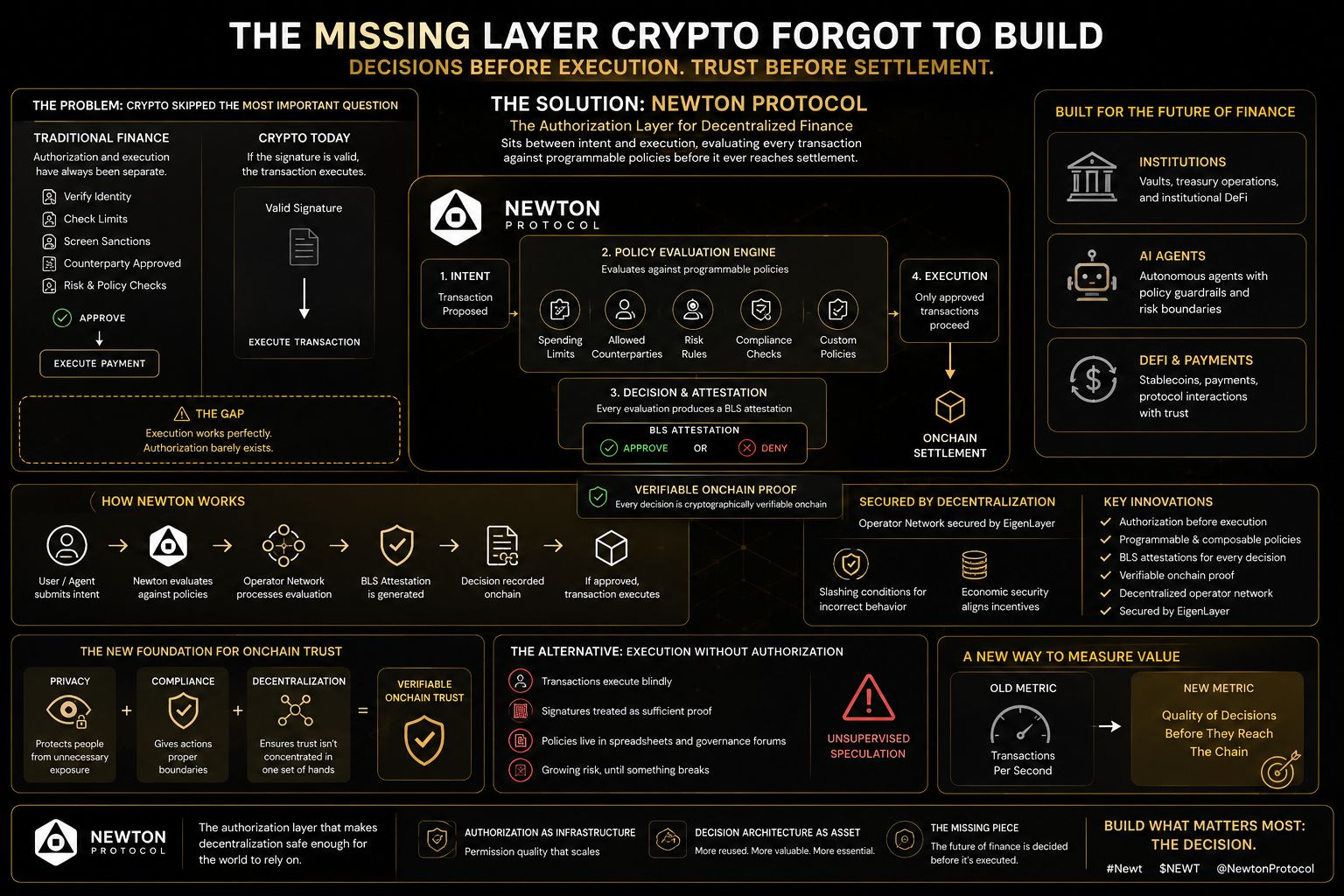
In traditional finance, authorization and execution have always been separate. A bank doesn't just verify your signature and move millions of dollars because the signature is valid. It checks limits. It screens for sanctions. It verifies identity. It confirms the counterparty is approved. Only after all those checks pass does the money actually move.
Crypto collapsed those layers into one. If the signature is valid, the transaction executes. That was the innovation. Remove the gatekeepers. Let code decide.
And for permissionless systems, that works beautifully. Nobody needs authorization to send Bitcoin between their own wallets. Nobody needs a compliance check to interact with a public smart contract.
But as DeFi grows into something larger, something that institutions are starting to explore, something that AI agents are beginning to navigate autonomously, the question quietly returns. Not every transaction should execute just because someone signed it. Not every valid signature represents a good decision.
I've been watching this tension grow for a while now. Vaults managing hundreds of millions of dollars. Stablecoins settling global payments. Treasury systems running on automated rules. In every case, the same gap appears. Execution works perfectly. Authorization barely exists.
That's the gap Newton Protocol is targeting.
Not another blockchain. Not another DeFi application. An authorization layer that sits between intent and execution, evaluating every transaction against programmable policies before it ever reaches settlement.
What makes this interesting to me isn't the technology alone. It's the shift in thinking it represents.
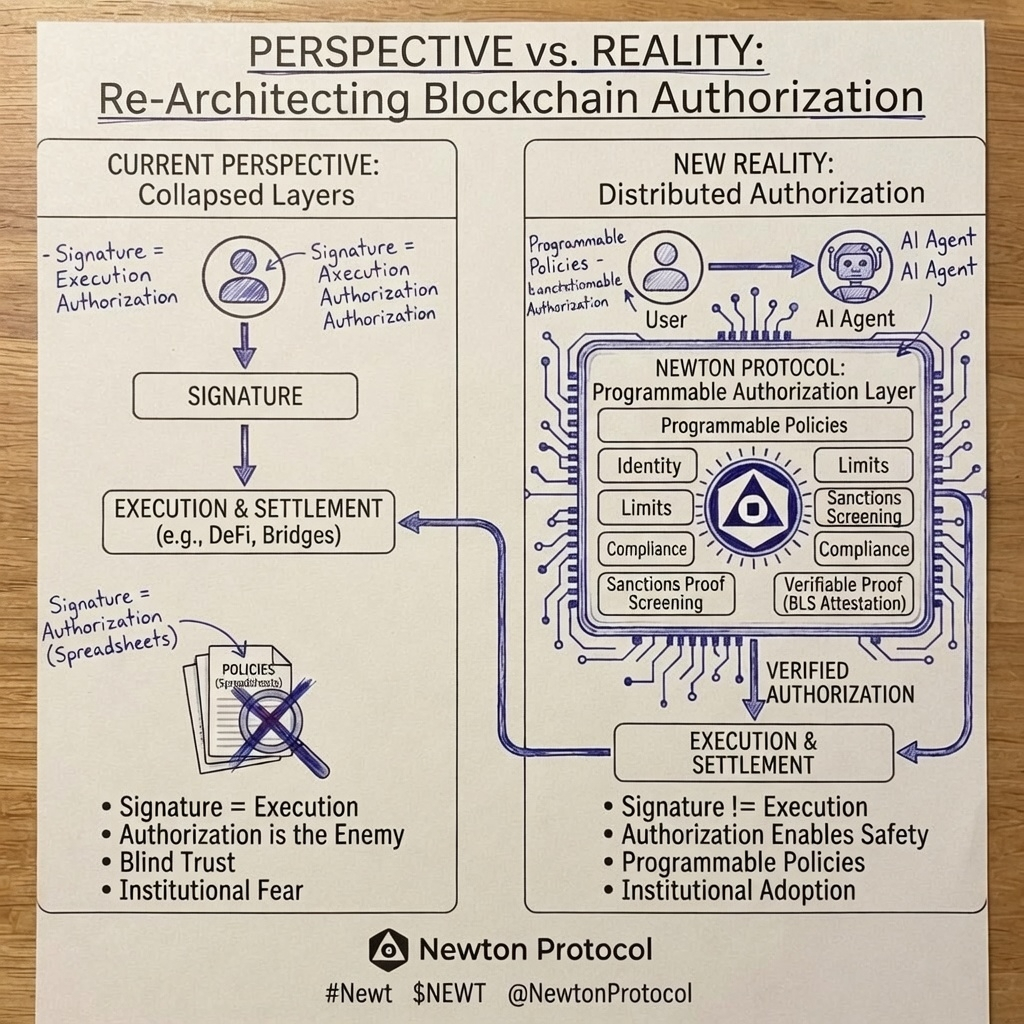
For years, crypto treated authorization as the enemy. Something to remove. Something that slowed things down. Something that smelled like centralization. Newton is suggesting something different. Authorization isn't the enemy of decentralization. It's the missing piece that makes decentralization safe enough for institutions to actually use.
I keep coming back to a simple equation that's been forming in my head. Privacy plus compliance plus decentralization equals verifiable onchain trust. It sounds almost too neat. But the more I sit with it, the more I think it captures something real.
Privacy protects people from unnecessary exposure. Compliance gives actions proper boundaries. Decentralization ensures trust isn't concentrated in one set of hands. None of those three work well alone. Together, they start looking like infrastructure that could actually scale.
The alternative is what we have now. Transactions that execute blindly. Signatures treated as sufficient proof. Policies that live in spreadsheets and governance forums rather than onchain. And a growing awareness that something is missing, even if most people can't name what it is.
I also think about what happens when AI agents enter this picture more fully.
People spend enormous energy debating how intelligent agents will become. Far less energy goes into asking how disciplined they'll remain. An agent managing a treasury without authorization guardrails isn't intelligent. It's dangerous. Programmable policies that enforce spending limits, approved counterparties, and risk boundaries before execution aren't friction. They're the difference between autonomous finance and unsupervised speculation.
Newton's approach to this feels more mature than most. Every policy evaluation produces a BLS attestation. Every decision is verifiable onchain. The operator network is secured by EigenLayer with slashing conditions for incorrect behavior. This isn't a compliance API that sends back an advisory opinion. It's infrastructure that says yes or no before money moves, with cryptographic proof of why.
I don't think the market has priced this yet.
Permission quality as infrastructure. Decision architecture as an asset class. Authorization that becomes more valuable the more it's reused across protocols, agents, and institutions. These aren't categories that show up on a chart. But they're the kind of quiet infrastructure that markets eventually discover they can't operate without.
Right now, most people still measure blockchain value by transactions per second.
I suspect the next generation will measure it by the quality of decisions made before those transactions ever reach the chain.

