Everyone keeps saying AI is the future. Every conference, every timeline, every headline repeats the same promise. Faster models. Smarter agents. Bigger investments. More automation. But after hearing the same story over and over, I can't shake the feeling that we're celebrating the surface while ignoring the question that actually matters.
Who owns the intelligence we're all helping build?
That question rarely makes it into the conversation. Instead, we're distracted by benchmark scores, billion-dollar valuations, and token launches claiming to be "AI-powered." It's becoming painfully familiar because the tech industry has repeated this pattern before. We get excited about innovation, overlook ownership, and then wake up years later realizing that the infrastructure quietly ended up in the hands of a few dominant players.
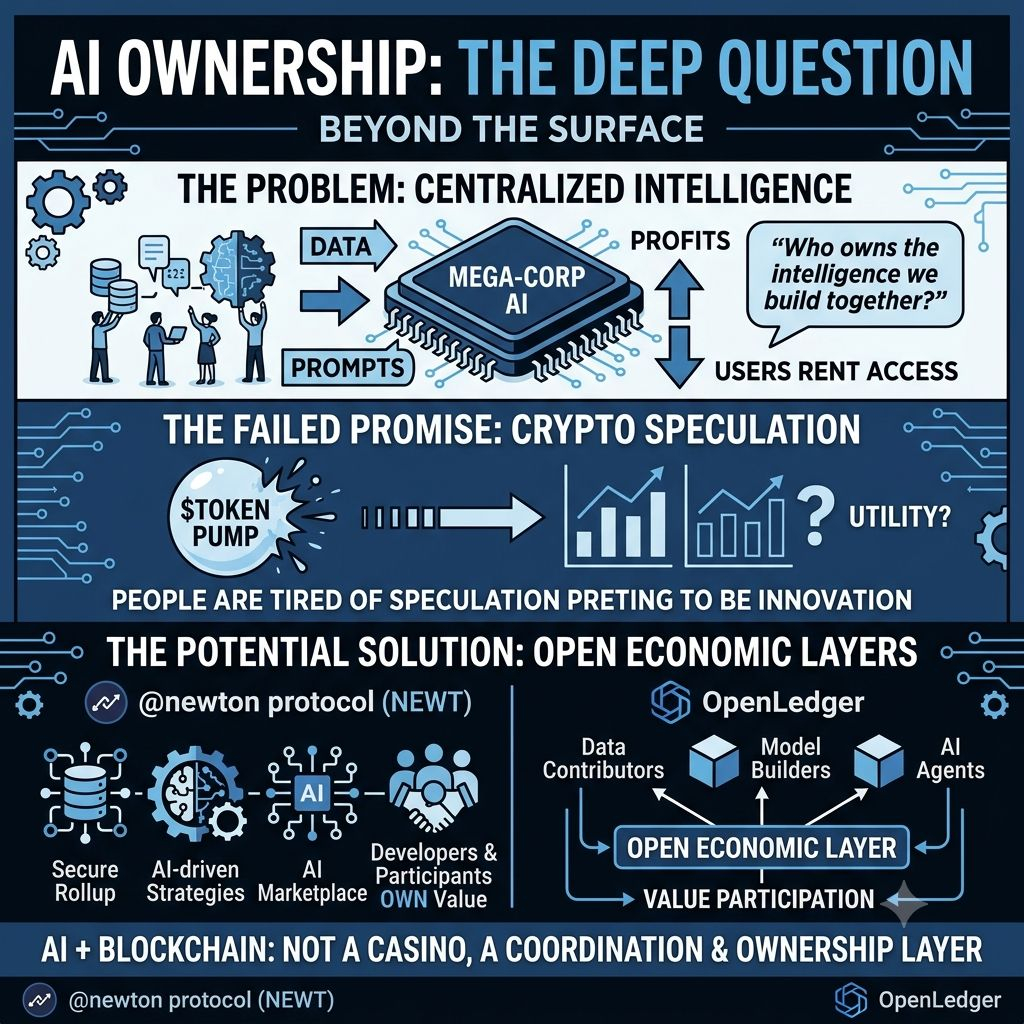
Today, a handful of companies control the compute, the data pipelines, the distribution channels, and increasingly the models themselves. Millions of people contribute prompts, conversations, feedback, and creative work every single day, often without thinking about how much value they're generating. Users become unpaid contributors to centralized systems while the economic rewards flow somewhere else.
Crypto was supposed to challenge that kind of concentration.
Instead, too much of the industry became obsessed with creating narratives instead of solving problems. Every cycle brings another wave of projects attaching "AI" to their branding as though the acronym alone creates utility. New tokens appear faster than useful products. Communities argue about price while the underlying technology barely changes. After years of watching the same cycle repeat, it's hard not to feel exhausted.
People aren't tired of innovation.
They're tired of pretending speculation is innovation.
They're tired of products that require reading ten guides before accomplishing something simple. They're tired of ecosystems that prioritize token charts over users. They're tired of hearing that decentralization is automatically valuable when many decentralized products still fail to offer experiences people genuinely want.
Because decentralization, by itself, solves nothing.
If the product doesn't work, users leave. If ownership exists only on paper while usability disappears, the market eventually notices. Real systems have to balance openness with products that ordinary people can actually use.
That balance becomes much more important as AI evolves.
We're slowly reaching a point where AI isn't just another software category. It starts looking more like an economic layer. Data becomes productive. Models become productive. Autonomous AI agents may eventually perform work, negotiate services, generate value, and interact with digital economies on behalf of users. If that future develops, ownership won't be an abstract philosophical discussion anymore. It will determine who captures the value created by intelligence itself.
That's where the conversation becomes uncomfortable.
If AI infrastructure remains centralized, then intelligence slowly becomes another rented service. Developers build on platforms they don't control. Businesses depend on APIs they don't own. Users continuously generate value inside ecosystems they can never meaningfully participate in. The technology improves, but ownership becomes narrower.
History has shown how quickly the open internet can become centralized through convenience. There's no guarantee AI won't follow exactly the same path.
This is why projects experimenting with different ownership models deserve attention, even if skepticism remains necessary.
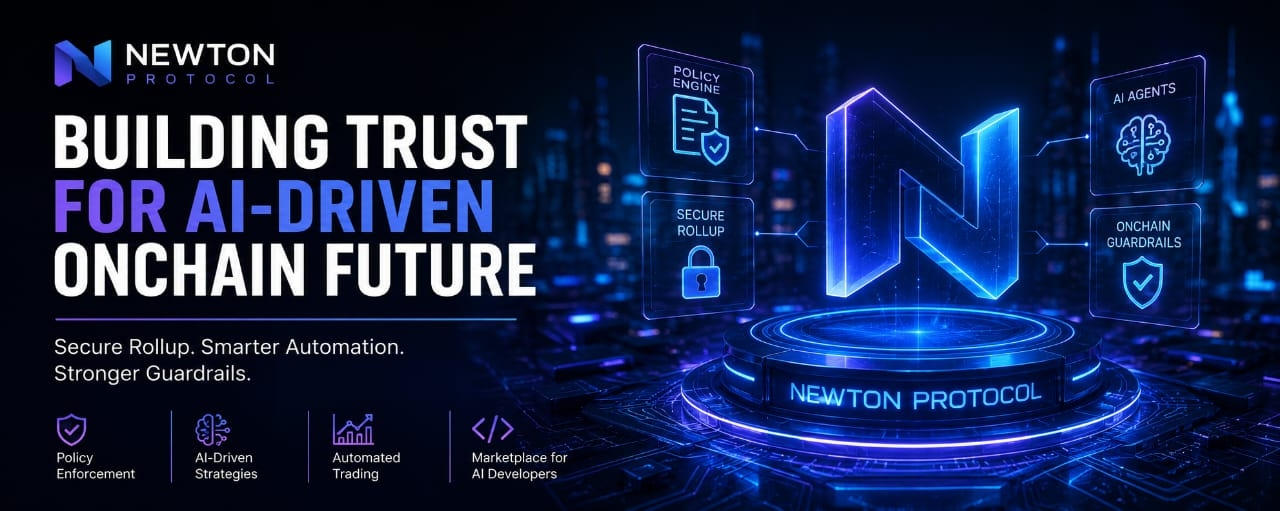
One example is @undefined (NEWT), which is exploring a secure rollup for AI-driven strategies, automated trading, and a marketplace where AI developers can build and participate. The interesting part isn't simply combining AI and blockchain. Plenty of projects claim that. The more meaningful question is whether infrastructure can allow participants to retain ownership over the value created by intelligent systems rather than simply renting access from centralized platforms.
A similar conversation exists around OpenLedger, which is attempting to build an open economic layer for AI where data contributors, model builders, and AI agents can all participate in creating and capturing value instead of being locked inside closed ecosystems. That doesn't guarantee success. It may fail. Many ambitious infrastructure projects do.
But failure doesn't make the problem imaginary.
The problem is real.
Builders increasingly depend on infrastructure they don't own. Independent developers compete against companies with nearly unlimited compute. Data becomes more valuable every year, yet the people generating it rarely participate in the upside. Intelligence risks becoming another centralized utility where everyone pays subscription fees while only a few organizations control the foundations.
Blockchain becomes interesting again when viewed through this lens.
Not as a machine for speculation.
Not as another casino.
But as a coordination and ownership layer capable of recording contributions, distributing value, and allowing economic participation across networks where intelligence itself produces output. Whether today's projects succeed is still uncertain. The direction feels more important than the individual winners.
Crypto already showed what happens when utility is ignored. Entire ecosystems chased financial engineering while forgetting that sustainable networks need products people actually use. AI could easily repeat the same mistake if every project focuses on marketing instead of building infrastructure that changes incentives.
That's why realism matters more than excitement.
The future probably won't belong entirely to centralized corporations, nor entirely to decentralized protocols. It will likely belong to whichever systems combine useful products with credible ownership structures. Open systems don't win simply because they're open. They have to compete on experience, reliability, and trust.
Still, ownership cannot remain an afterthought.
Because AI is moving far faster than society's ability to decide who should control it. If ownership layers aren't built while the foundations are still taking shape, intelligence itself may gradually become something we never truly possess. It will simply become another rented utility—operated by a handful of corporations, accessed through subscriptions, and paid for indefinitely by everyone else.