
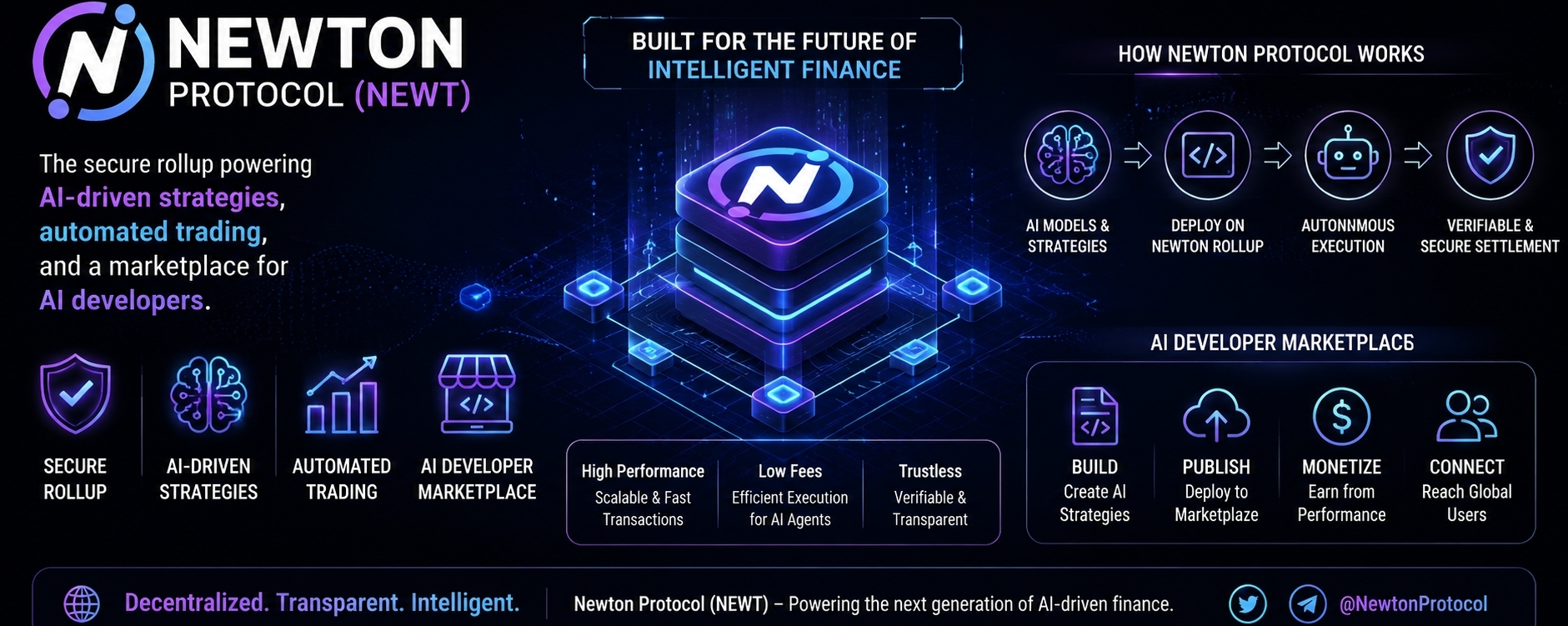

I've been paying closer attention to the projects trying to combine artificial intelligence with blockchain, and I've noticed that the most interesting ones are no longer competing to build the smartest chatbot or the flashiest AI demo. What keeps pulling my attention back is the infrastructure behind those ideas. That's where I think Newton Protocol (NEWT) becomes worth discussing. Instead of treating AI as another marketing trend, the project is trying to build an environment where autonomous strategies can actually operate in a secure and transparent way. Whether it succeeds is still an open question, but I think it's asking more practical questions than many projects in the same space.
The vision behind Newton Protocol is centered on creating a secure rollup designed for AI-driven strategies, automated trading, and a marketplace where developers can build and distribute AI-powered tools. That combination makes sense because these pieces naturally depend on one another. Developers need a place to launch intelligent agents, users need confidence that those agents behave as advertised, and the network itself needs a reliable way to process everything without sacrificing security. It is a difficult balance to achieve, but at least the project is attempting to solve a real infrastructure problem rather than creating another token with an AI label attached to it.
One thing I appreciate is that the project doesn't seem to assume AI automatically creates value. Financial markets have a way of exposing weak ideas very quickly. An AI strategy might produce impressive results for a short period, but changing market conditions eventually test every model. That is why transparency matters so much. If users cannot understand how strategies are executed or verify that they are operating fairly, trust disappears regardless of how advanced the technology sounds.
I also think the decision to build around a dedicated rollup is more meaningful than it might appear at first glance. AI-powered applications can generate far more activity than traditional blockchain transactions, especially if automated strategies are constantly making decisions. Running those processes efficiently while keeping costs predictable is not a simple engineering challenge. If Newton Protocol can provide that balance without compromising security, it would address one of the biggest limitations facing AI-based financial applications today.
The marketplace for AI developers is another part of the project that I find interesting. There are already talented developers building sophisticated trading models and autonomous systems, but many of those tools remain private because there are few reliable ways to commercialize them in a decentralized environment. A functioning marketplace could create new opportunities for developers while giving users access to a broader range of strategies. Of course, that only works if performance can be measured objectively. A marketplace filled with exaggerated claims would add very little value, so transparent evaluation will be just as important as the technology itself.
Something I always watch with projects like this is whether real developers decide to build on the network. Marketing campaigns can generate attention for a few weeks, but active builders create ecosystems that last for years. If independent teams begin launching applications, improving the protocol, and attracting users without constant incentives, that tells me much more than short-term price movements ever could. Strong ecosystems usually grow because developers see genuine opportunities, not because they are temporarily rewarded to participate.
The token itself is another area where patience is important. Almost every crypto project introduces multiple use cases for its native asset, but long-term value comes from sustained network activity rather than theoretical utility. If the rollup becomes a place where AI applications are actively deployed, transactions increase, and developers continue contributing to the ecosystem, demand for the token could develop naturally. If those fundamentals never materialize, the token becomes much harder to justify beyond speculation.
Security is probably the area I will watch most closely. Combining artificial intelligence with financial infrastructure creates risks that go beyond ordinary smart contracts. Questions about model integrity, data quality, execution reliability, and resistance to manipulation become just as important as blockchain security itself. These are complicated problems, and I have not seen enough evidence yet to conclude how effectively Newton Protocol will address all of them. That uncertainty is perfectly normal for a project at this stage, but it is something investors should acknowledge instead of overlooking.
Competition is another reality that cannot be ignored. The AI and blockchain sector has become increasingly crowded, with many teams working on decentralized computing, intelligent agents, and AI infrastructure. Standing out will require consistent execution over a long period rather than a compelling narrative. In my experience, technology sectors eventually reward projects that quietly solve difficult problems more than those that dominate social media conversations for a few months.
I also think it is important not to judge Newton Protocol purely by its early market performance. New tokens often experience significant volatility because expectations change faster than fundamentals. Price can attract attention, but adoption is what ultimately builds value. I would rather see steady developer growth, increasing application activity, and expanding network usage than dramatic price spikes followed by long periods of inactivity.
The more I follow this sector, the more I believe that infrastructure projects have the potential to create lasting value if they execute well. They rarely receive the same excitement as consumer-facing applications because much of their work happens behind the scenes, but they often become the foundation that allows entire ecosystems to grow. Newton Protocol is positioning itself within that category, focusing on the systems that AI-powered finance may eventually depend on instead of chasing short-lived trends.
For me, Newton Protocol remains a project to watch carefully rather than one to celebrate unconditionally. The concept is ambitious, the technical challenges are substantial, and there is still a long distance between a promising vision and a widely adopted network. If the team can demonstrate meaningful developer participation, reliable infrastructure, and genuine demand for AI-powered applications, the project could establish a valuable position in an increasingly competitive market. Until then, I think the smartest approach is to follow the evidence as it develops, because in crypto, sustainable progress usually speaks louder than ambitious promises.