
Why Newton Protocol Made Me Rethink What Security in Crypto Actually Means
I've stopped reacting to the word "secure" in crypto whitepapers because it stoped meaning anything useful a long time ago. Every project claims its protocol is secure. Every team says they've thought carefuly about the risks. After a few years in this market, I've learned that security claims are usually the easiest thing to write and the hardest thing to actually prove. That's what made me pay closer attention when I came accross @NewtonProtocol $NEWT , because they aren't just claiming to be secure — they're describing a specific mechanism for how enforcement actually happens before a transaction settles, and that's a meaningfully different conversation.
The problem they're addressing is one I've felt personnaly, even if I couldn't always articulate it clearly.
Every time I've used an automated DeFi strategy, there's a moment where I have to just accept that the system will do what its suppose to do. I check the parameters, I read the documentation, I verify the smart contract is audited — and then I have to trust that all of those pieces actually hold together at execution time. Most of the time they do. But crypto moves fast, and the times they don't tend to be expensive. I've had positions behave in ways I didn't expect because a rule that existed on paper wasn't actually enforced in the code. That gap between what a protocol says it does and what it actually enforces at runtime is something I've never seen properly solved until I started reading about what Newton is building.
What makes the authorization layer concept click for me is how simple the underlying logic is.
A transaction gets evaluated against a policy before it settles. If the action violates the rule, it doesn't execute. A signed attestation records exactly what was checked and what the result was. That's not revolutionary technology in isolation — it's a principal that traditional finance has used for decades. Your bank evaluates a payment against fraud rules before it clears, not after. Card networks authorize transactions in real time before funds move. The suprising thing isn't that Newton is doing this onchain. The surprising thing is that nobody built it properly before now, considering how much capital moves through DeFi every single day.
I've also come to beleive that infrastructure projects are consistently undervalued in the early stages because they aren't exciting to talk about.
Everyone wants to discuss which token might move next week. Very few people want to discuss the compliance layer that makes institutional capital feel comfortable entering DeFi. But those conversations are connected. The reason serious money hasn't fully moved onchain isn't because the yields aren't attractive. It's because the enforcement infrastructure that large capital requires simply hasn't existed in a decentralized form. If Newton Protocol can genuinely fill that gap, the value doesn't come from speculation — it comes from becoming necessary to the ecosystem the same way payment rails are necessary to commerce. That's the kind of adoption I find much more durable then narrative-driven price movements.
The policy marketplace is something I'm watching with genuine interest but realistic expectations.
Developer ecosystems are extraordinarily difficult to build. I've watched projects launch impressive frameworks and then struggle to attract builders who actually create things people use. The reason Ethereum retained its dominance wasn't just technical superiority — it was that developers kept finding reasons to build there, and those applications created organic demand that compounded over time. If Newton Protocol can attract compliance developers, risk managers, and security researchers who build policy modules that protect real capital, then the network becomes more valuable in a way thats hard to replicate quickly. If it can't attract those builders, then the architecture stays elegant but unused.
At the same time, I'm being careful not to let the current AI narrative do my thinking for me.
We've been through this before. NFTs were going to change ownership forever. The metaverse was going to replace physical reality. GameFi was going to make everyone wealthy while playing games. Every one of those narratives attracted genuine innovation and also enormous amounts of capital chasing a story rather then a product. AI in crypto feels different to me because the underlying problem is real — autonomous agents genuinly do need authorization infrastructure before they can be trusted with serious capital. But feeling different isn't the same as being different. The only thing that will actually seperate Newton from the noise is whether the protocols handling real volume start using it.
I'm also spending time on the token side of things because I've learned that ignoring tokenomics is expensive.
Early in my crypto career I evaluated projects almost entirely on technology and narrative. I payed for that repeatedly. A project can solve a genuine problem and still have a token that underperforms for years because the supply dynamics work against price appreciation. I'm not in a position to give a complete verdict on NEWT's tokenomics yet because I'm still working through the details, but its something I'm researching carefully before making any meaningful decision. The technology and the token are seperate questions, and treating them as the same question has costed me money before.
Competition is something Newton Protocol can't afford to ignore either.
The onchain compliance and security sector is attracting serious attention, and serious attention attracts well-funded competitors. Some will be dedicated protocols. Others will be larger platforms adding compliance features to existing infrastructure. Newton's advantage has to come from the quality of its decentralized operator network, the composability of its policy modules, and the trust that comes from verifiable enforcement rather than centralized promises. Those advantages are real, but they have to be demonstrated through integrations that matter — not just announced through partnership posts.
The timing does feel worth mentioning though, because something is genuinly shifting in the industry conversation.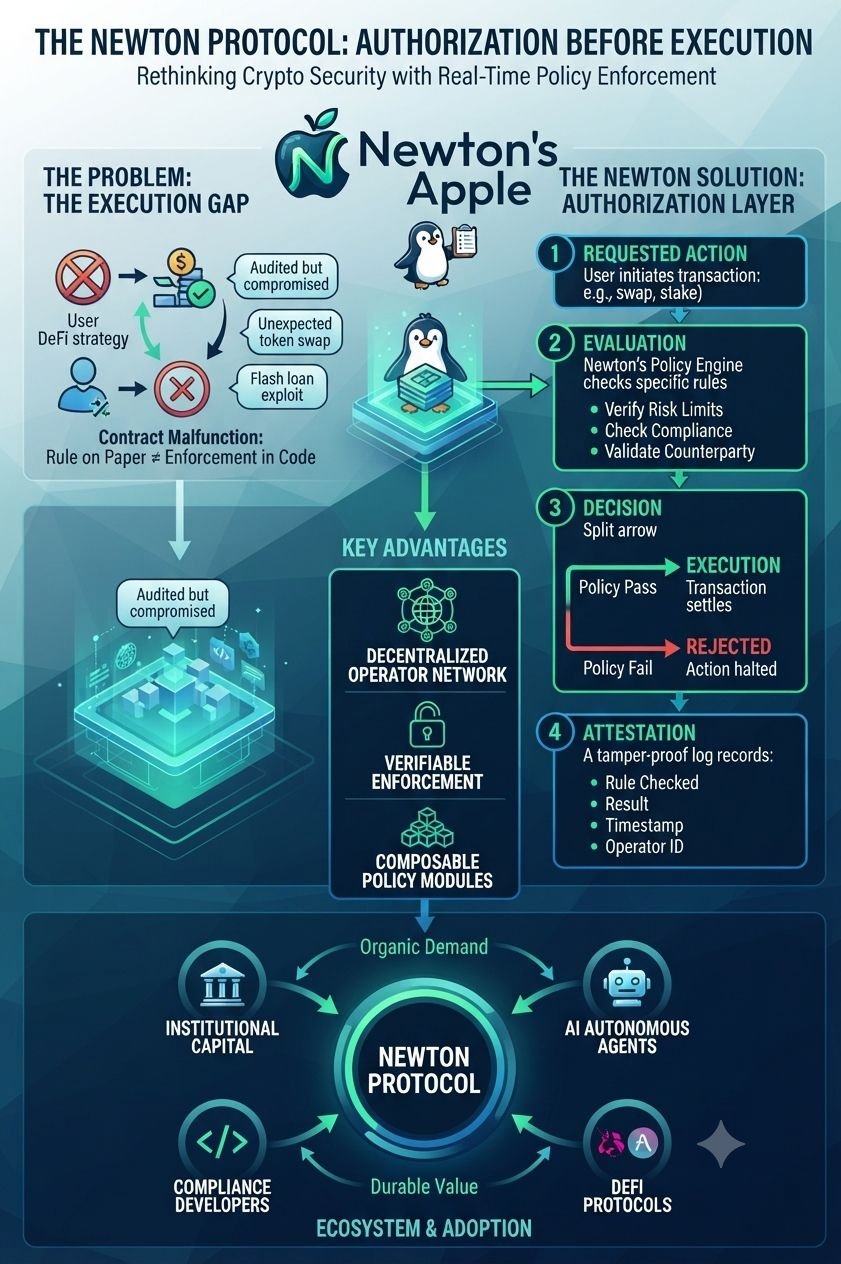
A year ago most discussions about AI in crypto were about trading performance — which bot had the best returns, which algorithm was most accurate. Those conversations are starting to be replaced by harder questions about accountability and enforcement. If an AI agent executes a transaction that violates a risk limit, who's responsible? How do you prove what rules were evaluated before the action happend? Those are compliance and infrastructure questions, not performance questions, and they're the ones Newton is positioned to answer. Whether that positioning translates into adoption depends entirely on execution.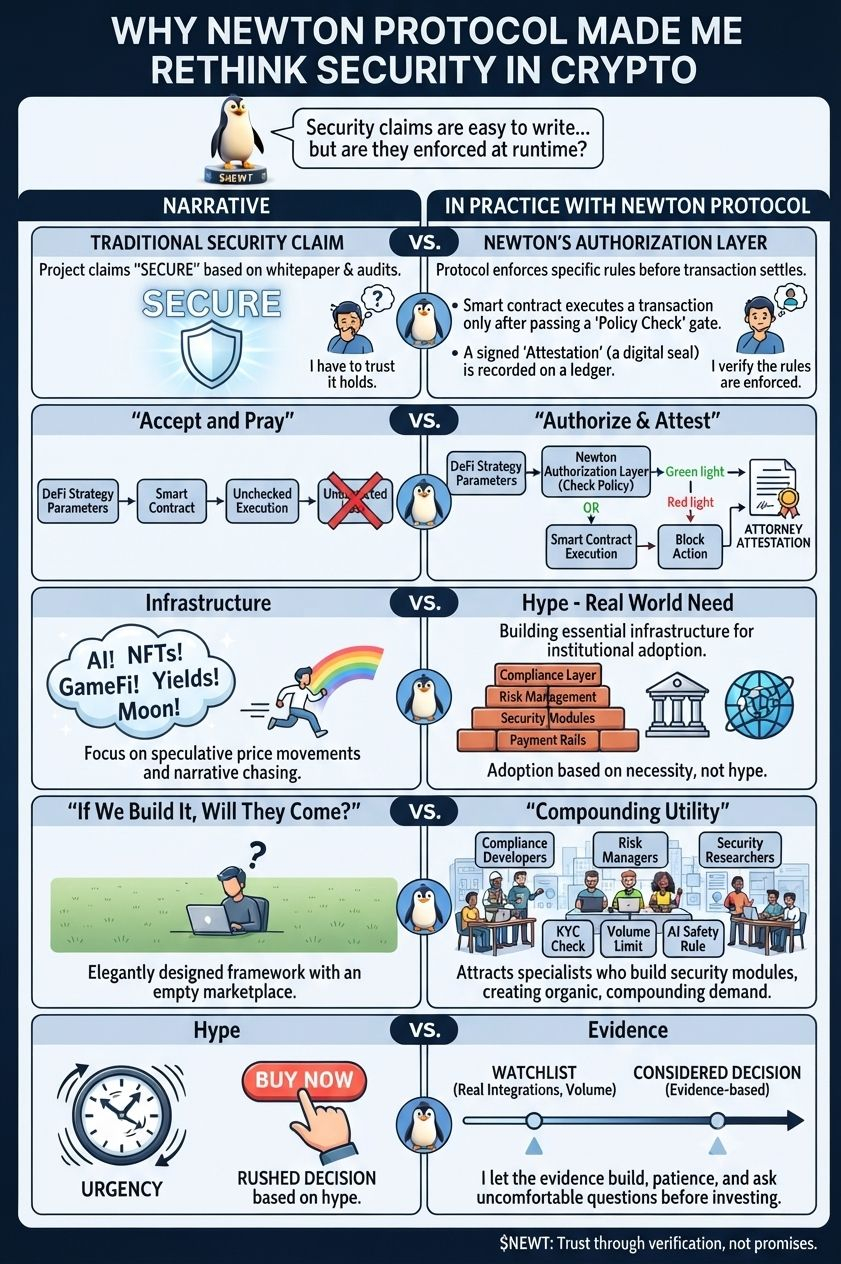
I'm not making any rushed decisions based on how the story sounds right now.
I've chased good narratives before and learned that compelling ideas and successfull products are not the same thing. The projects I've done best with over the years weren't the ones I got most excited about at launch. They were the ones I watched carefuly for several months, noticed consistent developer activity, saw real integrations with protocols handling genuine volume, and then made a considered decision after the initial hype had settled. That's the process I'm applying to Newton Protocol right now. The idea makes sense to me. The execution is what I need to see.
For now, NEWT stays on my watchlist while I continue following the progress closely. I want to see which protocols integrate the enforcement layer and whether those protocols are the kind that handle capital from users who actually care about security and compliance. I want to see whether the policy marketplace attracts builders who create things people pay to use. And I want to see whether the team keeps delivering after the attention from the current campaign fades, because thats when you find out what a project is actually made of. Until then, I'll keep doing what works — staying patient, asking uncomfortable questions, and letting the evidence build before letting excitement make decisions for me.

