
@NewtonProtocol I keep coming back to the same thought, usually when the market gets loud and everybody starts acting like the next big thing is finally here. Most of the time, it is just the same story in a different coat. New token, new chain, new promise, same old hope that this time machines will make the hard parts disappear.
Newton Protocol feels a little different to me, though I’m not ready to call that a good thing or a bad thing. It just feels more honest about what crypto is actually dealing with now. The idea of letting AI agents manage digital assets without a human watching every move sounds exciting in the abstract, but in practice it raises all the uncomfortable questions people usually skip. Who set the rules? Who checks the rules? What happens when the model gets something wrong? What happens when the agent is technically doing what it was told, but the instruction itself was sloppy, incomplete, or just plain dangerous?
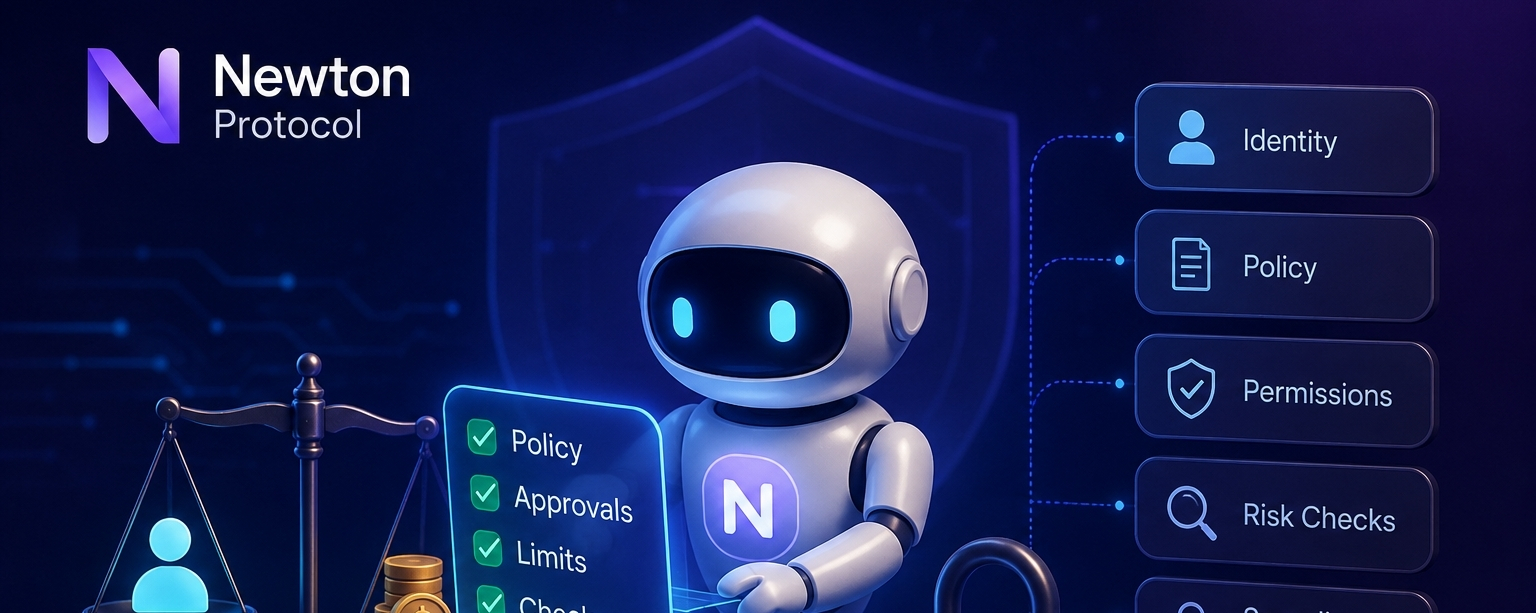
That is where Newton starts to look less like marketing and more like a response to a problem that already exists. The whole point seems to be $NEWT putting a policy layer in front of the transaction, so the machine cannot just wander off and do whatever it wants. That makes sense to me. It is not glamorous, but neither is risk management, and yet risk management is usually the thing standing between a clever idea and a very expensive lesson.
I’ve seen enough cycles to know that crypto loves autonomy until autonomy costs money. Then everybody suddenly discovers the value of controls. Then there is compliance. Then there are limits. Then there are exceptions. Then there is somebody quietly rebuilding the same guardrails that were mocked six months earlier. Newton seems to be starting from the guardrails instead of pretending they are optional, and that is probably why it catches my attention at all.
Still, I don’t fully trust any project that talks too comfortably about machine-led finance. I keep noticing that the hardest part is never the execution itself. The hard part is the thing before execution: deciding what is allowed, what is not, what should be blocked, what should be reviewed, and what should be left alone. Once you let an AI agent handle assets on its own, every tiny weakness becomes more serious. A bad prompt. A confused model. A poisoned input. A weak identity check. A policy written too loosely. A rule written too tightly. It does not take much for something like that to turn into an ugly story.
That is why the details matter more than the pitch. Newton’s focus on policy enforcement, approvals, spending limits, and offchain checks feels grounded in the reality that crypto systems are only as safe as their weakest assumption. If a protocol is meant to let agents act without human intervention, then the system around those agents has to know who they are, what they are allowed to do, and when they should be stopped. That sounds obvious, but crypto has a habit of acting like obvious things are optional until the damage shows up on-chain.
I keep thinking about the strange balance here. On one hand, automation is the whole point. People want less friction, faster decisions, fewer manual steps, and fewer places where a human has to sit there clicking approve all day. On the other hand, once the machine is actually allowed to move value, the cost of a mistake stops being theoretical. It becomes a transaction. It becomes a loss. It becomes something visible. That is the part people do not like talking about. Everyone loves the upside of autonomy. Nobody loves the part where autonomy does exactly what it was allowed to do, and that turns out to be the wrong thing.
Newton seems to understand that the future of AI-driven finance is not going to be built on blind trust. It is going to be built on narrower trust, cleaner trust, trust with conditions attached. That is a more annoying answer, but it is probably the real one. I respect that more than the usual “let the agent run free” narrative, because free agents in crypto tend to become free losses pretty quickly.
I’m also interested in the fact that the project seems less focused on fantasy and more focused on the boring stuff people actually need. Compliance, policy, proof, permissions, identity, fraud checks, spend limits. It is easy to dismiss all that as unsexy, but the longer I watch this industry, the more I think the boring parts are where the lasting systems come from. The flashy parts get attention. The boring parts keep the lights on.
So when I think about AI agents managing digital assets on Newton Protocol, I do not picture some dramatic sci-fi future where code replaces judgment. I picture something more ordinary and more believable: machines acting inside rules, people setting those rules, and everyone slowly realizing that the real product is not autonomy alone. It is controlled autonomy. The kind that is useful because it can act, but safe enough that it does not act like it owns the place.
That is probably the only version of this story that has a chance of surviving contact with reality. And maybe that is why Newton feels worth watching. Not because it promises to remove risk, but because it seems to admit, quietly, that risk is the whole problem.
