
One thing I like about Newton Protocol (NEWT) is that it looks at AI in crypto from a different angle.
Most projects talk about faster bots, smarter trading, better signals, or fully automated systems. Newton is asking a more serious question:
What happens when an AI agent is allowed to move real money?
That sounds simple, but it is a big question.
If an AI agent can trade, send funds, manage a vault, or interact with DeFi, then it cannot just be trusted blindly. It needs limits. It needs permissions. It needs rules that are checked before anything happens.
This is where Newton becomes interesting.
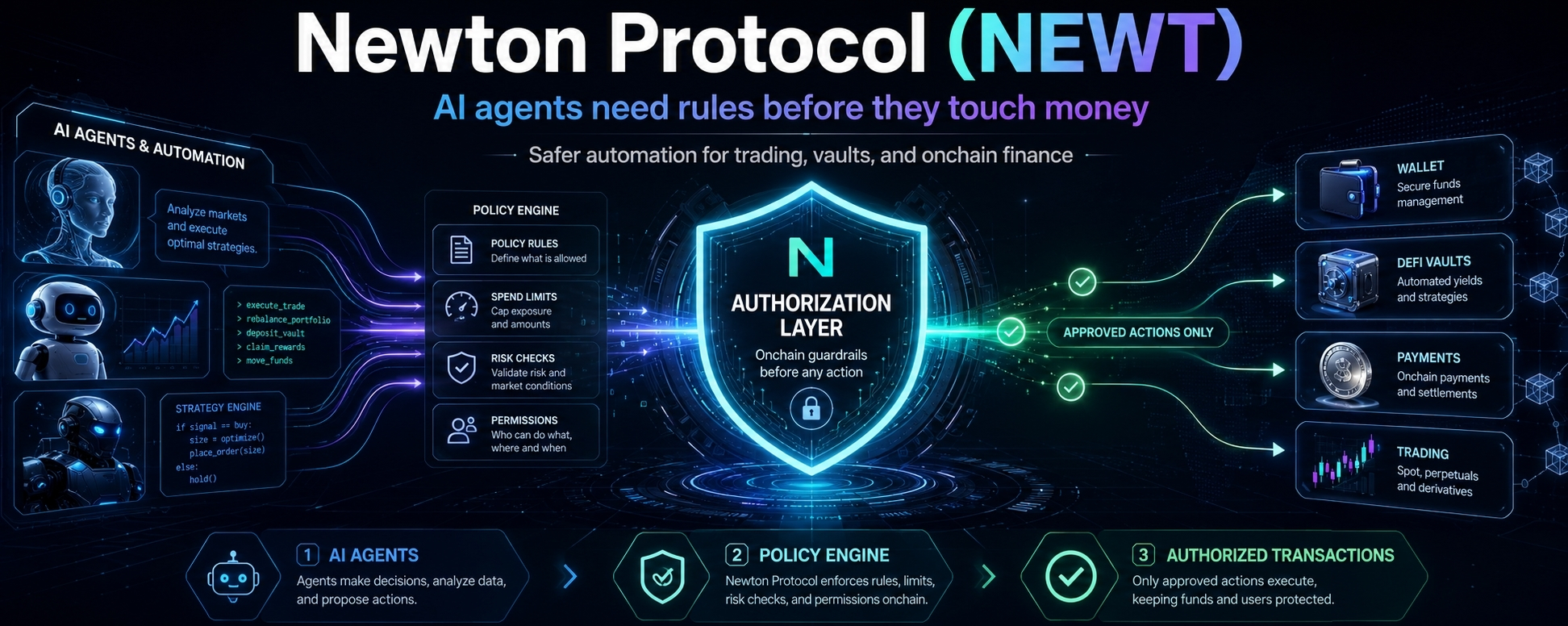
Newton Protocol is building an onchain authorization layer. In simple words, it works like a rule-checking system for blockchain transactions. Before a transaction goes through, Newton can check whether that action follows the rules that were already set.
For example, a user may allow an AI agent to trade, but only within a fixed limit. A vault may allow certain changes, but only if they match the risk policy. A payment system may allow transfers, but only if they pass basic safety checks.
So Newton is not only about making automation possible. It is about making automation safer.
That matters because crypto is slowly moving toward a world where more actions will happen without humans clicking every button. AI agents may trade, rebalance funds, manage payments, check opportunities, or handle routine financial actions. This can be useful, but it also creates a new kind of risk.
If an agent has too much freedom, one wrong action can become very expensive.
Newton tries to reduce that risk by placing rules between the agent and the transaction.
The idea is easy to understand.
First, an AI agent, user, vault, or smart contract wants to perform an action. This could be a trade, transfer, vault update, or any other onchain move.
Then Newton checks that action against a policy. A policy is basically a set of instructions. It can say things like: do not spend more than this amount, only use approved assets, do not interact with risky contracts, or stop the transaction if it breaks the set limits.
If the action follows the policy, it can move forward. If it does not, it can be blocked.
That is the main value Newton brings: it gives automation a boundary.
This can be very useful for AI-driven trading. A trading agent might be allowed to enter positions, but only within certain limits. It may have a maximum trade size, a daily loss limit, a slippage limit, or a list of assets it is allowed to touch.
Without those limits, the user is mostly hoping the agent behaves correctly. With those limits, the agent still has freedom, but not unlimited freedom.
That is a better model.
Newton can also matter for DeFi vaults. Many vaults depend on managers or automated systems to move funds. That creates trust risk. If rules are not enforced clearly, users have to believe that the manager or system will always act properly.
Newton can help by checking vault actions before they happen. A vault may be able to move funds, change exposure, or update strategy, but only if the action matches the rules.
This can make vault management more transparent and controlled.
The same idea can apply to stablecoins, real-world assets, payment flows, and institutional finance. As more serious money moves onchain, simple transfers are not enough. People need to know that actions follow limits, rules, and safety checks.
That is why Newton feels bigger than just another AI token. It is trying to become part of the trust layer for automated finance.
The NEWT token is connected to this system. It is expected to support network security, fees, staking, developer activity, and governance. If Newton gets real usage, the token could become more than a market narrative. It could become part of how the network runs.
But tokenomics still matter.
NEWT has a fixed total supply of 1 billion tokens. Only part of that supply was circulating at launch, so future unlocks are important. This is something traders should watch carefully.
A project can have strong technology and still face price pressure if new supply enters the market faster than demand grows.
So for NEWT, price alone is not enough. It is better to watch market cap, fully diluted value, unlocks, volume, liquidity, staking demand, and actual usage.
Newton’s roadmap seems focused on a few main areas: growing real usage, expanding policy enforcement, improving AI-agent safety, supporting automated finance, building tools for developers, and moving toward stronger community governance over time.
That is a big vision, but it will not be easy.
The first challenge is adoption. Developers and protocols need to actually use Newton. If integration feels too difficult, teams may avoid it.
The second challenge is trust in the system itself. Newton is trying to help others enforce rules, so its own network must be reliable, secure, and transparent.
The third challenge is market timing. AI agents in crypto are still early. The idea is exciting, but real demand may take time.
The fourth challenge is token supply. Unlocks can create pressure if usage and demand are not growing at the same speed.
The fifth challenge is competition. Many projects are working around automation, wallets, AI agents, and onchain security. Newton has to prove that its approach is actually needed.
Still, the idea behind Newton is strong because it focuses on a real problem.
AI agents may become common, but users will not only care about what agents can do. They will care about what agents are allowed to do.
That is where Newton’s role becomes clear.
For me, the most important part of Newton is not just AI. It is permission.
AI gives speed. Automation gives scale. But without rules, both can create risk.
Newton Protocol is trying to make those rules programmable and enforceable before money moves.
That makes NEWT more of an infrastructure play than a simple hype coin.
The bullish case is that if AI agents, automated trading systems, DeFi vaults, and onchain finance all need better controls, Newton could become useful in the background. If that happens, NEWT may gain stronger utility through fees, staking, and network activity.
The cautious case is that if adoption stays slow, if token unlocks become heavy, or if the market only treats it as another AI narrative, the token may struggle.
So Newton is interesting, but it still needs proof.
The idea is smart. The problem is real. The market just needs to see whether people actually use it.
In simple words, Newton Protocol is trying to answer one important question:
If AI agents are going to touch money, who checks the rules before they act?
That is why NEWT is worth watching.