Everyone keeps talking about AI like it's the greatest breakthrough of our generation. Every week there's another announcement, another model, another startup claiming to redefine the future. The headlines keep getting louder while the questions that actually matter somehow become quieter.
Who owns the intelligence we're building?
That's the part that rarely makes it into the conversation.
After watching the same cycle repeat across the internet for years, it's hard not to feel a little tired. We've seen platforms promise openness before slowly becoming closed ecosystems. We've watched communities create value that eventually gets captured by a handful of companies. We celebrated innovation while quietly accepting that ownership would concentrate somewhere else.
Now AI feels like it's following the same script.
The uncomfortable reality is that most people contribute to AI every single day without realizing it. Every prompt, every interaction, every correction, every piece of feedback becomes another small contribution to systems they don't control. The infrastructure belongs to someone else. The compute belongs to someone else. The models belong to someone else. Even distribution belongs to someone else.
Users help improve the product, but rarely own any part of the value that gets created.
That isn't necessarily malicious. It's simply how centralized technology tends to evolve. Convenience attracts users, users generate data, data improves the product, and eventually the platform becomes powerful enough that leaving becomes difficult.
We've seen this story before.
Crypto was supposed to interrupt that pattern. Instead, too much of the industry became distracted by speculation. Every market cycle produced thousands of tokens promising revolutions that never extended beyond price charts. Then AI arrived, and suddenly almost every project wanted to describe itself as "AI-powered."
The phrase became marketing before it became utility.
It's exhausting.
People aren't just tired of scams anymore. They're tired of fake innovation. They're tired of interfaces that make simple things unnecessarily complicated. They're tired of token launches pretending to solve problems that don't actually exist.
Somewhere along the way, building products stopped being enough. Everything needed a narrative.
That's why conversations around infrastructure feel more interesting than conversations around hype.
Projects like @undefined and Newton Protocol (NEWT) attract attention not because they promise another speculative cycle, but because they focus on something more fundamental: the infrastructure needed for AI-driven strategies, automated execution, and a secure environment where intelligent systems can interact more reliably. Whether that vision succeeds is still an open question, but it reflects a shift away from chasing headlines and toward building the foundations that future applications may actually depend on.
The bigger question, though, isn't whether one protocol succeeds.
It's whether AI itself becomes something people can genuinely own.
Because AI is quietly changing categories. It no longer feels like software alone. It's beginning to resemble an economic layer.
Data creates value.
Models create value.
AI agents will likely create value.
The people who train them, improve them, deploy them, and coordinate them all contribute something economically meaningful.
If that's true, then ownership suddenly becomes much more important than features.
Who captures that value?
Who decides how intelligence evolves?
Who gets paid when AI systems perform useful work?
These questions feel larger than any single company or blockchain.
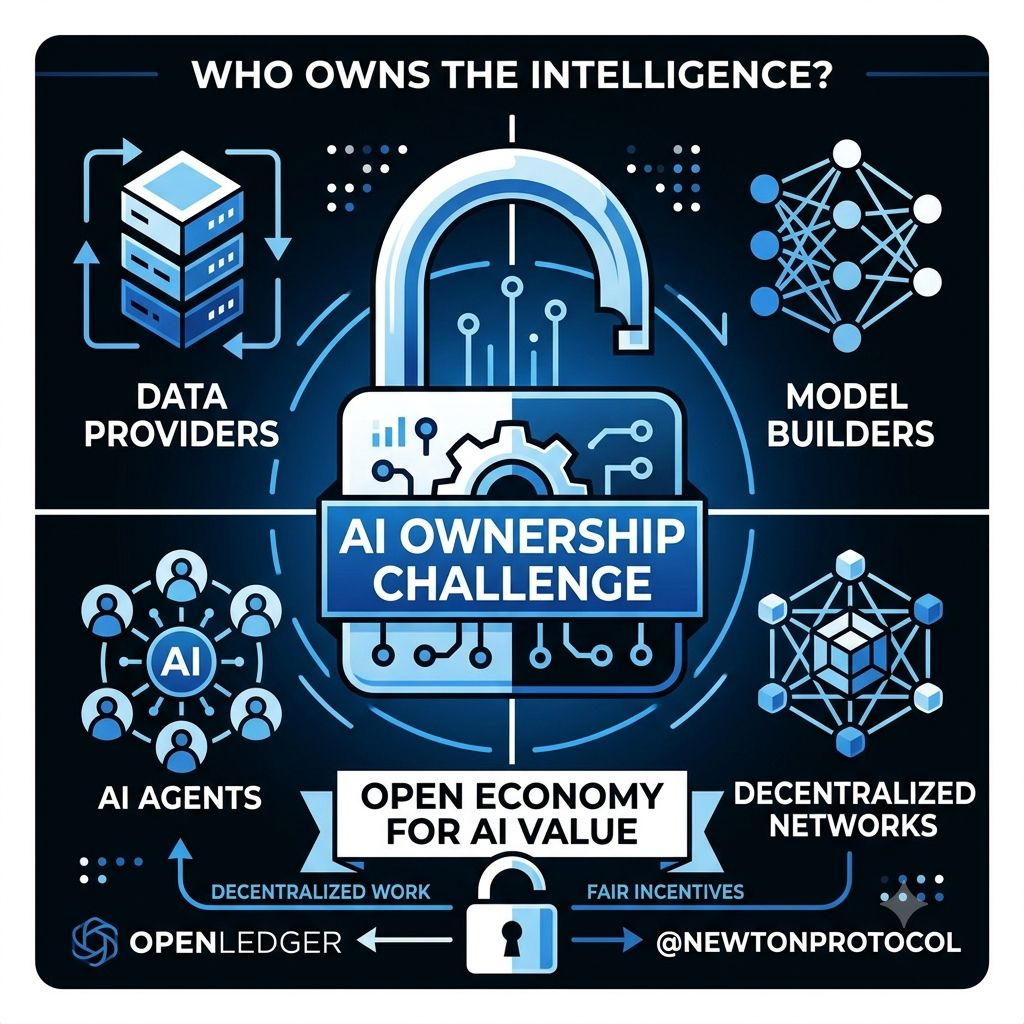
This is where projects like OpenLedger become interesting—not because anyone can guarantee they'll succeed, but because they're trying to address a problem that's becoming increasingly difficult to ignore. Instead of assuming AI should remain inside centralized platforms, OpenLedger explores the idea of an open economic layer where data providers, model builders, and AI agents can participate in the value they help create.
That's a very different conversation from launching another token with an AI logo.
It also comes with enormous challenges.
Decentralization sounds attractive until people actually have to use decentralized products. If applications are slow, confusing, or unreliable, users won't care how open the ownership model is. History has already demonstrated that ideology alone doesn't win markets.
Products have to work.
Utility still matters more than philosophy.
This is probably where many crypto projects failed. They believed decentralization itself was the product. In reality, decentralization is only valuable when it enables something people genuinely want to use.
The tension between openness and usability hasn't disappeared.
If anything, AI makes it even harder.
Builders need incentives without creating endless speculation. Users need simplicity without surrendering ownership. Networks need coordination without recreating the same centralized structures they're supposed to replace.
None of those problems have easy answers.
Maybe OpenLedger succeeds.
Maybe @undefined succeeds.
Maybe neither does.
But failure doesn't make the underlying questions disappear.
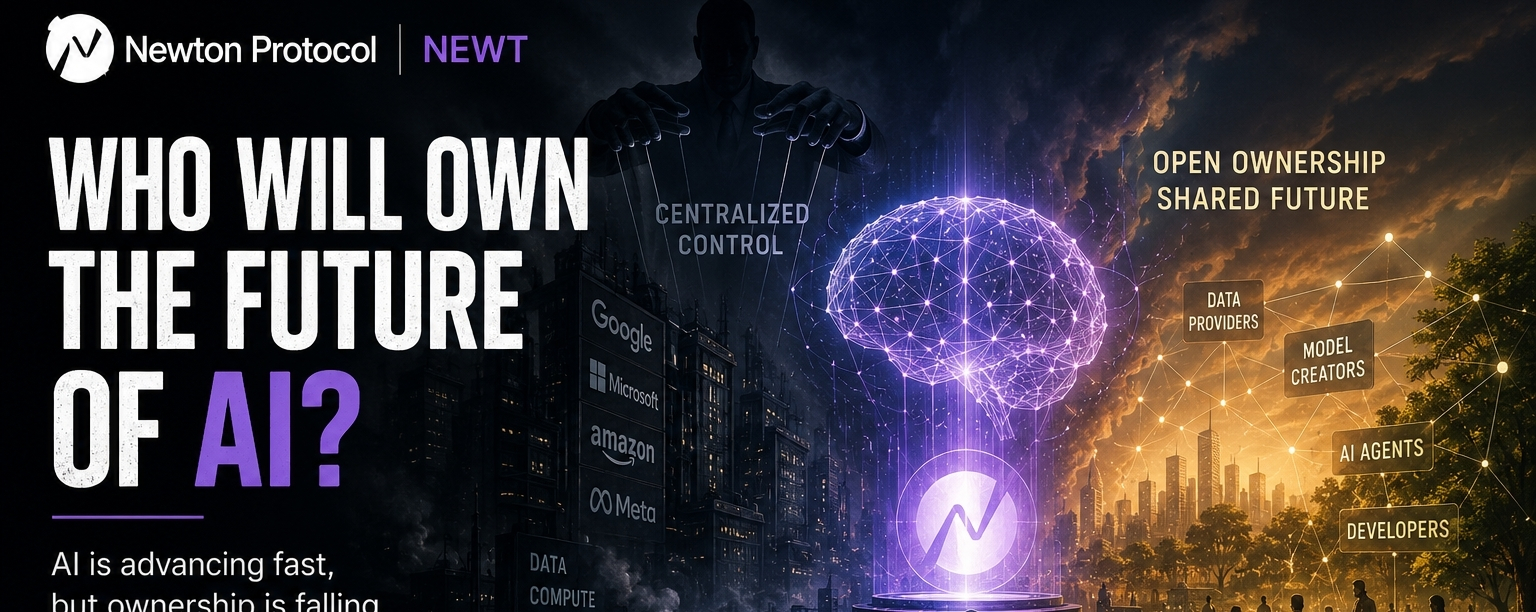
The internet has repeatedly shown that value naturally flows toward whoever controls infrastructure. AI may accelerate that pattern faster than anything we've seen before. If intelligence becomes one of the world's most valuable resources, whoever owns the underlying layers won't simply own software—they'll own the systems that increasingly shape economies, businesses, creativity, and decision-making itself.
That's a level of concentration worth thinking about.
Blockchain may ultimately matter less as a speculative asset class and more as a coordination and ownership layer. Not because every problem needs a token, but because ownership has to exist somewhere if intelligence itself becomes economically valuable.
Maybe that's where the real conversation should begin.
Not with bigger models.
Not with faster benchmarks.
Not with another week of market excitement.
But with ownership.
Because AI is moving far faster than society's ability to decide who should control it. If those ownership layers aren't built while the technology is still taking shape, we may eventually wake up in a world where intelligence itself has become a rented utility—controlled by a small group of corporations while everyone else simply pays for permission to use it.