
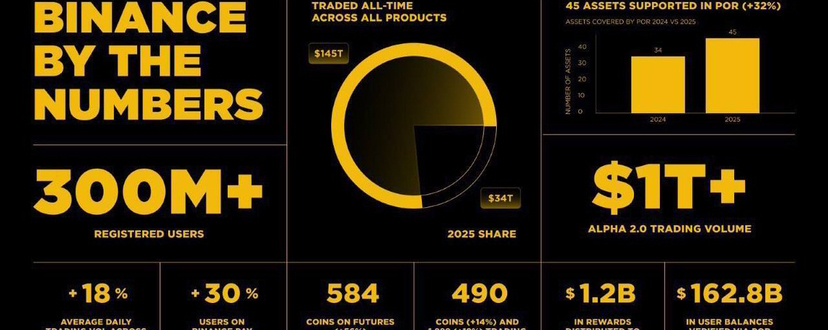
One number: $34 trillion. That's Binance's total product trading volume for 2025 more than the combined annual GDP of the US and China. No other exchange comes close.
Market share, verified
#Binance closed 2025 with a 39.2% share of centralized exchange spot volume, per #CoinGecko 's full-year study the largest single venue share in the industry, out of a top-10 field totaling $18.7 trillion. In December alone, Binance processed $361.8 billion in spot volume (38.3% share), more than 4x its nearest competitor, ($90B, 9.5%).
Scale of users and assets
According to Binance's own year-end letter from co-CEOs @Yi He and @Richard Teng , the platform now serves 300M+ registered users, holding $162.8 billion in user assets. That's roughly triple Coinbase's ~120M user base reported earlier in 2025.
Reserves you can verify
Binance's April 2025 Proof-of-Reserves showed collateralization above 100% across major assets: BTC at 105.78%, ETH at 104.21%, BNB at 107.90%, USDT at 101.34%. This isn't a claim it's cryptographically verifiable via Merkle tree proof.
Where the numbers get honest
Dominance isn't absolute everywhere. overtook Binance in derivatives volume in September 2025, hitting $1.3 trillion monthly (per Bloomberg data). And the broader market is shifting: #DEX share of spot volume rose from 6.9% in January 2024 to 13.6% in January 2026, per CoinGecko a real, measurable erosion of CEX dominance industrywide, Binance included.
What the data actually means
Binance's lead isn't built on one metric it's the compounding effect of liquidity depth, user count, and product breadth (500+ coins, 1,500+ pairs) reinforcing each other. Deep liquidity attracts serious traders; serious traders deepen liquidity further. That flywheel is hard for competitors to break with fee wars alone which is exactly what tried in 2025 (+90.9% YoY growth via zero fees) without touching Binance's top spot.
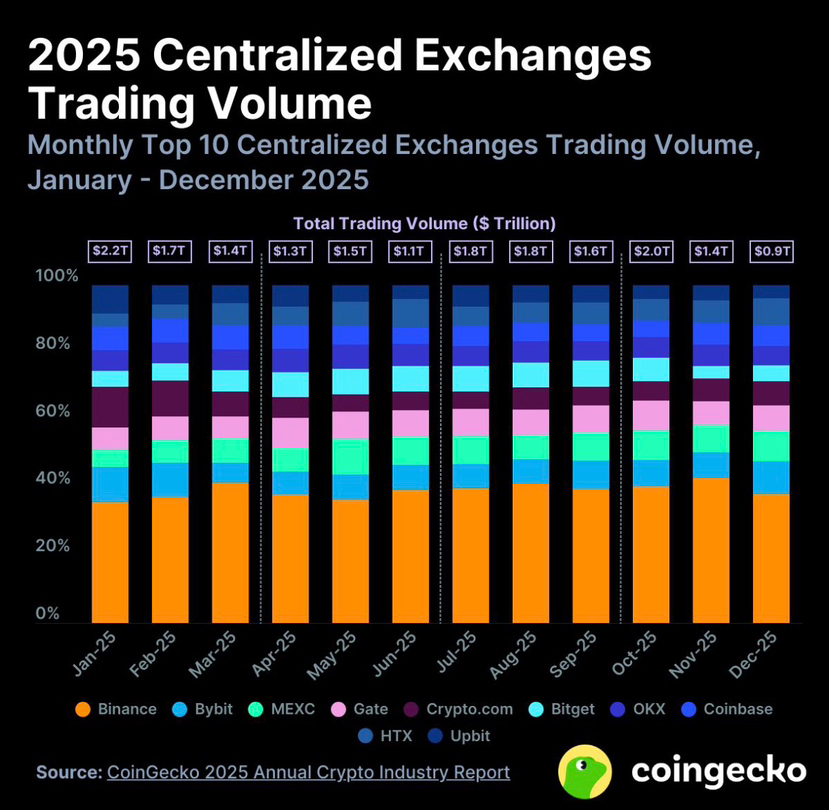
But the DEX growth trend is the number worth watching into 2026. Leadership in a shrinking share environment is a different challenge than leadership in a growing one.
The question worth discussing Is Binance's edge structural (liquidity network effects) or circumstantial (regulatory timing, first-mover scale) and what would it actually take for that to change?