
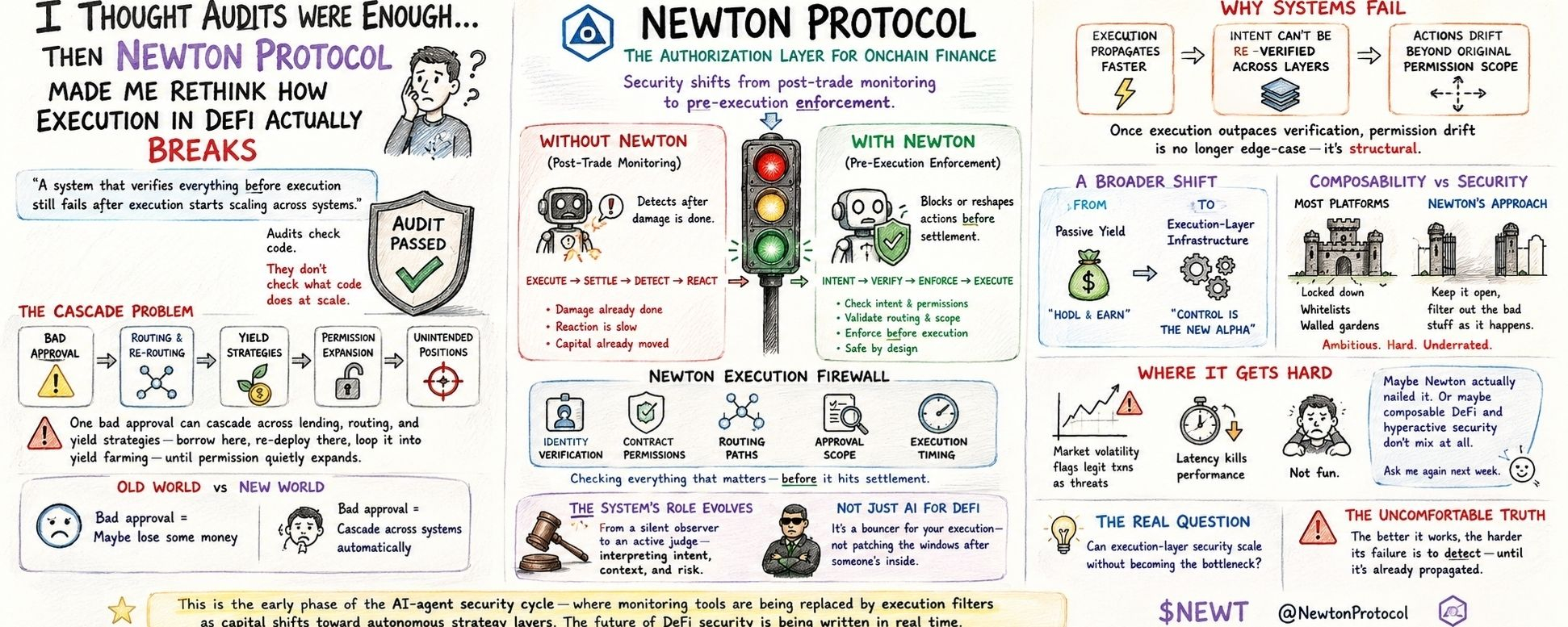

A system that verifies everything before execution still fails after execution starts scaling across systems.
Honestly, the whole reason is because crypto still loves to pretend that audits are enough, like you can just lock things down once and call it a day. But this AI agent they’re building? It’s not just moving tokens or claiming rewards—it’s stitching together all these protocols, juggling funds, chasing yields all on autopilot.
It’s a recursive execution loop: approval routing, re-routing, yield compounding, permission expansion. That’s powerful, yeah, but maybe a little scary, too.
Here’s the catch: in the old days, you made a bad approval, and maybe you lost some money. Now, one bad approval can cascade across lending, routing, and yield strategies automatically—borrow here, re-deploy there, loop it into yield farming—until the same permission quietly expands into positions you never explicitly intended.
Newton’s way shifts security from post-trade monitoring to pre-execution enforcement—blocking or reshaping actions before they ever hit settlement, instead of reacting after damage is already done. This only feels obvious after you see the cascade in practice. But DeFi is messy as hell.
I keep thinking I’m overcomplicating it, but the more I trace it, the more it stops feeling like overthinking and starts feeling like the actual shape of the system.
Suddenly, you’ve got a security layer checking transaction intent, contract permissions, routing paths, approval scope, and execution timing before settlement.
The system fails when execution propagates faster than intent can be re-verified across layers—so actions drift beyond original permission scope.
This reflects a broader shift in crypto: capital is rotating from passive yield strategies into execution-layer infrastructure, where control systems themselves become the new alpha.
At that point, failure stops being an exception and becomes the default system behavior.
Once execution outpaces verification, permission drift is no longer edge-case—it’s structural.
The system’s more of a judge now, interpreting everything, not just watching silently.
This sits in the early phase of the AI-agent security cycle—where monitoring tools are being replaced by execution filters as capital shifts toward autonomous strategy layers.
That’s what grabs me. Not the “AI for DeFi” pitch, but the idea that it’s morphing security infrastructure into something with real teeth—a bouncer deciding who gets into the club, not just patching the windows after someone’s inside.
Most platforms play it safe by locking things up—tight integrations, whitelists, the whole walled garden routine. Newton’s saying, “Let’s keep things open, just filter out the bad stuff as it happens.” That’s ambitious. People aren’t really chewing on how hard that is.
Once execution outpaces verification, permission drift is no longer edge-case—it’s structural. At first, it worked, but once markets got wild, it started catching legit transactions as “threats,” and latency tanked performance. Not fun.
Maybe Newton actually nailed it this time. Or composable DeFi and hyperactive security simply don’t mix at all and we’re all about to break things in a brand new way. Ask me again next week—I’m sure I’ll have a fresh disaster story.
The real question isn’t whether AI agents work in DeFi—but whether execution-layer security can scale without becoming the bottleneck itself.
And the uncomfortable truth: the better it works, the harder its failure is to detect—until it’s already propagated.