
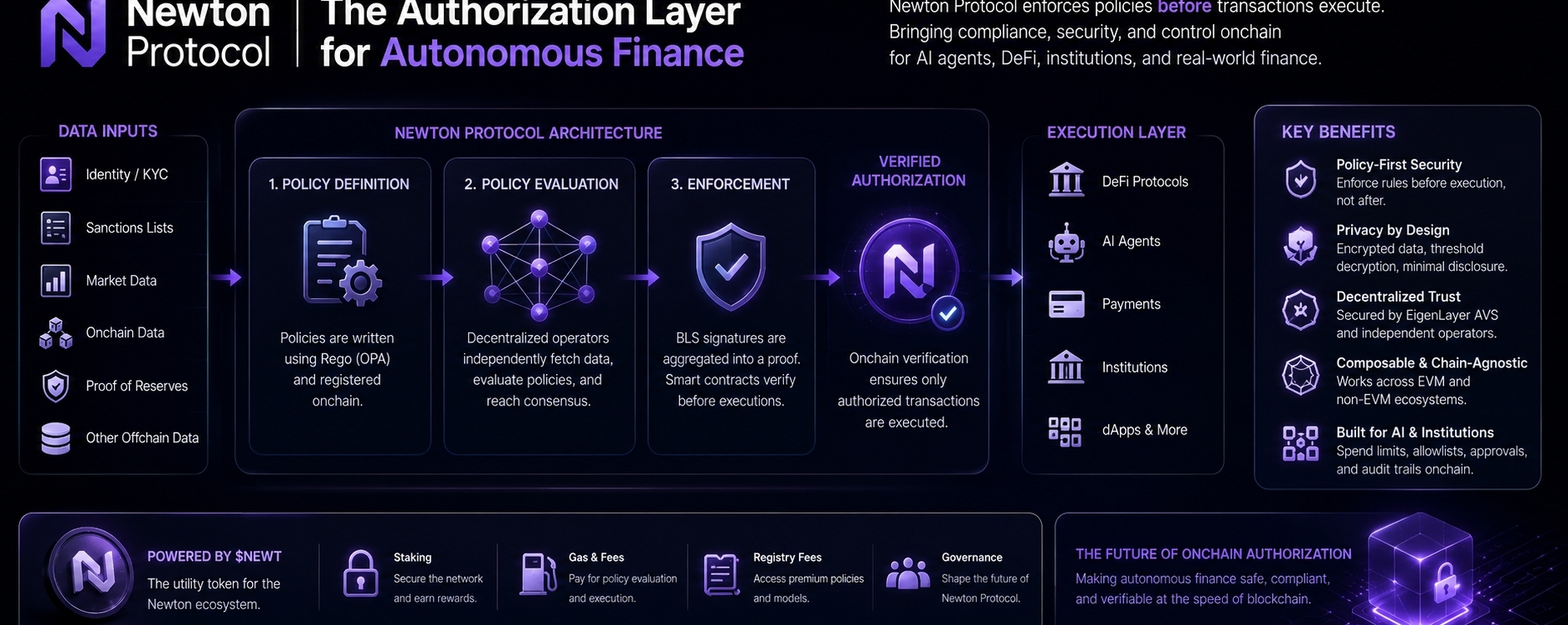
Newton Protocol is trying to solve one of the quietest but most important problems in the next phase of crypto: what happens when wallets, smart contracts, and AI agents can move money instantly, but no one has a clean way to decide whether a move should be allowed in the first place. The project describes itself as an onchain authorization layer, designed to enforce policies before execution rather than after the fact, and its materials frame it as infrastructure for spending limits, sanctions screening, identity checks, fraud prevention, and other rule-based controls. That makes Newton less of a flashy consumer app and more of a governance layer for programmable finance.
The deeper idea behind Newton is that blockchain systems are very good at settling value, but still awkward at handling permission. Smart contracts can execute logic precisely, yet they are not naturally suited to deciding whether a transaction should be permitted based on outside conditions such as compliance status, market data, or policy constraints. Newton’s whitepaper and developer docs argue that this missing layer should be moved into a verifiable policy system tied directly to execution, so the chain does not merely know how to run a transaction, but also whether the transaction is authorized in the first place.
What makes the protocol interesting is the way it tries to turn policy into infrastructure instead of treating it like custom backend logic. Newton’s architecture splits the system into policy definition, policy evaluation, and enforcement. Policies can be registered onchain, evaluated against live offchain inputs, and then enforced only if the network produces the right proof. The protocol also uses an EigenLayer AVS model, which means it is borrowing Ethereum-adjacent economic security rather than building trust from zero. In practical terms, that is Newton’s real bet: that rules can be made portable, auditable, and reusable across applications instead of living inside each app’s private compliance stack.
The technical details matter because they show the project is not just speaking in broad compliance language. Newton’s documentation describes policy data oracles, operator-based evaluation, and BLS signature aggregation so multiple participants can independently assess a policy and collapse their agreement into a single verifiable proof. It also talks about handling numeric oracle values with median-based normalization and tolerance thresholds for disagreement. That is a surprisingly pragmatic design choice. A policy network only becomes useful if it can survive imperfect information without either freezing up or pretending that every data feed is spotless.
The privacy layer pushes the idea further. Newton says sensitive inputs can be encrypted with HPKE, threshold-decrypted by operators during evaluation, and kept offchain so plaintext does not need to appear onchain. That is a meaningful distinction, because most compliance systems quietly sacrifice privacy to gain control. Newton is trying to do the harder thing: let the network verify enough to enforce a rule without turning every transaction into a public compliance record. The same logic shows up in its dual-signature flows, where both the user and the dApp may need to approve decryption before evaluation can proceed.
The most immediate use cases are the ones where crypto has always been stuck between speed and control: stablecoins, institutional DeFi, and AI-driven agents. Newton’s own use-case pages describe payments that need sanctions checks, jurisdiction checks, and velocity limits before settlement, as well as institutional flows that require approved protocol lists, exposure limits, and auditable controls. For AI agents, it proposes caps, allowlists, rate limits, and human approval thresholds for sensitive actions. That is the real emotional center of the project. It assumes autonomy is useful, but not trustworthy by default. In other words, it treats AI like a powerful actor that must be constrained, not a magical system that should be believed.
NEWT, the token, is meant to hold that system together economically. The official announcement says NEWT is used for staking, gas and fees, registry fees and royalties, and later governance as the network decentralizes. It also states a fixed supply of one billion tokens, with 215 million circulating at launch and a 60/40 community-to-internal allocation. That makes the token feel less like a speculative add-on and more like the fuel for a protocol that wants to be embedded into real transaction flow.
The launch context makes the strategy easier to see. Binance introduced Newton Protocol in 2025 as a project aimed at a secure rollup for AI-driven strategies, automated trading, and a marketplace for AI developers, while Magic Labs later highlighted integration of the Newton SDK into its developer ecosystem. Those two facts point to the same ambition from different directions: Newton wants to sit beneath the visible product layer, where wallets, agents, and apps already live, and become the part that decides whether the machine is actually allowed to act. If it works, the biggest shift will not be that transactions get faster. It will be that permission becomes legible, portable, and enforceable at the same speed as execution.
