
I've been thinking about what we actually mean when we say we "trust" automation. The word gets used so casually that I've started wondering whether it's describing technology at all, or just describing our willingness to stop paying attention.
That sounds harsher than I mean it to. Most automation is built because people don't want to make the same decision a hundred times. We automate repetitive work, then gradually forget there was ever a choice involved. Somewhere along the way, convenience starts to look like certainty.
The part I keep circling back to is AI.
Everyone seems excited about AI agents executing trades, moving assets, and reacting faster than any human could. Fair enough. Speed has value. But speed also compresses the amount of time available to notice when something is wrong. If an agent can make a hundred decisions in the time it takes me to question one, then the real challenge probably isn't intelligence. It's restraint.
Maybe that's why I find myself paying more attention to permissions than to models.
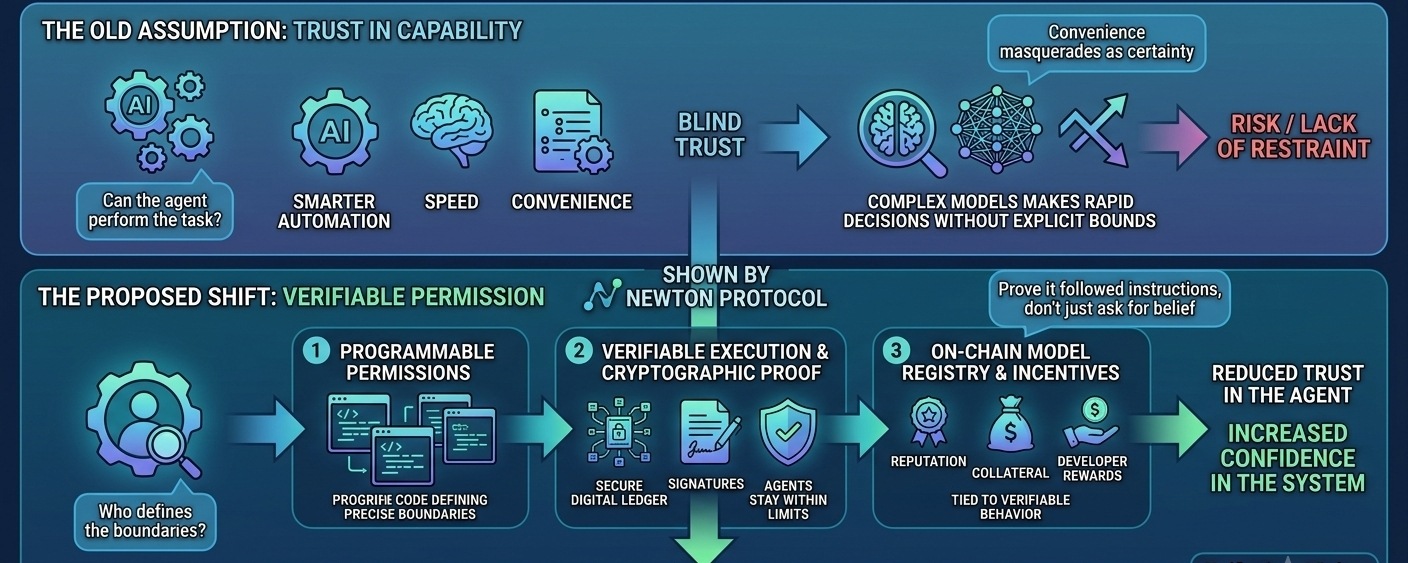
We spend a lot of time asking whether an AI can perform a task, but much less time asking who defines the boundaries around that task. Those are different questions. Capability tells us what is possible. Permission determines what is acceptable. Confusing the two feels like a mistake.
That's partly why Newton Protocol caught my attention. Not because it promises smarter automation, but because it treats authorization as infrastructure instead of an afterthought. The protocol is built around programmable permissions, verifiable execution, and cryptographic proof that an agent stayed within the limits it was given, rather than expecting users to trust its behavior blindly. It also introduces incentives for developers and operators through an on-chain model registry, where reputation and collateral matter alongside performance.
Of course, none of that guarantees good outcomes. Policies are still written by people, and people are perfectly capable of writing incomplete rules. A system can faithfully enforce a bad policy just as easily as a good one. That's an uncomfortable reminder that verification isn't the same thing as wisdom.
Still, I think there is an interesting shift happening here.
For years, crypto has focused on removing trust from counterparties. Maybe the next step is reducing the amount of trust we place in our own automation. Not because AI will inevitably fail, but because any system acting on our behalf should probably spend more effort proving it followed instructions than asking us to believe it did.
I don't know if that's where the industry ultimately ends up. But the more autonomous our software becomes, the less I think the important question is, "Can the agent act?"
I'm starting to think the better question is, "Who decided the agent was allowed to act that way in the first place?"