Most storage systems are built around immediacy. Data is written, acknowledged, and optimized for retrieval in the short term. Over time, responsibility fades. Nodes change, incentives weaken, and data quietly becomes fragile. Walrus is designed around a different assumption. It assumes that the real value of data appears later, not at the moment it is created.
In Walrus, data is expected to be questioned in the future. A file may need to be reconstructed months later. A record may need to be verified long after the original participants are gone. This expectation shapes the entire system. Blob storage is not used to reduce cost or increase speed. It is used to remove dependency on any single actor. Files are split into fragments, fragments are distributed across Walrus nodes, and recovery is possible even when some fragments disappear. The system does not rely on perfect behavior. It relies on structure.
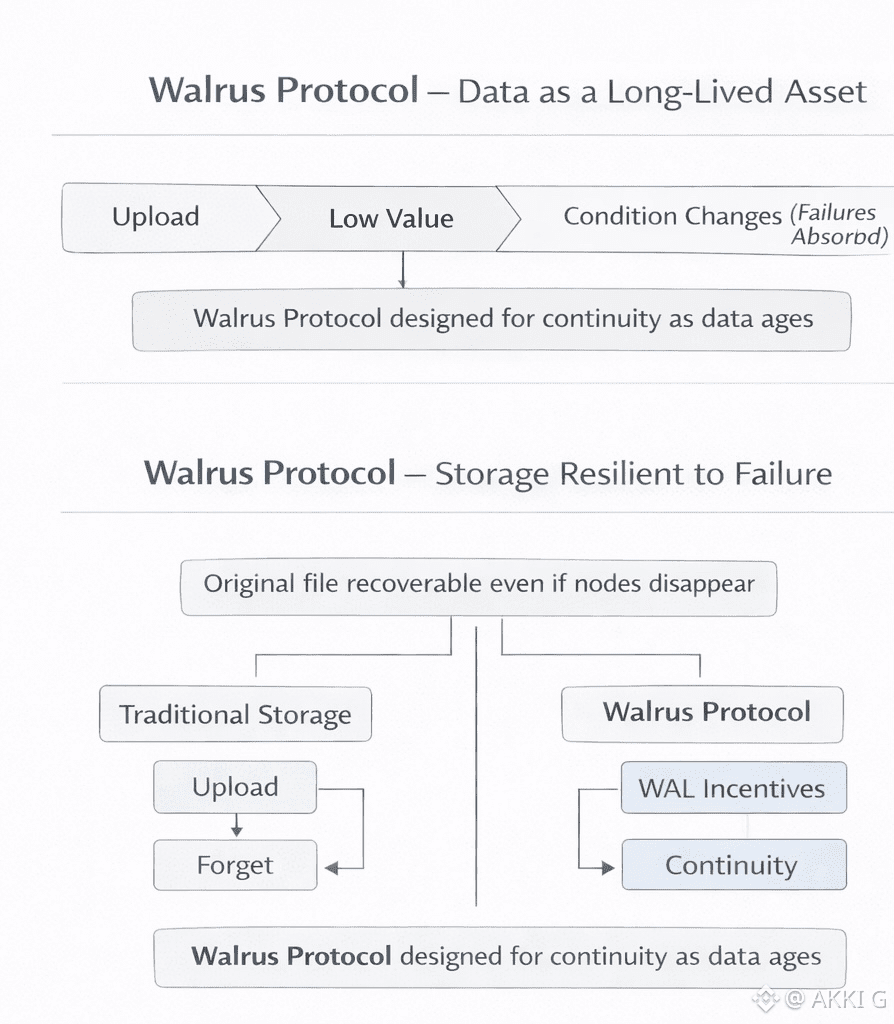
This is where WAL becomes essential again. WAL exists to keep this structure intact over time. Nodes are not only participating in storage. They are participating in continuity. WAL aligns incentives so that remaining available, responsive, and compliant is economically rational even as conditions change. Without this coordination layer, long term availability would depend on goodwill. Walrus removes that dependency.
An important outcome of this design is that data on Walrus gains credibility as time passes. The longer data survives, the more confidence users can place in it. Survival itself becomes proof. This is different from traditional storage, where longevity is assumed but rarely guaranteed. On Walrus, longevity is demonstrated repeatedly as the network absorbs failures without losing access.
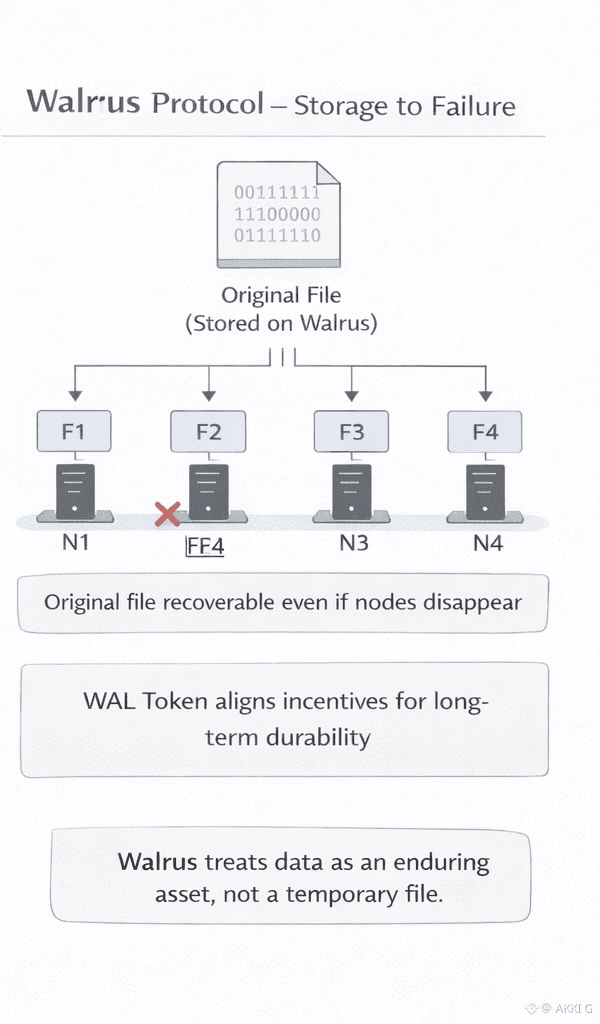
What stands out is that Walrus does not try to eliminate uncertainty. It assumes uncertainty is permanent. Hardware will fail. Operators will leave. Markets will change. Instead of fighting these realities, Walrus builds around them. Data remains accessible not because nothing went wrong, but because the system expected things to go wrong.
My take is that this is what makes Walrus practical rather than theoretical. It treats data as an asset that must endure, not a file that merely exists. In systems where history matters, endurance becomes value. Walrus is designed to capture that value by turning survival into a feature of the protocol itself.