Imagine a world where your data isn’t locked inside giant tech companies’ servers, where your files, your art, your AI models, your NFTs, even your websites, can exist freely, safely, and securely across a global network of computers. That’s the world Walrus is building. Walrus isn’t just another storage project. It’s a decentralized storage revolution running on the Sui blockchain, designed to give power back to the people, creators, and developers. It’s about putting control, ownership, and monetization into the hands of those who actually create and use the data, instead of letting centralized giants hold the keys.
At its core, Walrus solves one of the trickiest problems in Web3: how to store massive amounts of data in a way that’s cheap, fast, and secure, without relying on a single server farm. Think about it: AI datasets can be massive, NFTs need permanent and verifiable hosting, dApps need their assets delivered reliably, and enterprises need secure, immutable records. Centralized servers cost money, can fail, and can be censored. Traditional decentralized storage like Filecoin and Arweave exists, but Walrus takes things further with a unique approach to data distribution, efficiency, and blockchain integration.
So how does it work? Walrus breaks data into tiny pieces called “slivers” using a smart technique called erasure coding. This is different from simply copying files over and over. Instead of making dozens of copies, it slices the data and spreads it across many independent nodes. Even if most of the nodes go offline, the data can still be rebuilt. This means low cost, high reliability, and speed — even when the network is under stress. It’s like turning a single fragile sculpture into hundreds of tiny, magical shards that can reconstruct themselves anywhere, anytime.
Walrus doesn’t just scatter your data and hope for the best. It ties everything to the Sui blockchain, which acts as the brain of the operation. Ownership, metadata, storage epochs, payments, and even proofs that your data exists and is available are all verifiable on-chain. Smart contracts can check whether your files are accessible, automatically renew storage, or revoke access if needed. This makes everything trustless, programmable, and transparent. You can pay for storage, run dApps, or trade data without asking anyone for permission.
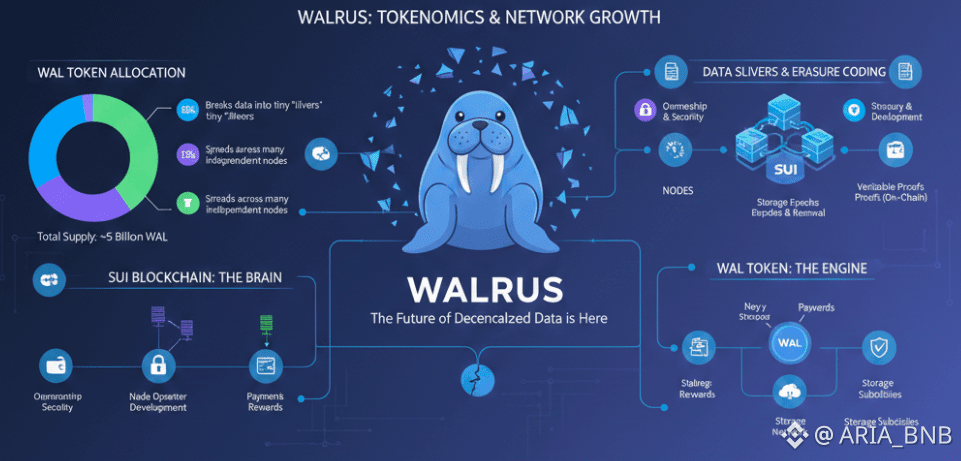
The WAL token is the engine that drives all of this. It’s used to pay for storage, reward node operators, stake to secure the network, and participate in governance. Users pay WAL to store their data, operators earn WAL for keeping it safe, and token holders can vote on key decisions like pricing, rewards, and protocol upgrades. The total supply is capped at around 5 billion tokens, with allocations for the community, contributors, investors, and storage subsidies — ensuring long-term incentives and sustainable growth.
The potential uses for Walrus are staggering. NFT creators can finally host their artwork permanently on a decentralized network, making sure it never disappears. AI researchers can store massive datasets and models securely, verifiably, and accessibly, enabling a truly decentralized AI ecosystem. Entire websites and dApps can be hosted without depending on centralized servers or CDNs, opening the door to a fully decentralized internet. Enterprises can back up sensitive information, create immutable audit trails, and manage access transparently, disrupting the traditional cloud storage market.
Of course, the road isn’t without hurdles. Walrus competes with established storage networks, so it must prove itself on cost, performance, and ease of use. It needs a growing network of reliable nodes, and its tokenomics must balance rewards and long-term stability. The technical complexity might be intimidating for newcomers, meaning the team must prioritize user experience and developer tools.
Yet despite these challenges, Walrus is already making waves. Its integration with Sui, advanced erasure coding, and smart token-driven incentives make it one of the most compelling infrastructure projects in the Web3 and AI era. As decentralized applications multiply and AI data grows exponentially, the need for secure, scalable, and programmable storage will only increase — and Walrus is ready to fill that role.
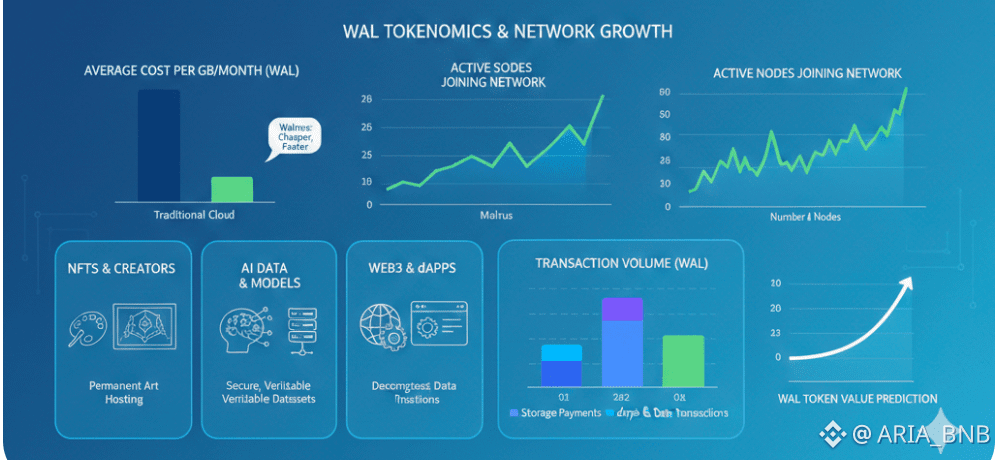
Walrus is more than storage. It’s a vision of a future where data belongs to those who create and use it, not the tech giants who control centralized servers. It’s a network that’s programmable, verifiable, and economically sustainable. It’s a tool for artists, AI developers, dApp builders, enterprises, and investors who believe that the next frontier of the internet should be free, open, and decentralized.
In short, Walrus is the dawn of a new era a world where data sovereignty is real, storage is smart, and the power of information returns to the people. The project isn’t just building a network; it’s creating a foundation for Web3’s next generation, where your data, your creations, and your digital life can thrive safely in the open. The era of decentralized, programmable, and sustainable storage has arrived, and its name is Walrus