

Some blockchains live on hype. Others chase raw speed or meme culture. Dusk Network took a different path. It stayed quiet. It ignored trends. It spent years building instead of marketing. That choice now looks intentional.
After six years of research and cryptographic engineering, Dusk has emerged with something rare in crypto. A blockchain designed from day one for real finance. Not experimental finance. Not loophole finance. Actual regulated markets running on decentralized rails.
Dusk does not promise a shiny new future and hope it figures itself out later. It builds the infrastructure first. The boring but essential parts. The parts institutions care about. Compliance. Privacy. Finality. Legal certainty. That focus is why many people no longer see Dusk as “another chain.” It feels like its own category.
The idea behind Dusk started with a problem most blockchains avoid. How can banks and regulated institutions use blockchain without breaking the law or exposing sensitive data? Public ledgers are transparent by default. Every balance is visible. Every transaction is traceable. That openness is great for trustless systems. It is a nonstarter for regulated finance.
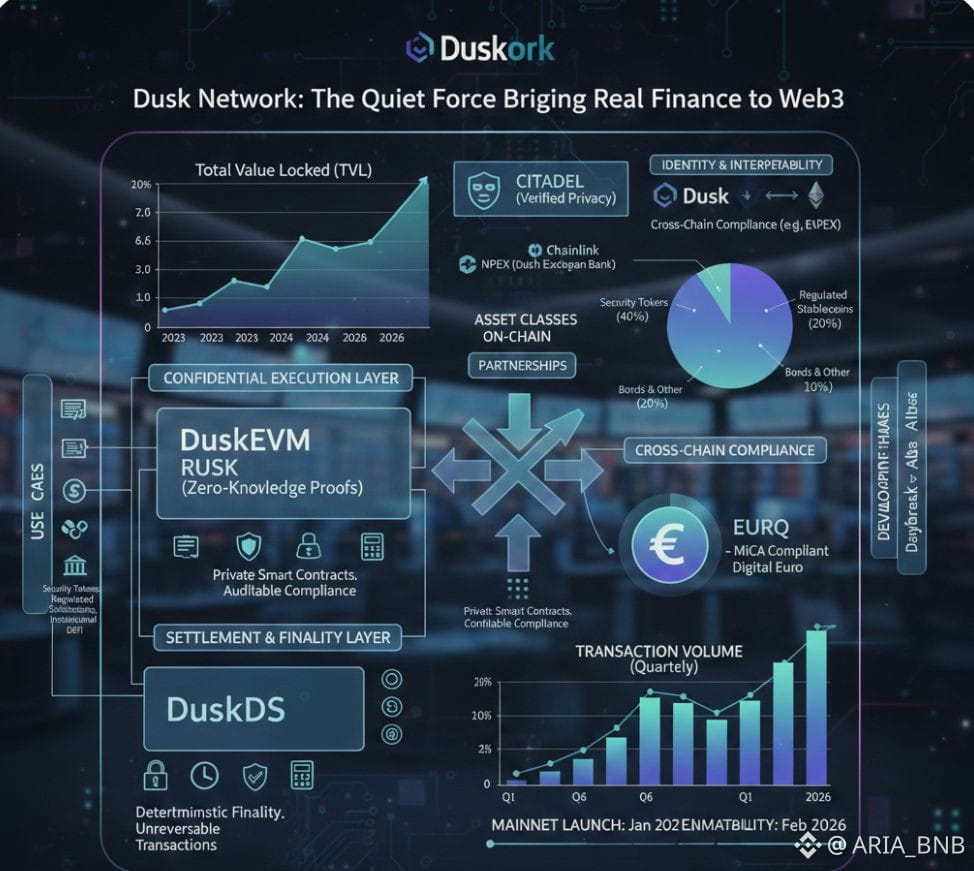
Dusk solves this by changing the rules. Transactions can stay private while still being provably compliant. Smart contracts can execute confidentially while remaining auditable when required. Users can prove eligibility without revealing identity. Privacy and regulation stop being enemies.
That balance comes from the network’s design. Dusk did not fork Ethereum and hope for the best. It built a modular architecture. One layer handles settlement and finality. Another handles private execution. The settlement layer, called DuskDS, provides deterministic finality. That matters in markets where reversals are unacceptable. On top sits DuskEVM. Developers can deploy Solidity contracts just like on Ethereum but with the option to run sensitive logic through zero-knowledge proofs.
This is where things get interesting.
Rusk is the execution environment that powers confidential smart contracts. It allows applications to hide what must stay hidden while still proving correctness. Traders do not expose positions. Institutions do not leak flows. Issuers do not reveal investor data. This is not theoretical. The mainnet went live in January 2026. These systems are running now.
Identity is handled through Citadel. This might be one of Dusk’s most underrated breakthroughs. Citadel lets users prove they meet regulatory requirements without handing over personal data. You can be verified without being visible. Platforms remain compliant without becoming data hoarders. In a world where data breaches are routine, that matters.
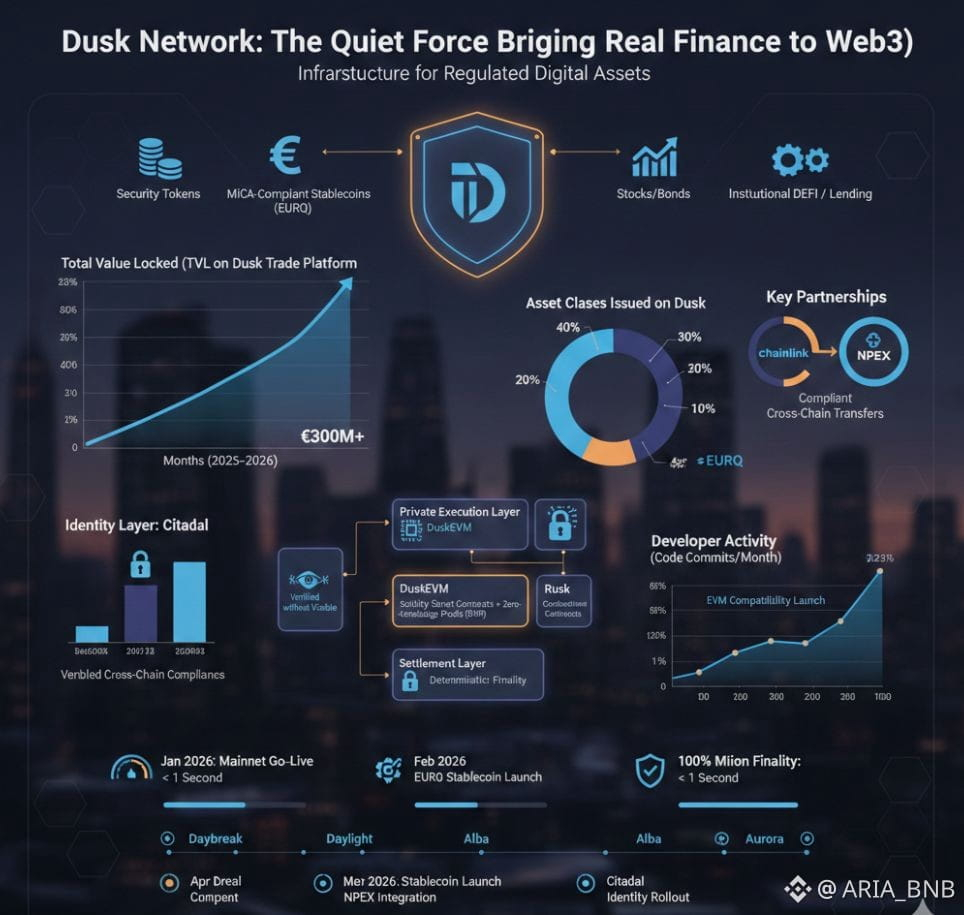
Where Dusk really separates itself is in its use cases. This is not a playground for short-term speculation. It is built for security tokens, regulated stablecoins, stocks, bonds, institutional DeFi, settlement systems, and lending markets. In short, the parts of finance that cannot afford mistakes.
Institutions have been waiting for this kind of blockchain. One that does not force them to choose between decentralization and legality.
Momentum followed. Dusk partnered with Chainlink and NPEX, a regulated Dutch exchange. That integration enabled compliant cross-chain transfers of regulated assets. Securities issued on Dusk can now move across ecosystems like Ethereum without breaking regulatory constraints. That is real interoperability. Not the buzzword version.
Then came EURQ. A fully MiCA-compliant digital euro. Add to that platforms like Dusk Trade managing hundreds of millions in assets and it becomes clear what is happening. Dusk is turning into infrastructure. Not a product. Not a trend.
Development moves in steady phases. Daybreak. Daylight. Alba. Aurora. Each phase tightens performance, improves privacy, and smooths tooling. Updates ship regularly. APIs improve. The execution layer matures. With EVM compatibility live, developers can migrate without relearning everything from scratch.
Dusk fills a gap no other chain has closed. It does not try to replace open public crypto. It complements it. It builds the confidential, compliant layer where real assets and global institutions can finally operate on-chain
