

The idea behind Midnight’s dual token structure stands out in a space where simplicity is often sacrificed for hype.
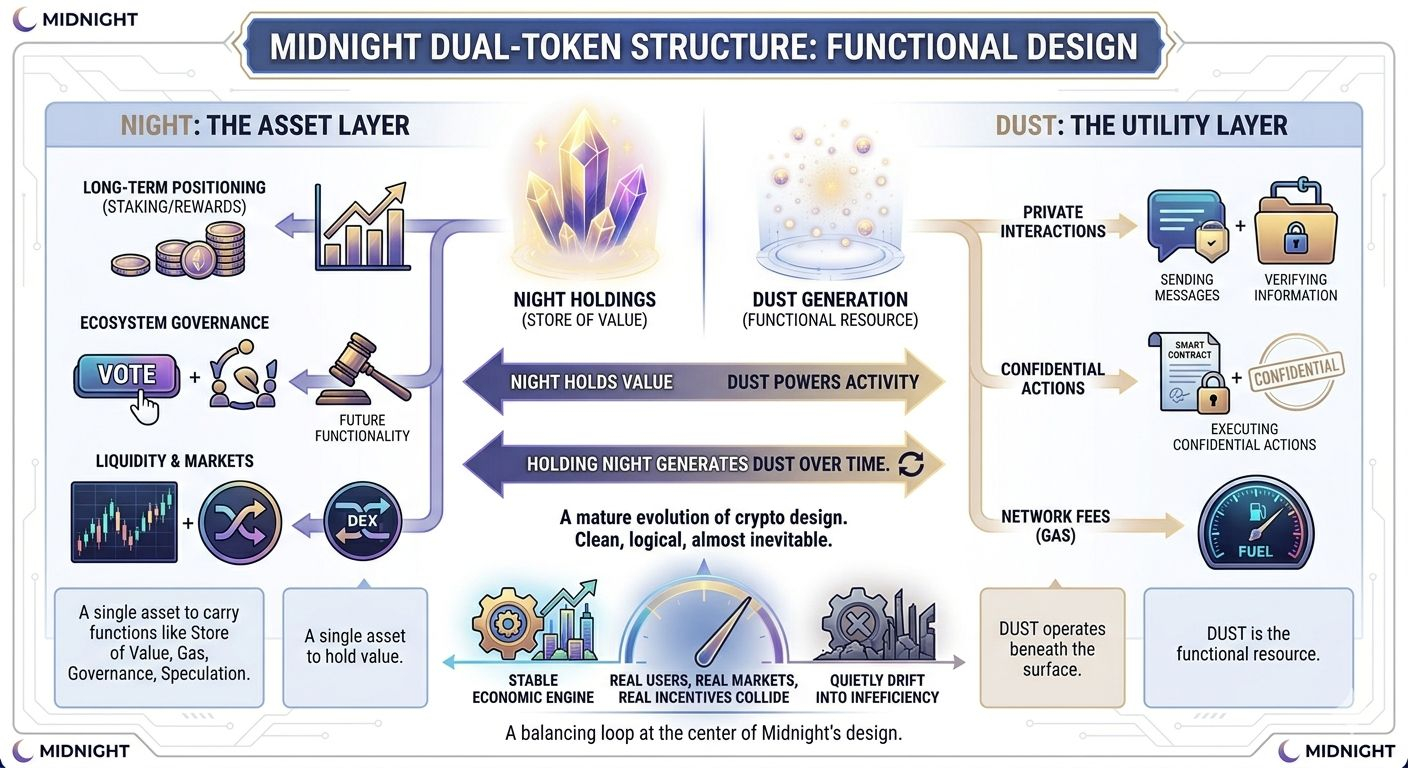
Instead of forcing a single asset to carry every function store of value gas governance and speculation Midnight separates roles into two distinct layers.
On the surface this feels like a mature evolution of crypto design.
One asset holds value the other powers activity.
Clean logical almost inevitable.
But crypto systems rarely fail on paper. They struggle when real users real markets and real incentives collide.
Midnight’s model is no exception.
What looks like a well balanced loop could either become a stable economic engine or quietly drift into inefficiency.
At the center of Midnight’s design are two components NIGHT and DUST.
NIGHT is the visible asset. It’s what people buy hold trade and evaluate.
It represents long term positioning within the ecosystem. DUST on the other hand operates beneath the surface.
It’s the functional resource used for private interactions sending messages verifying information or executing confidential actions on the network.
The relationship between the two is straightforward.
Holding NIGHT generates DUST over time. Instead of spending your core asset directly you spend the output it produces.
This shifts the psychological experience of using the network.
Instead of feeling like you are constantly losing value through transaction fees you are using a renewable resource derived from your holdings.
That distinction matters more than it seems. In traditional blockchain systems every action chips away at your balance.
Even small fees accumulate into a persistent sense of loss.
Midnight attempts to remove that friction.
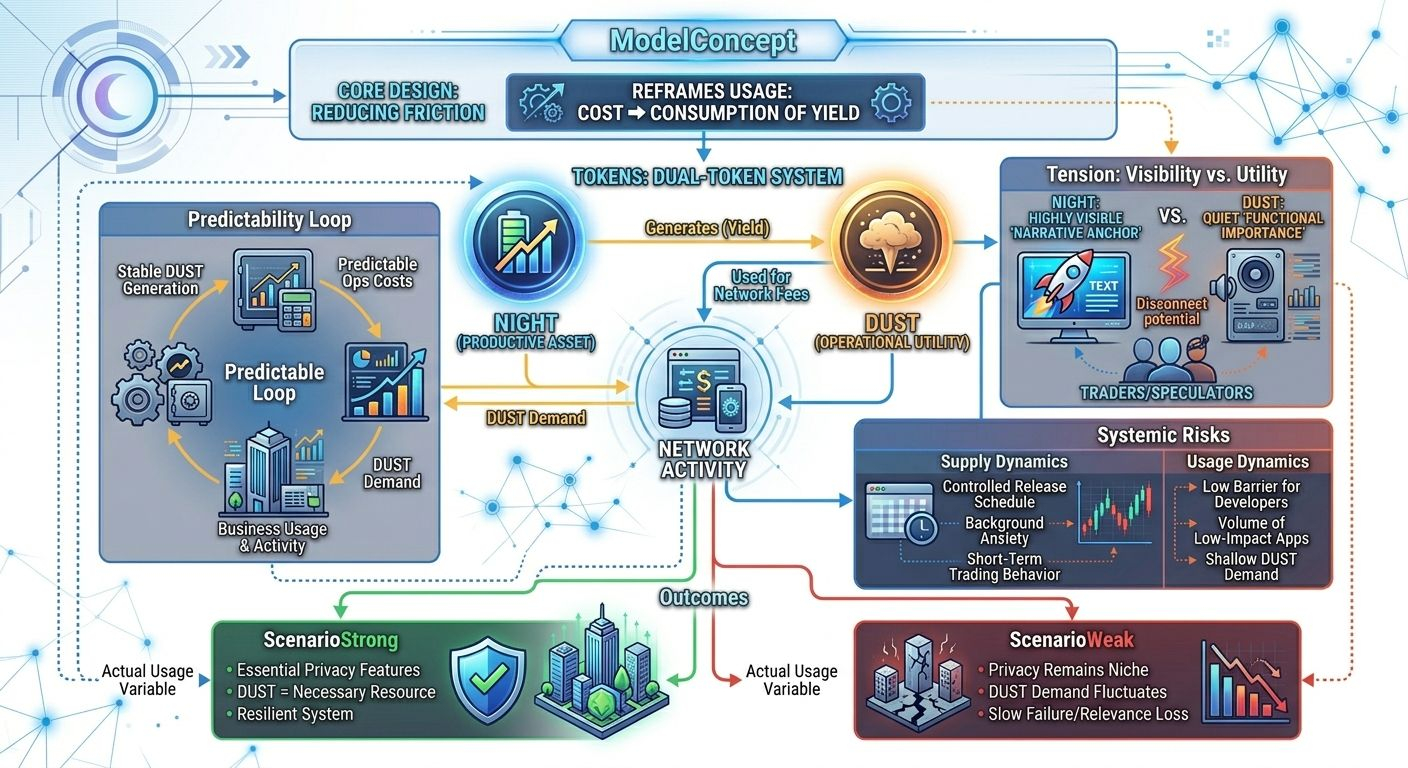
It reframes usage from cost to consumption of yield. In theory this encourages more activity and reduces hesitation.
For businesses the appeal is even clearer. Predictability.
If DUST generation is stable operational costs become easier to estimate. There’s less exposure to sudden fee spikes driven by market volatility.
Planning becomes possible in a way that most crypto environments struggle to offer.
However this elegant loop introduces a subtle dependency. The entire system assumes that DUST will be consistently useful and consistently demanded.
Without that demand the loop weakens.
This is where the first layer of tension appears visibility versus utility.
NIGHT is highly visible. It has a price chart liquidity and market sentiment attached to it. It becomes the narrative anchor for the ecosystem.
Traders watch it speculate on it and react to its movements.
DUST in contrast operates quietly. It doesn’t dominate dashboards or headlines.
Its importance is functional rather than emotional.
This creates a disconnect.
The market primarily reacts to NIGHT but the health of the system depends on DUST usage.
If NIGHT’s price rises without corresponding growth in DUST demand the system becomes unbalanced.
It starts to resemble a speculative asset disconnected from real activity.
The reverse scenario is also possible.
Strong DUST usage with weak market sentiment around NIGHT could undervalue the system’s actual utility.
Either way the separation introduces a gap between perception and reality. In crypto that gap can widen quickly.
Another pressure point lies in supply dynamics. Midnight’s total supply of NIGHT is large and a significant portion is released gradually over time.
A controlled release schedule is often seen as responsible design. It avoids sudden shocks and allows the market to absorb new tokens steadily.
But markets don’t always respond rationally. Even a predictable release can create constant background anxiety.
The knowledge that more supply is coming influences behavior. Traders become cautious..
Long term holders second guess their positions.
Short term strategies dominate because timing the market feels safer than trusting the system.
This is particularly challenging for an asset positioned as a long term battery for generating DUST.
The model depends on people holding NIGHT consistently.
If participants treat it as a short term trade instead the foundation weakens.
Beyond supply and sentiment the most critical variable is actual usage.
Midnight lowers the barrier for developers by offering tools that are familiar and accessible. This increases the likelihood of rapid ecosystem growth.
More developers can build experiment and deploy applications without steep learning curves.
At first glance this is a clear advantage.
More builders should lead to more applications and more applications should lead to more DUST consumption.
The loop strengthens as activity increases.
But accessibility has a downside.
When building becomes easy the volume of low impact or superficial applications tends to rise.
Not every app creates meaningful engagement.
Not every feature drives sustained usage.
The ecosystem can become crowded with projects that exist but do not contribute significantly to demand.
If DUST consumption remains shallow the core value proposition begins to erode. Holding NIGHT only makes sense if the generated DUST has real utility.
If users do not need much DUST the incentive to hold NIGHT weakens.
This leads to a more fundamental question what anchors demand.
In a strong scenario Midnight’s privacy features become essential.
Businesses rely on them.
Users prefer them. Applications integrate them in ways that cannot be easily replaced. DUST becomes a necessary resource not an optional one.
In that environment holding NIGHT is justified. It becomes infrastructure not speculation.
In a weaker scenario privacy remains a niche feature. Applications exist but do not scale. Users engage occasionally but not consistently. DUST demand fluctuates without clear growth.
In this case the system still functions but the economic loop loses its strength.
NIGHT becomes harder to justify beyond narrative.
There is also a behavioral dimension to consider. Crypto participants are not purely rational actors.
They respond to trends narratives and momentum. Even the most well designed system can struggle if it fails to capture sustained attention.
Midnight’s model is intellectually appealing. It introduces structure in a space that often lacks it. But intellectual appeal does not guarantee adoption.
The system must create experiences that people actually want to use repeatedly. Without that the design remains theoretical.
Another subtle risk is the slow nature of failure in such systems.
A dual token model does not collapse instantly if it underperforms. Instead it gradually loses relevance. Demand softens. Activity declines. The gap between design and reality widens over time.
This makes it harder to diagnose problems early.
Everything can appear stable on the surface while underlying dynamics weaken. By the time the imbalance becomes obvious reversing it is more difficult.
Despite these challenges the model is not inherently flawed.
In fact it addresses real issues that have limited blockchain usability for years.
Separating value storage from operational cost is a meaningful improvement. It aligns incentives more clearly and reduces friction for users.
The outcome depends on execution.
If Midnight can cultivate applications that generate consistent necessary DUST usage the loop becomes self sustaining.
NIGHT evolves into a productive asset rather than a passive one.
The system gains resilience because demand is rooted in function not just sentiment.
If it fails to achieve that the model risks becoming a slow value trap. The structure remains intact but the underlying demand does not keep pace.
Over time the elegance of the design becomes less relevant than the absence of activity.
In the end the question is not whether the two layer economy is clever.
It clearly is.
The real question is whether it can maintain alignment between what people hold and what they actually use.
Because in crypto design sets the stage but behavior writes the outcome.

