

Newton Protocol is the kind of project I have learned not to dismiss too quickly, even if the market probably will.
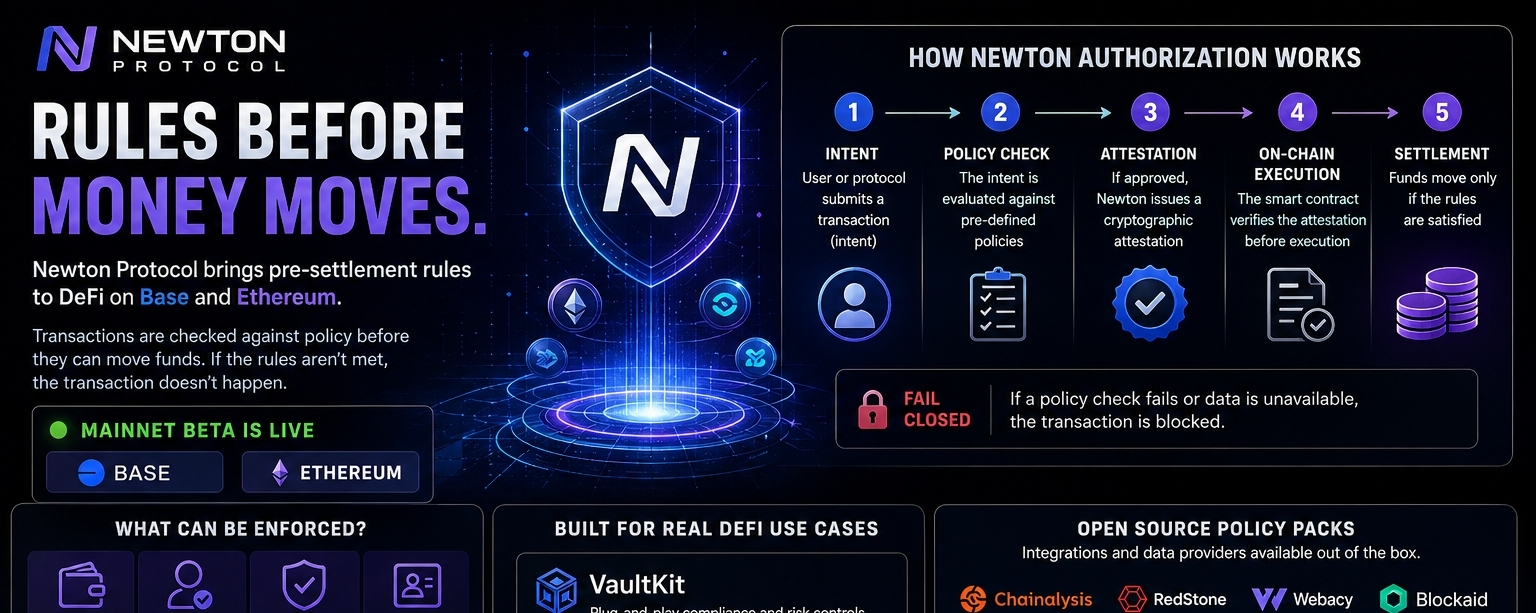
Not because it is loud. It is not. Not because it has some clean, easy story that traders can repeat in ten seconds. It does not. Newton is working on something more uncomfortable than that: authorization before onchain transactions settle. Basically, a way to check whether money should move before it actually does.
That sounds dry. I know.
But dry is not always useless. Sometimes dry is where the real damage gets prevented.
I have watched enough crypto projects recycle the same promises with new branding to be tired of the whole routine. Faster execution. Smarter automation. Better rails. Bigger future. Then something breaks, funds move where they should not, permissions turn out to be weaker than expected, and everyone suddenly remembers that control matters. For about three days. Then the market goes back to chasing noise.
Newton Protocol seems to be building for that forgotten middle part. The part between intent and execution. The part where a transaction should be checked against rules before it gets final approval.
That is the piece most people ignore because it does not feel exciting until something expensive happens.
The project’s main idea is simple enough once you strip away the technical wrapping. A vault, treasury, automated system, or protocol should be able to say, “These are the rules,” and then actually enforce those rules when a transaction tries to move through the system. Spending limits. Approved addresses. Access controls. Risk boundaries. Conditions that are not just written somewhere in a document, but actually sitting in the path of execution.
That matters.
It matters more than the market wants to admit right now.
Crypto is very good at making money move. That has never been the weak point. The weak point is making sure money moves only when it should. A transaction can be fast, final, and completely wrong. That is the part people learn the hard way, usually after the post-mortem is already being written.
Newton is trying to put friction in the right place. Not random friction. Not the kind that ruins user experience for no reason. Useful friction. The kind that asks one more question before capital leaves the door: is this action allowed?
I like that idea more than I like most current narratives.
But here’s the thing. Good infrastructure does not automatically become a good market story. I have seen that trap too many times. A project solves a real problem, but the problem is not fashionable yet. The token floats around. The community gets impatient. The team keeps explaining the same concept. Traders ask where the catalyst is. Builders ask for more proof. Everyone waits, and waiting in crypto feels like decay.
That is where Newton sits.
It may be right about the direction of onchain finance. It may also be early enough that the market treats it like background noise. Both can be true.
The project becomes easier to understand when you stop forcing it into the usual automation box. Automation alone is not the point. Automation without limits is just a faster way to create a mess. If an onchain system can act on its own, it needs boundaries. If a vault can move funds across strategies, those movements need rules. If a treasury allows programmable spending, somebody has to define what is acceptable before the transaction happens.
Newton’s pitch gets stronger there.
Not flashy. Stronger.
The best use case is probably vaults and managed onchain capital. That is where trust gets stretched thin. A vault manager can say funds will only go into approved strategies, but users still have to believe the manager, the interface, the process, and the humans around it. Newton’s model tries to make those promises harder to break by pushing them into the transaction flow itself.
That is the kind of thing serious capital eventually cares about.
Eventually is doing a lot of work in that sentence.
Right now, the broader market still rewards cleaner stories. It likes projects that can be packaged quickly. Newton is not easy to package without making it sound more exciting than it really is. And honestly, making it sound too exciting would probably hurt the project. This is not supposed to be entertainment. It is supposed to be a control layer.
The real test, though, is not whether the idea sounds sensible. Plenty of dead projects sounded sensible. The real test is whether builders actually use it when no one is handing them attention for doing so. I want to see policies protecting real capital. I want to see repeated usage. I want to see Newton become something protocols quietly depend on, not something people mention only when the market is looking for another narrative to recycle.
That is where I’m still cautious.
Because crypto infrastructure has a graveyard full of “needed later” projects. Some were genuinely early. Some were just unnecessary. Some had decent technology but never found a painful enough problem. Newton has to prove that authorization before settlement is not just a neat architectural idea. It has to prove that people will build around it because the alternative is worse.
There is also the branding problem. If Newton tries to be about vaults, agents, compliance, stable assets, institutional access, and every other serious-sounding category at once, the message will start to blur. I have seen that happen. A project gets ambitious, then vague. The stronger path is narrower. Pick the place where the pain is sharpest and make the product impossible to ignore there.
For Newton, that probably means staying close to onchain capital management. Vaults. Permissioned actions. Risk controls. Places where one bad movement can cost real money.
That is enough.
It does not need to sound bigger every week.
What makes Newton worth watching is that it is not trying to make crypto faster for the sake of speed. The industry already has enough speed. Too much, maybe. What it lacks is judgment at the transaction level. Not speeches about safety. Not dashboards that look reassuring. Actual checks before execution.
That is a harder sell. It is slower. It has more grind in it.
Maybe that is why it feels believable.
I do not know if Newton Protocol becomes a major piece of onchain infrastructure or another project that was early, serious, and mostly ignored. The market has ignored useful things before. It has also rewarded useless things for months at a time. That is the job. You keep separating signal from noise, even when the noise has better volume.
Newton is betting that the next phase of crypto will need more than movement. It will need permission, restraint, and rules that actually bite.
Maybe the market is not ready to care yet.
But if enough capital starts moving through automated systems, the question will not be whether checks slow things down. The question will be how long people were willing to run without them.