
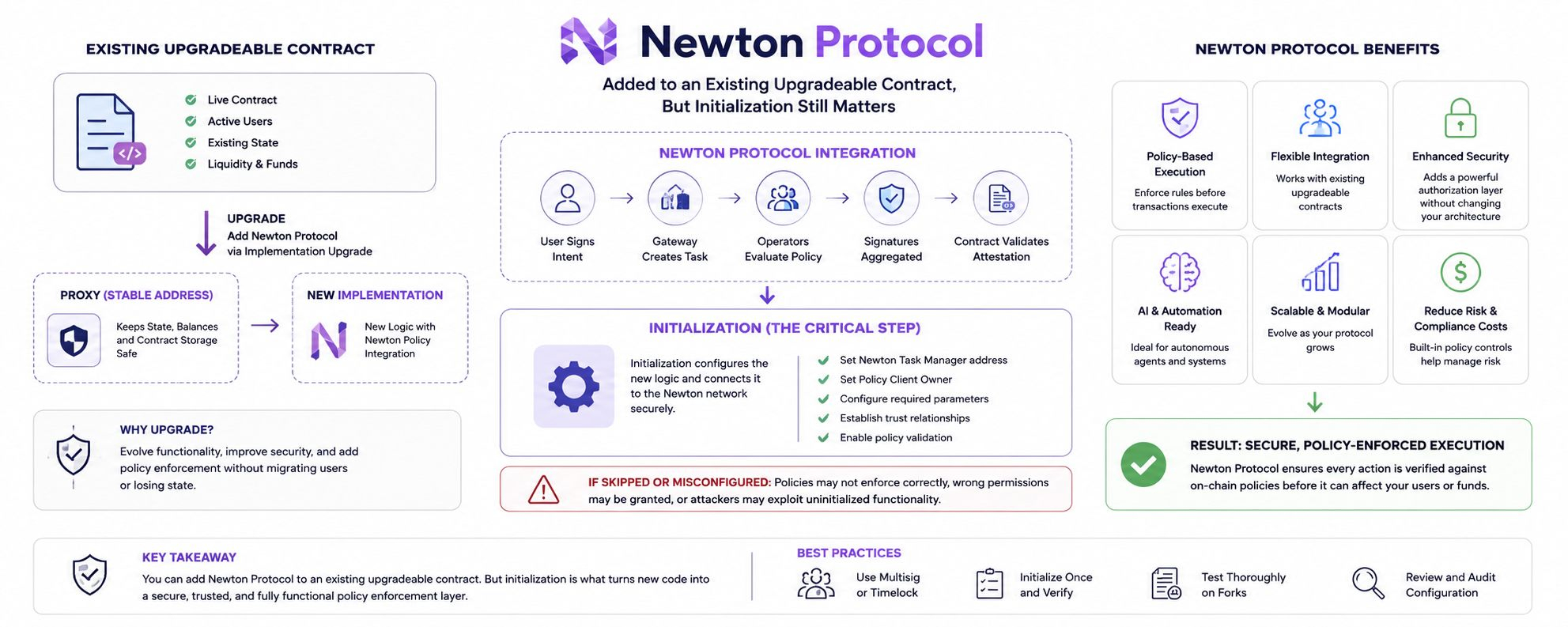

@NewtonProtocol I'd been following discussions around upgradeable smart contracts for a while before I started looking more closely at Newton Protocol, and one detail kept standing out to me. Most conversations focus on how easy it is to add new functionality to an existing contract, but very few people spend time talking about what happens immediately afterward. From what I've learned, that second step is often the one that determines whether the upgrade actually improves security or quietly introduces new risks.
What caught my attention about Newton Protocol wasn't simply that it can be integrated into an existing upgradeable contract. Plenty of tools can be added through upgrades. What interested me was the emphasis on proper initialization after the upgrade is complete. That may sound like a small implementation detail, but I don't think it should be treated that way.
The blockchain industry has matured enough that simply shipping new code isn't considered an achievement anymore. Protocols are expected to evolve, patch vulnerabilities, and introduce better infrastructure without forcing users to migrate funds every few months. Upgradeable contracts have made that possible, and they've become a common choice across DeFi and other on-chain applications.
At first glance, upgrading a contract feels like the hard part. Once the new implementation is deployed, it's tempting to think the work is finished. The more I read about how upgradeable systems actually function, the more I realized that's only half the story. The upgrade installs new logic, but initialization is what gives that logic its intended role within the system.
That's one reason I found Newton Protocol interesting. Its documentation explains that developers can integrate Newton's policy framework into an existing upgradeable contract instead of rebuilding everything from scratch. For projects with live users, established liquidity, and years of history, that flexibility matters. Replacing an entire contract is rarely practical, while upgrading existing infrastructure is often the more realistic path.
But flexibility always comes with responsibility.
I think initialization deserves much more attention than it usually receives because it establishes how the upgraded functionality actually behaves. Administrative permissions need to be assigned correctly. Required components have to be connected. The contract needs to know which configuration it should trust before any policy enforcement begins.
If those steps aren't completed properly, the contract may still compile, deploy, and appear functional while carrying hidden weaknesses that only become obvious later.
That's something I believe many people outside the development community underestimate. Security failures don't always come from complicated exploits or sophisticated cryptography. Sometimes they begin with something much simpler—a missing initialization step, an overlooked permission, or a configuration that never should have reached production.
Looking at Newton Protocol, I don't see initialization as an afterthought. I see it as part of the protocol's security model. Since Newton is designed to help verify whether transactions comply with predefined policies before execution, the configuration behind those policies has to be established correctly from the beginning. Otherwise, the framework can't provide the assurances it's designed to deliver.
I also think this becomes increasingly relevant as AI agents and automated financial systems continue to grow. Automation promises greater efficiency, but efficiency without clearly defined boundaries isn't enough. If autonomous systems are expected to interact with smart contracts, move assets, or execute strategies, then every layer responsible for authorization has to be configured with precision.
That's another reason Newton Protocol stood out to me. Rather than focusing only on execution, it encourages developers to think about controlled execution—where programmable policies determine whether an action should proceed in the first place. That feels like a meaningful shift in how on-chain systems can be secured.
The more I explored the project, the more I felt that the real takeaway wasn't simply that Newton Protocol can be added to an existing upgradeable contract. The more important lesson is that an upgrade alone doesn't create security. Initialization is what turns newly deployed code into a functioning and trustworthy part of the protocol.
To me, that's an important distinction. Anyone can talk about adding features through an upgrade. The projects that leave a stronger impression are the ones that recognize the smallest implementation details often have the biggest impact on long-term reliability. Newton Protocol reminded me that building secure blockchain infrastructure isn't just about writing better code—it's also about making sure every critical step after deployment is handled with the same level of care.