

Most crypto stories move fast. They are about throughput, TVL spikes, meme velocity, or the next speculative wave. But some of the most consequential infrastructure in financial history was built quietly — settlement rails, clearing houses, custody systems that never made headlines yet ended up supporting trillions in global value. Dusk’s narrative belongs to that slower, heavier category. It isn’t chasing retail excitement. It is chasing something more subtle and arguably more difficult: how to bring regulated finance on-chain without exposing its secrets.
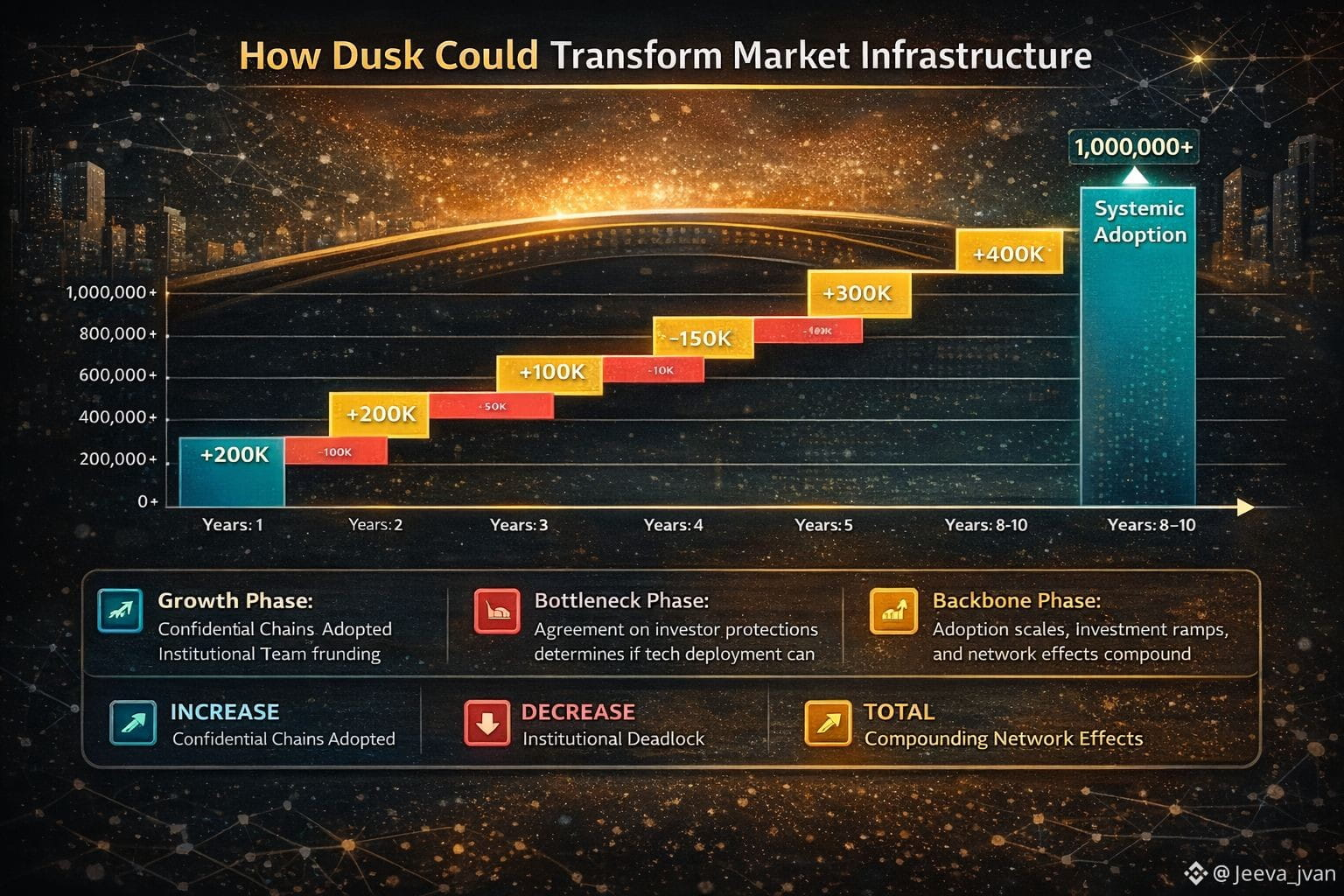
In a world where blockchains default to radical transparency, this is a contrarian position. Every transaction public. Every wallet traceable. Every strategy legible to competitors. For traders and hobbyists, that openness is a feature. For institutions — asset managers, exchanges, market makers, custodians — it is often a non-starter. Their businesses depend on confidentiality: order sizes, collateral positions, settlement terms, client identities, proprietary strategies. The moment those become public, competitive advantage evaporates and regulatory risk multiplies.
Dusk is designed around that friction point. Instead of asking institutions to adapt to public ledgers, it flips the equation and asks: what would a blockchain look like if it were built from day one for regulated markets? Not a private database masquerading as crypto, but a public network where sensitive data can remain hidden while the correctness of transactions remains provable.
That distinction matters. Traditional privacy projects in crypto often focused on total obscurity — hiding senders, receivers, and amounts from everyone. Dusk’s angle is narrower and more surgical. The real-world problem institutions face is not that nobody should see anything; it is that the wrong people should not see the wrong details. Regulators need assurance. Auditors need proof. Counterparties need settlement guarantees. Competitors do not need to know your positions. Dusk frames privacy not as rebellion against oversight, but as a tool that makes compliant markets workable on shared infrastructure.
Technically, this vision rests on confidential smart contracts and zero-knowledge cryptography. Instead of pushing raw financial data onto the chain, participants encrypt inputs, execute logic privately, and then post succinct proofs that the computation followed the rules. The network verifies those proofs and finalizes settlement without ever learning the underlying secrets. Think of it like submitting a tax return sealed inside an envelope — except the envelope itself mathematically proves that the numbers inside were calculated correctly.
For builders, that unlocks an entirely different design space. Private auctions where bids are hidden until closing. Tokenized bonds whose coupon flows are confidential to holders. Syndicated loans settled on-chain without revealing every lender’s exposure. Secondary markets for regulated assets that preserve discretion while remaining globally accessible. These are not flashy consumer apps. They are the backstage systems that keep financial theaters running.
For investors, the appeal is less about short-term cycles and more about optionality on structural change. If real-world assets continue migrating onto blockchains — equities, funds, debt instruments, commodities — then confidentiality becomes infrastructure, not a feature request. Whoever provides the rails for that transition sits at a choke point in the value chain. The upside is not just token appreciation; it is becoming part of the plumbing of a tokenized financial system.
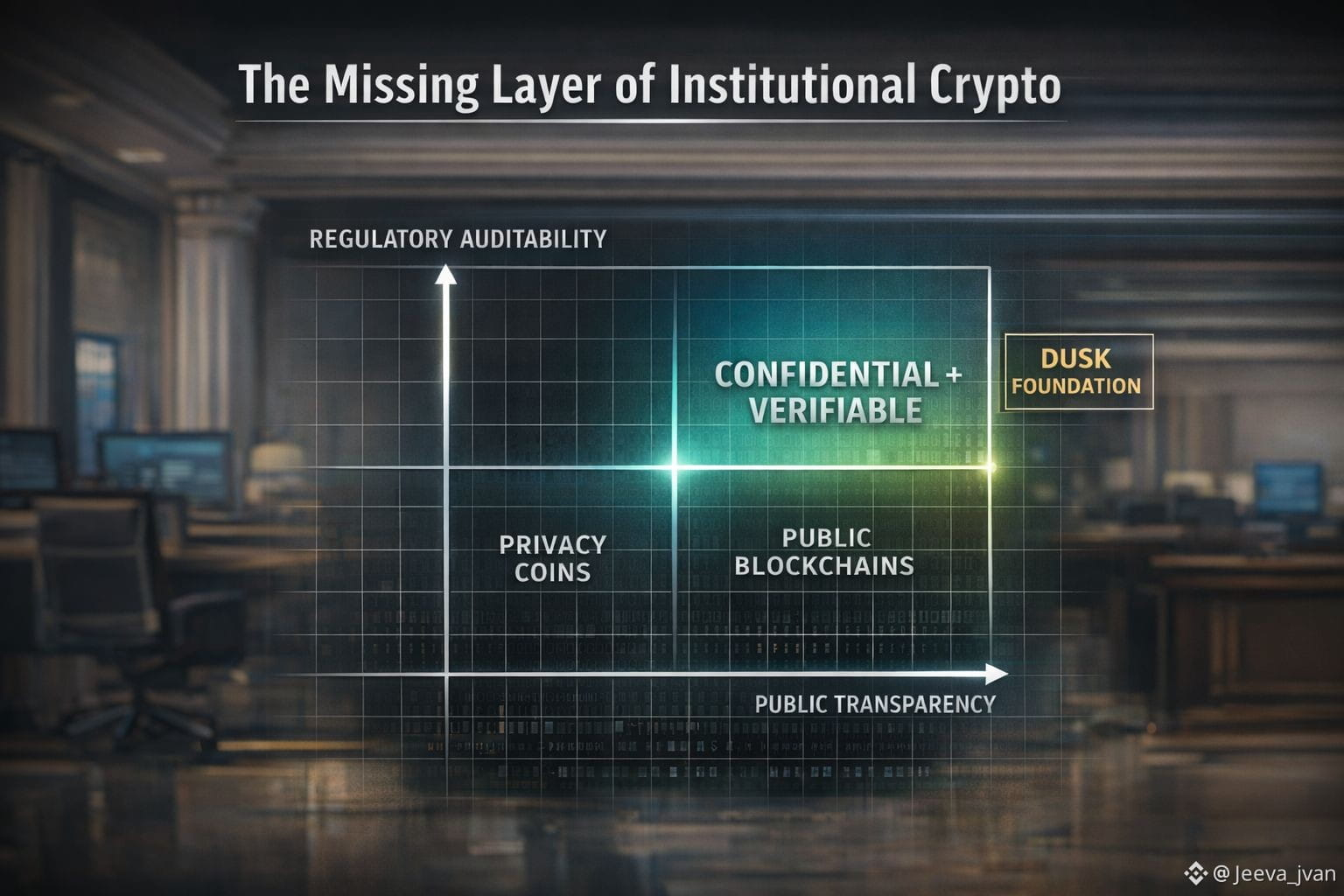
Zooming out further, the ambition is philosophical. Crypto began as a reaction to opaque institutions. Now it is being asked to host them. That is not hypocrisy — it is maturation. Global finance does not run on radical openness alone; it runs on contracts, discretion, reporting obligations, and carefully controlled information flows. The next generation of networks will need to encode those realities directly into software. Dusk’s bet is that cryptography can replace paperwork, and proofs can replace trust relationships that once required armies of intermediaries.
If that vision works, the implications ripple outward. Settlement could become faster and more global without exposing sensitive books. Compliance might shift from manual reporting to automated cryptographic attestations. Regulators could verify constraints without demanding raw data dumps. Market structure itself could change as private venues migrate onto shared public rails, reducing fragmentation while preserving competitive boundaries.
This is not a story about overnight adoption. Infrastructure never is. It is about pilots, integrations, regulatory conversations, and slow accumulation of credibility. But those are exactly the processes that precede major rewiring of financial systems. When they succeed, the public rarely notices the scaffolding — only that markets suddenly work in new ways.
The deeper narrative, then, is not about privacy as ideology. It is about privacy as engineering discipline — the careful design of systems where disclosure is precise rather than total, and where trust is replaced by verifiable computation. In that frame, Dusk is less a speculative experiment and more a hypothesis about what programmable finance must become if it wants to absorb serious capital.
Crypto’s next chapter may not be written by the loudest protocols. It may be written by the ones that learned to coexist with regulation, complexity, and institutional reality — and quietly turned those constraints into advantages. If selective confidentiality becomes standard for on-chain markets, the projects that mastered it early could end up powering settlement layers beneath exchanges, funds, and asset issuers we already know.
The future of blockchain might look less like a trading floor and more like a clearing house: invisible to most users, indispensable to everyone who matters. And in that future, the most valuable networks may not be the ones making the most noise — but the ones doing the hardest work behind the scenes. @Dusk #dusk $DUSK
