
@Plasma The first time I came across Plasma, it didn’t feel like the usual kind of blockchain project that tries to capture attention with big claims or sweeping visions. There was no dramatic language about reshaping the internet or replacing the financial system. Instead, it read more like a quiet piece of infrastructure, something built with a very specific job in mind. That restraint stood out to me. After watching several cycles of this industry, you start to notice how rare it is for a system to know exactly what it wants to be.
Most networks begin with broad ambitions. They promise to be general, flexible, capable of doing everything for everyone. Over time, that flexibility becomes a burden. The chain gets crowded, fees rise, and simple actions start to feel strangely complicated. Sending money should feel like handing someone cash. Instead, users often find themselves thinking about tokens for fees, waiting for confirmations, and calculating costs that change every few minutes. The experience becomes technical in ways that ordinary people never asked for.
Plasma seems to have entered the space with a different mood. Rather than asking, “How do we support every possible application?” it appears to ask a smaller, almost humble question: “What if moving stable value from one person to another just worked, quietly and predictably?” That narrow focus shapes everything that follows. You can sense it in the design choices. It doesn’t try to invent a new language or a new mental model. It keeps the familiar environment developers already understand, while smoothing the path for everyday transfers.
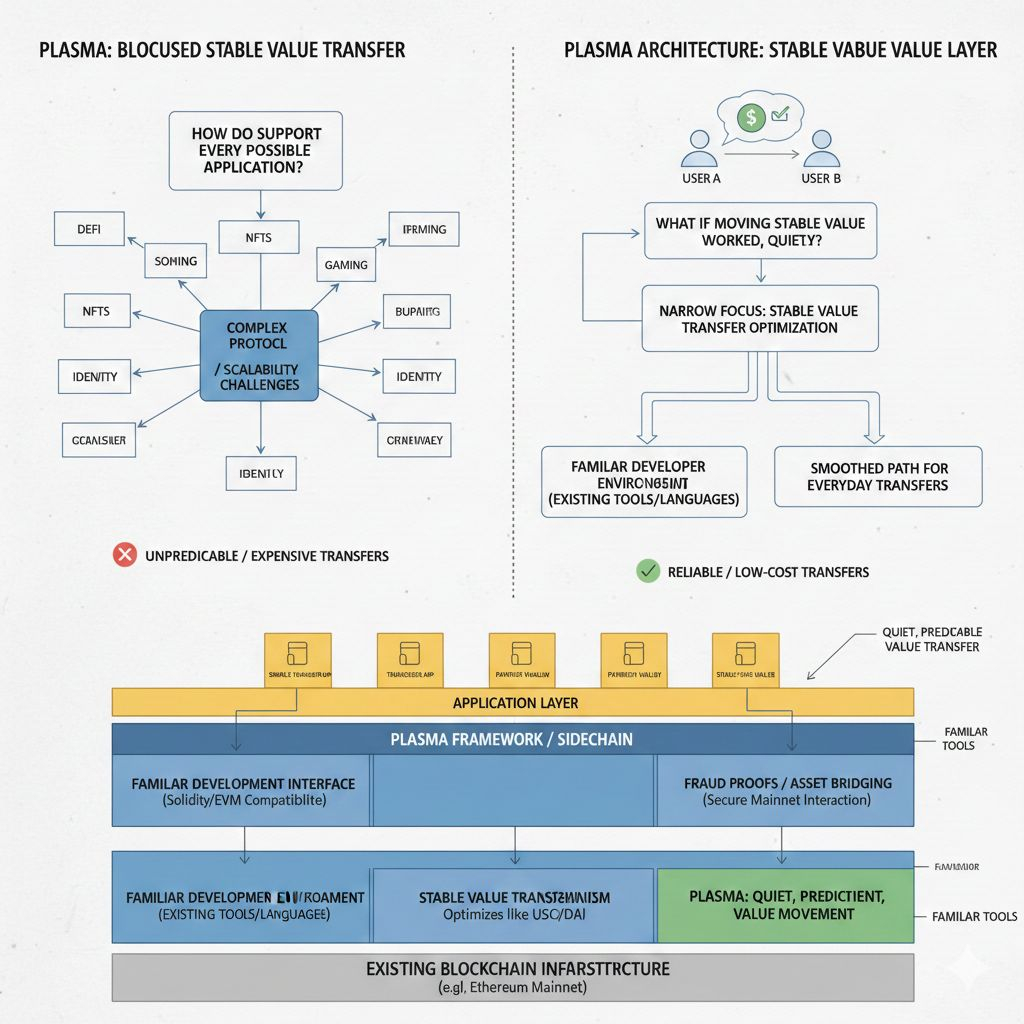
There’s a kind of practicality behind that decision. Over the years, I’ve seen many teams chase novelty for its own sake. New architectures, new terms, new rules that promise elegance but end up isolating the network. Plasma seems less interested in being clever and more interested in being usable. It accepts the tools people already know and simply rearranges them so that sending stablecoins feels less like a technical operation and more like a basic action.
The real-world context matters here. In many parts of the world, stablecoins are not an experiment or a trading tool. They are just dollars with better mobility. They are used for remittances, small payments, savings, and everyday business. But the rails that carry them are often inherited from systems built for speculation rather than payments. That mismatch creates friction. Fees fluctuate. Transactions stall. Something as ordinary as sending money home can feel uncertain.
Plasma seems to notice this awkwardness and treat it as a design problem rather than a market opportunity. Instead of building more layers of complexity, it removes a few. Letting people pay fees with the same stable asset they are already using sounds simple, almost obvious, but it quietly changes the experience. There’s no extra token to think about, no small balance to maintain just to keep the account alive. The system bends toward the user instead of asking the user to bend toward the system.
Of course, every simplification comes with a trade-off. A chain that optimizes for one purpose gives up some of the freedom that more general networks enjoy. Plasma doesn’t feel like a playground for endless experimentation. It feels more like a well-paved road. You can travel quickly and reliably, but you’re not meant to wander too far off the path. That constraint may disappoint some builders, but it also gives the network clarity. It knows what it is for.
I find that kind of discipline refreshing. After multiple crypto cycles, you start to appreciate limits. Systems that try to be everything often struggle to be dependable at anything. By focusing on stable settlement, Plasma quietly accepts that it won’t host every trend or every new narrative. Instead, it aims to become the place where value simply moves, without drama. In finance, that kind of boring reliability is often what people trust most.
The choice to anchor its security outward, rather than relying only on itself, also reflects a certain humility. It suggests an understanding that trust is accumulated slowly. Borrowing strength from an older, more established foundation feels less glamorous than promising a breakthrough, but it may prove steadier over time. There’s a sense that the system prefers gradual resilience over sudden leaps.
Still, realism demands acknowledging the limits. Payments infrastructure is a crowded space. Many chains now claim to be fast and cheap. Users don’t always care about architecture; they care about convenience and access. Without wallets, integrations, and real distribution, even the most carefully designed network can remain unnoticed. Plasma’s quiet nature, while admirable, may also make it easy to overlook in a market that rewards noise.
There are also unanswered questions about how far specialization can go. If usage grows, can the simplicity hold? Will new features slowly creep in, adding the same complexity it originally tried to avoid? History suggests that every system faces this pressure. Staying focused requires constant restraint, and restraint is harder than expansion.
Yet, when I step back, Plasma feels less like a bet on rapid dominance and more like a long-term utility. It reminds me of the less visible parts of the internet the protocols that don’t trend on social media but quietly carry enormous amounts of traffic every day. Nobody celebrates them, but everything depends on them. That may be the lane Plasma is choosing.
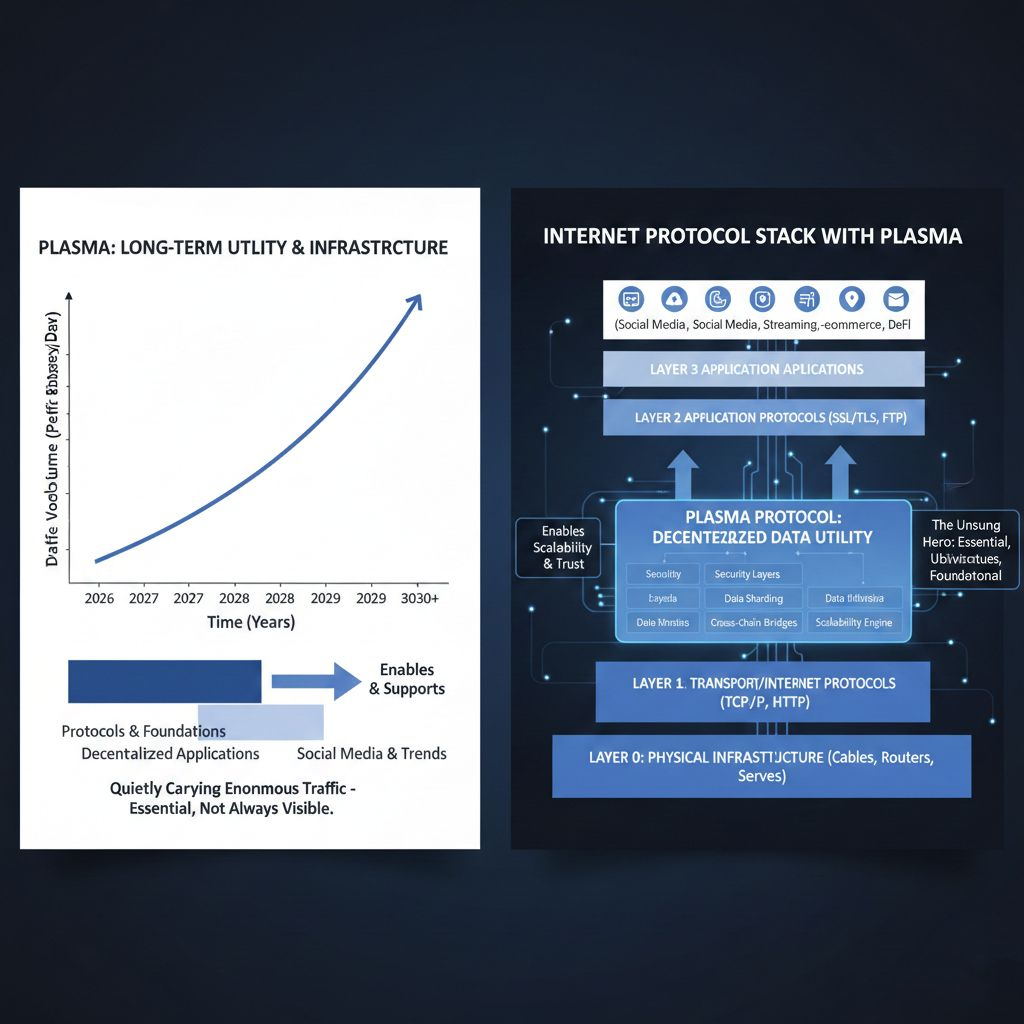
After years of watching grand promises rise and fade, I find myself drawn to projects that speak softly and build carefully. Not because they guarantee success, but because they feel grounded in reality. Plasma doesn’t present itself as a revolution. It feels more like maintenance work on a financial system that already exists, smoothing the rough edges so people can use it without thinking too much.
And maybe that’s enough. Not every piece of infrastructure needs to be visionary. Some just need to be steady, predictable, and quietly present in the background. If Plasma continues in that direction less spectacle, more consistencyit may never dominate headlines, but it could become something more durable: a place where value moves the way it probably should have all along, simply and without fuss.
