

When I first started digging into Fogo, I expected the usual Layer 1 pitch—faster blocks, better throughput, more scalable everything. Instead, what I found felt less like a new “city for apps” and more like someone trying to build a precision machine.
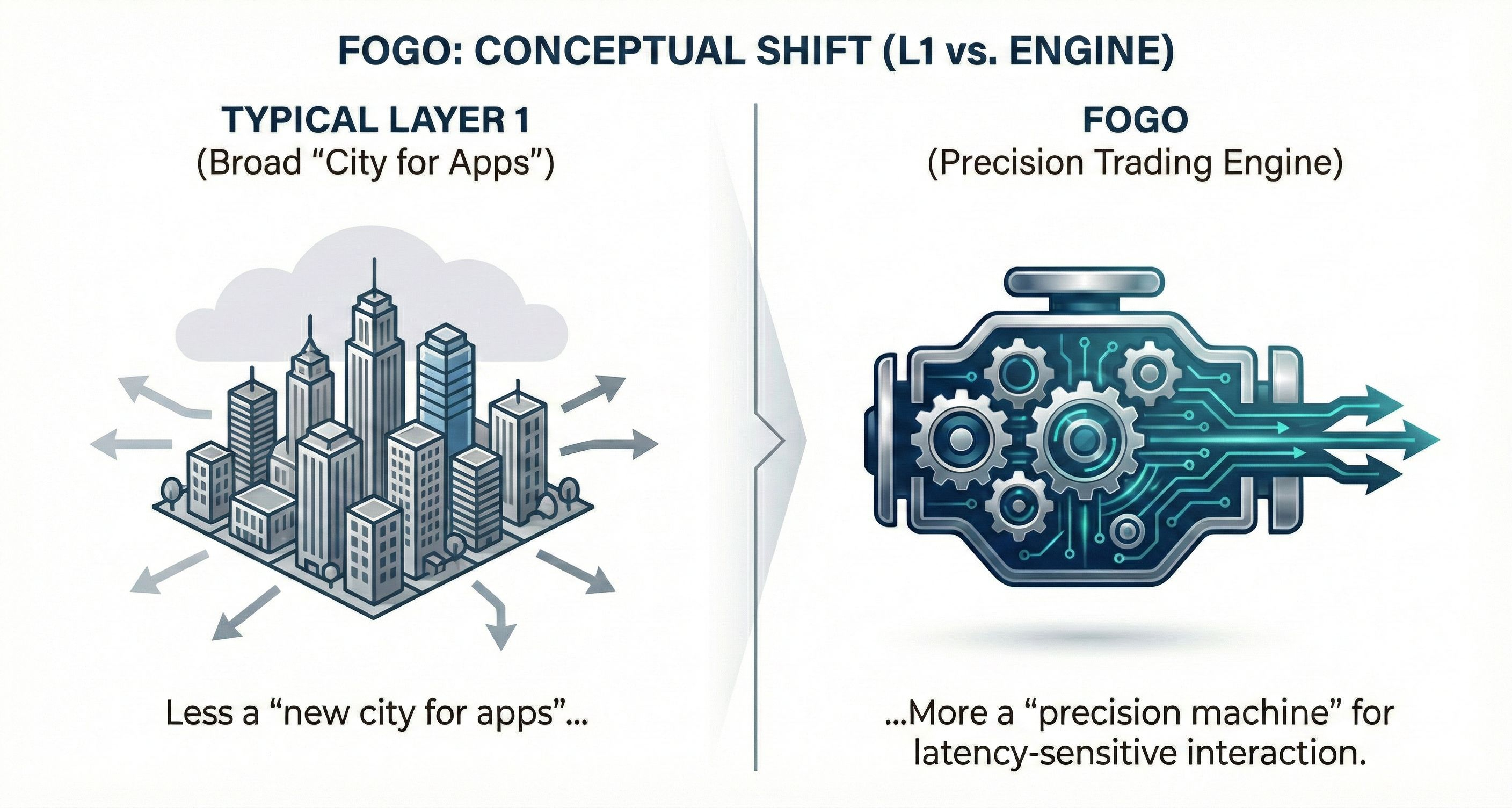
Most blockchains remind me of public highways. Anyone can get on, traffic flows from everywhere, and performance depends on how crowded things are at any given time. Fogo feels more like a racetrack. It’s not pretending to be optimized for every possible vehicle. It’s designed for a specific type of activity—high-speed, latency-sensitive interaction—where consistency matters more than openness-for-its-own-sake.
That difference shows up in how Fogo treats geography. On most networks, validator placement is an afterthought. Nodes are scattered around the world, which sounds great in theory, but it also means the network inherits the unpredictability of the public internet. Fogo takes a different stance. It clusters validators into “zones,” sometimes even within the same data center, to minimize the physical distance between them. That’s not a cosmetic choice—it’s an admission that speed isn’t just about software. It’s about physics.
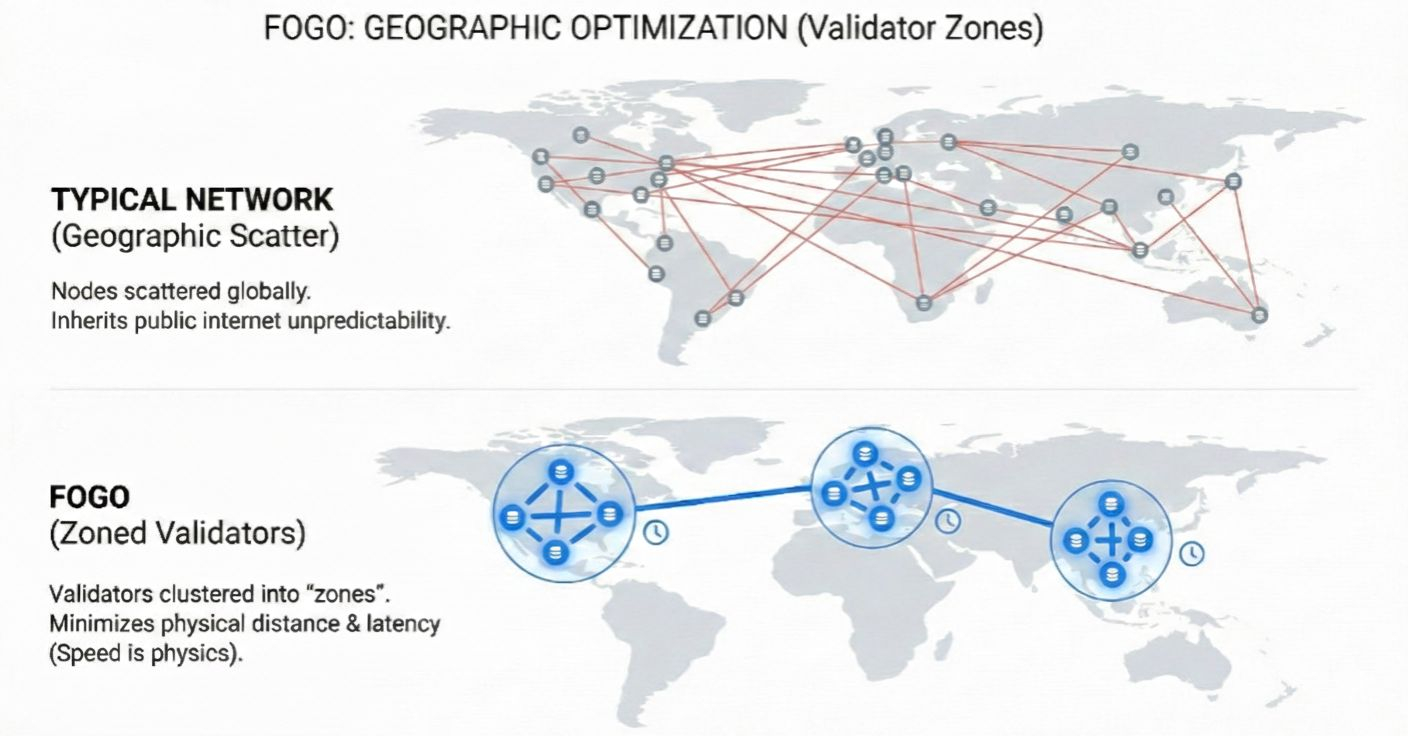
I actually appreciate the honesty in that. Instead of pretending the internet is flat and perfectly symmetrical, Fogo leans into the idea that proximity matters. Then it tries to balance that performance gain with rotating zones over time, so no single geographic cluster becomes permanent power. It’s a bit like saying, “Yes, we’re optimizing for speed—but we’re also going to keep moving the track.”
Of course, that introduces a new kind of social coordination problem. Rotating zones isn’t just technical; it’s governance-heavy. People have to agree. Validators have to adapt. There’s a human layer sitting on top of the machine. Whether that ends up being elegant or messy is something only time will reveal.
The same philosophy shows up in Fogo’s choice to standardize around a single high-performance client built on Firedancer. In crypto, multiple clients are often treated as sacred for decentralization. Fogo’s approach feels more pragmatic—almost impatient. If you want to push hardware limits, you don’t want five slightly different engines competing under the hood. You want one tuned system that everyone runs.
That’s a bold tradeoff. It prioritizes performance clarity over implementation diversity. I don’t see it as reckless, but I do see it as intentional. It suggests Fogo cares deeply about making latency predictable, not just low on average.
And then there’s Sessions, which might be the most human part of the whole design.
If you’ve used crypto long enough, you know the ritual: buy the native token, keep some aside for gas, sign every interaction, manage balances carefully so you don’t get stuck. It’s normal to us, but it’s weird if you step back. Fogo Sessions try to remove that ritual entirely. Users interact in SPL tokens, and paymasters handle the gas mechanics in the background. Even more interesting, Sessions don’t let users directly interact with the native FOGO token at all.
That decision feels almost philosophical. It’s saying: “The engine room is not the user’s problem.” FOGO becomes more of an infrastructure asset than a consumer-facing currency. Validators, paymasters, and governance participants carry the weight of the system, while users just use it.
I find that separation refreshing. It’s closer to how most modern systems work. When you swipe a card, you don’t hold shares in Visa just to pay the fee. The infrastructure runs behind the curtain. Fogo seems to want that same invisibility for gas.
Of course, that shifts where token demand comes from. If everyday users don’t need to hold FOGO, then the economic gravity centers around validators, staking participants, and sponsors. That’s a different value story than “everyone needs some gas.” It’s more institutional. More structural. Potentially more stable—but also more dependent on whether those actors find the economics worthwhile long term.
Mainnet being live makes all of this less theoretical. There’s currently a single active zone. There’s a defined validator set. The network feels early, and intentionally so. It doesn’t have the sprawling decentralization footprint of older chains yet. Instead, it feels like it’s still tightening bolts and measuring performance under controlled conditions.
I don’t read that as weakness. I read it as sequencing. If your thesis is that low-latency execution is your edge, you probably don’t start by maximizing chaos. You start by making sure the machine behaves exactly as designed.
The ecosystem choices reinforce that identity. The tools and integrations around Fogo lean heavily toward trading infrastructure—price oracles, bridges, indexing services, staking primitives. It’s not trying to become a cultural playground overnight. It feels like it’s preparing for serious, execution-heavy applications that care about milliseconds and reliability.
What I find most compelling is that Fogo doesn’t feel like it’s chasing the broadest possible narrative. It feels focused. Maybe even stubbornly so. It’s building for a specific use case: on-chain environments where latency isn’t an abstract metric but a real competitive factor.
Whether that focus becomes a strength or a constraint depends on a few very human factors. Will validators cooperate smoothly when zones rotate? Will paymasters form a competitive, healthy market? Will governance stay disciplined as the network grows? These aren’t purely technical questions. They’re social ones.
But that’s what makes Fogo interesting to me. It’s not just another chain promising scale. It’s a project that seems to understand that performance isn’t magic—it’s engineered. And engineering always involves tradeoffs.
Fogo isn’t trying to be the biggest city in crypto. It’s trying to be the fastest exchange floor. If it succeeds, it won’t feel like a louder blockchain. It will feel like one that simply reacts faster than the rest—and does it consistently enough that you stop thinking about it altogether.