

Most blockchains try to impress you.
They throw around TPS numbers, validator counts, ecosystem maps filled with tiny logos. It’s the crypto version of showing someone your car engine instead of just driving them somewhere. Vanar feels different to me—not louder, not necessarily flashier—but more obsessed with something ordinary: reducing friction.
And friction is what actually kills consumer adoption.
If you’ve ever tried onboarding a non-crypto friend into Web3, you already know the pattern. Download a wallet. Save a seed phrase. Buy a token. Pay gas. Wait. Hope the fee doesn’t spike. Explain why the transaction failed. At some point, they just look at you and say, “Why is this so hard?”
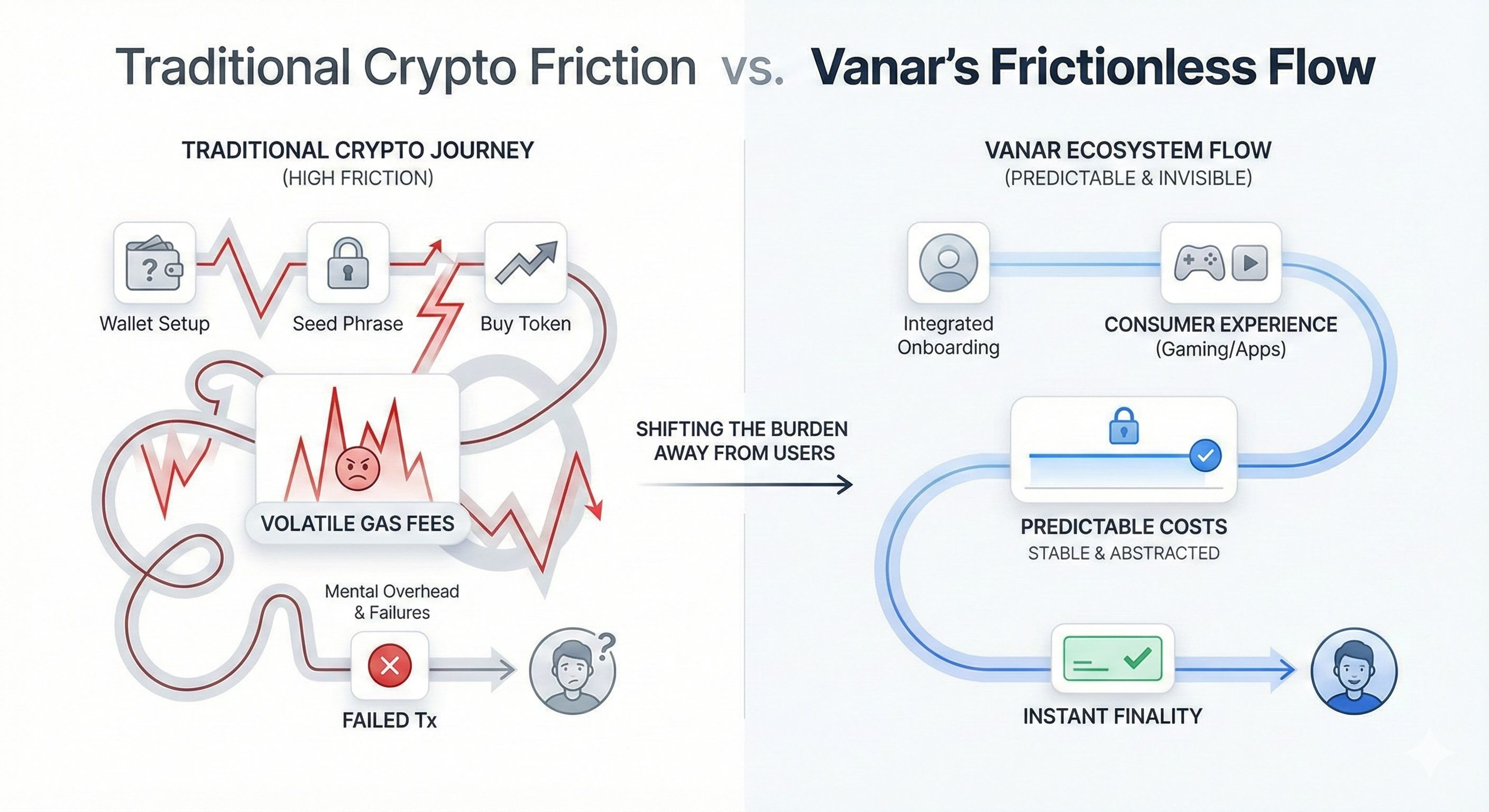
Vanar’s design choices read like they were written by someone who has had that exact conversation too many times.
One of the most practical decisions they emphasize is fixed, predictable transaction costs. Not “sometimes cheap.” Predictable. The documentation outlines a model where fees are designed to remain stable instead of fluctuating wildly based on network demand. In theory, that means developers can design economies without fearing sudden fee spikes breaking the experience. It also means apps could potentially abstract those costs away from users more easily. That’s a small technical detail, but from a product perspective, it’s massive.
Because here’s the truth: mainstream users don’t care about decentralization philosophy. They care whether something works without mental overhead.
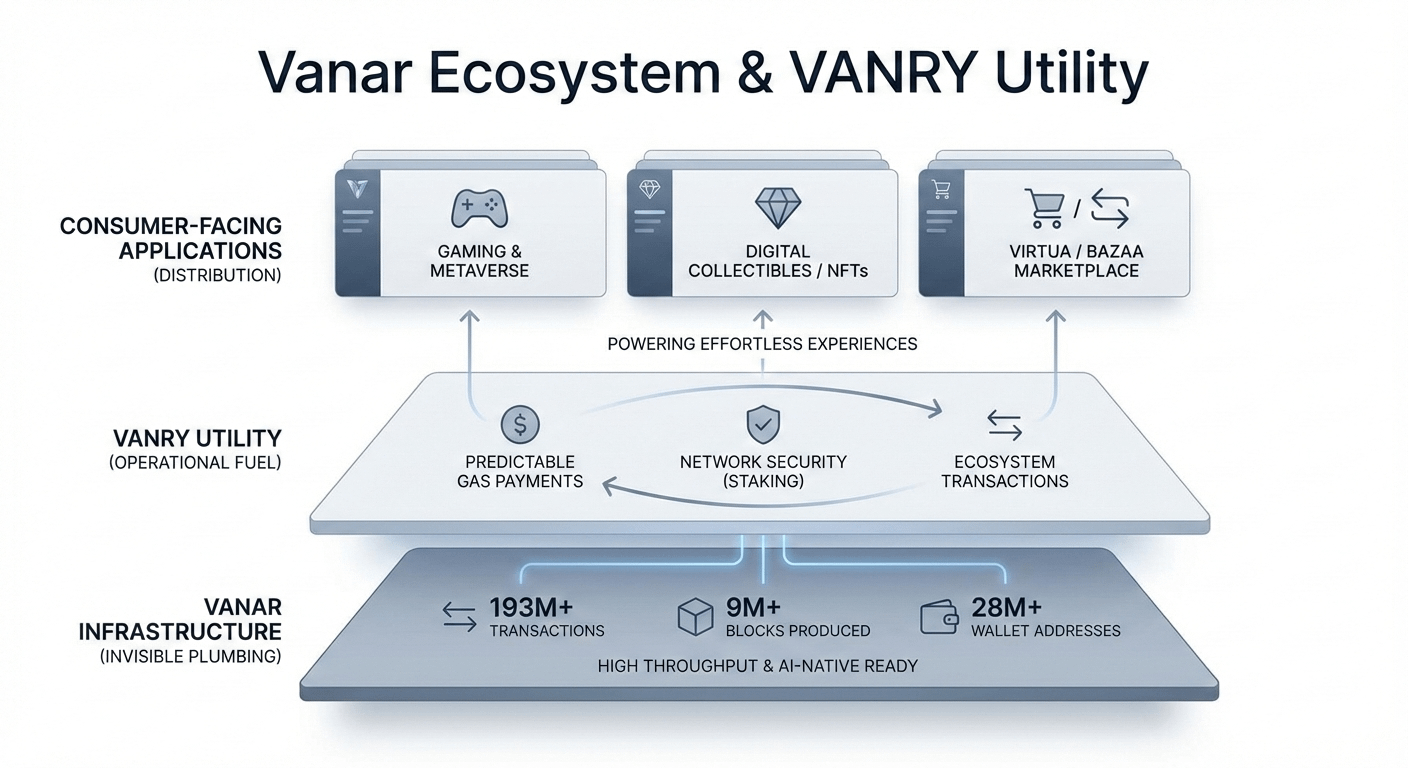
When I checked the mainnet explorer, what stood out wasn’t hype—it was activity. Around 193 million transactions. Nearly 9 million blocks produced. Over 28 million wallet addresses. Numbers like that don’t automatically mean 28 million humans are actively using the network—wallets can be automated, traffic can be programmatic—but they do show that the network is alive and processing significant volume. For a chain positioning itself around micro-interactions in games and digital environments, sustained activity matters more than a press release ever could.
But infrastructure alone doesn’t build adoption. Distribution does.
That’s where Vanar’s connection to platforms like Virtua becomes interesting. Virtua’s Bazaa marketplace is positioned as an on-chain trading environment embedded within digital experiences rather than isolated as a crypto-only tool. If someone shows up to explore a metaverse environment, collect digital items, or participate in a branded experience—and blockchain just quietly handles ownership behind the scenes—that’s a different adoption model than asking users to “enter crypto.”
It feels more like invisible plumbing than a spectacle.
And then there’s VANRY. On paper, it does what you’d expect: gas payments, staking, network security under a delegated proof-of-stake structure. But what makes it interesting isn’t the checklist of utilities—it’s how those utilities fit into a consumer-first thesis.
If apps on Vanar can budget transaction costs reliably, they’re in a better position to sponsor or abstract fees. That shifts the burden away from the user needing to understand token mechanics at the moment of engagement. Instead of “buy this token to play,” the flow becomes “play first, infrastructure happens in the background.” If that transition succeeds, VANRY demand ties more closely to ecosystem activity rather than speculative hype cycles.
Recently, Vanar has also leaned into positioning itself as an AI-native ecosystem layered on top of its chain infrastructure. I’m cautious with AI narratives because they’re everywhere right now, but the framing suggests something broader: an attempt to support intelligent, data-driven applications directly within its stack rather than bolting external services on top. Whether that evolves into meaningful developer traction remains to be seen, but it signals an ambition beyond simply being “another EVM-compatible chain.”
What I find most compelling isn’t any single feature. It’s the pattern.
Predictable fees. Consumer-facing products. Gaming and entertainment focus. Large transaction throughput. A token that can serve as operational fuel. These pieces only make sense if the real goal is to make blockchain unremarkable.
That may sound counterintuitive in an industry built on spectacle, but think about the technologies that actually reached billions of users. Most of them disappeared into everyday life. You don’t think about TCP/IP when you stream a movie. You don’t think about payment rails when you tap your card. You certainly don’t check gas auctions before sending a text.
If Vanar succeeds, people using its ecosystem won’t say, “I love this blockchain.” They’ll say, “That game was smooth,” or “That digital item just worked.”
From my perspective, that’s the right ambition. Not louder decentralization rhetoric. Not another ecosystem infographic. Just fewer reasons for a normal person to quit halfway through an experience.
The chain already shows signs of meaningful activity. The token has a defined role. The ecosystem has consumer-facing surfaces. The open question—the one that matters—is whether those pieces convert into repeat behavior from real users rather than temporary bursts of on-chain noise.
Because in the end, the next three billion users won’t join Web3 because it’s Web3. They’ll join because it feels effortless.
If Vanar can make effortlessness its defining feature, it won’t need to shout at all.