

When I first started looking into Fogo, I didn’t see another “high-performance L1.” I saw a chain that seems slightly impatient with how blockchains usually behave.
Most networks talk about speed as a number—TPS, block time, finality. Fogo talks about speed the way traders talk about it. Not as a benchmark, but as something you feel. That subtle difference changes how you evaluate everything else.
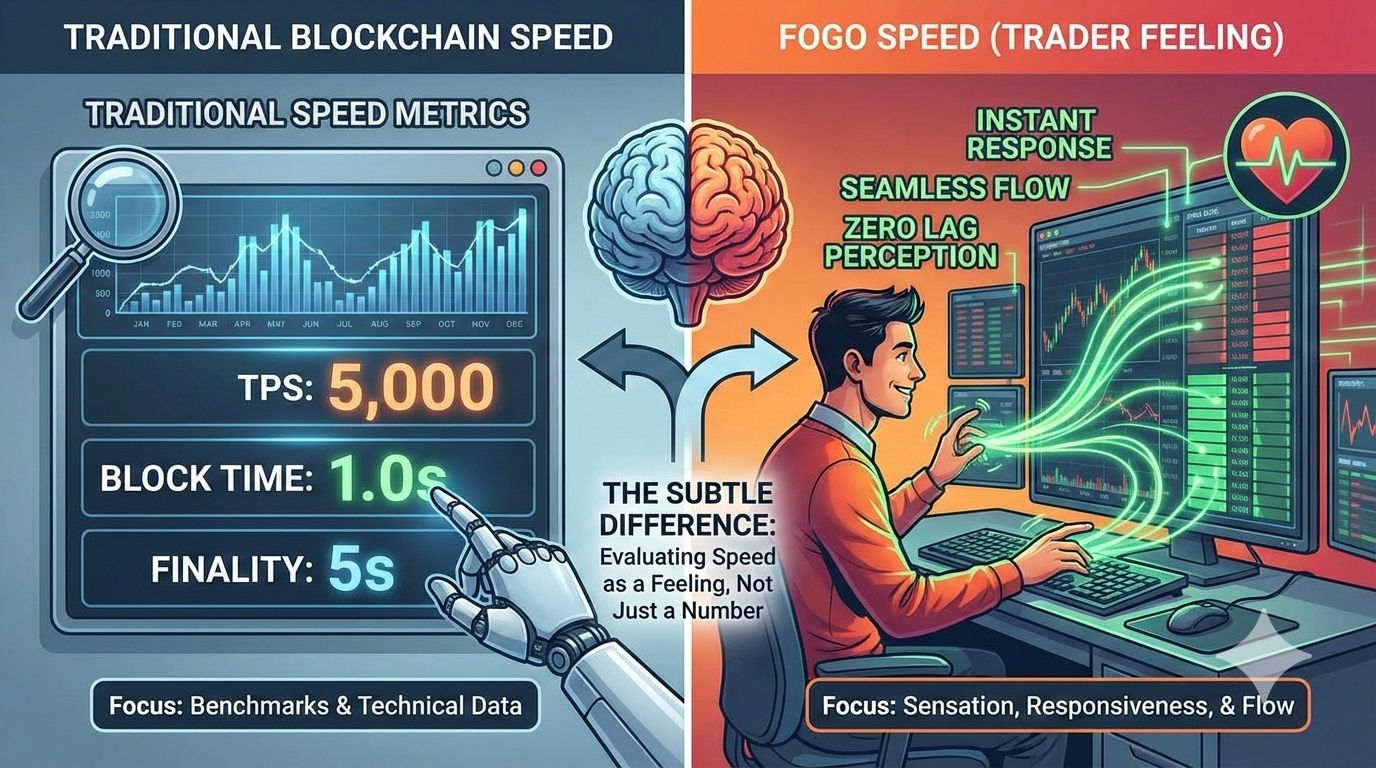
Fogo runs on the Solana Virtual Machine, which already carries a reputation for parallel execution and high throughput. But using SVM isn’t the real story. The real story is what Fogo is trying to do with it. Instead of building a broad, global network first and optimizing later, Fogo appears to have made a deliberate early choice to prioritize tight validator proximity and extremely fast block cadence. Independent analysis points out that early active validators were colocated in a single high-performance data center in Asia, close to major exchange infrastructure. That’s not the typical “max decentralization from day one” approach. It’s closer to how traditional exchanges think about physical infrastructure—reduce distance, reduce delay, reduce unpredictability.
You can disagree with that tradeoff. But you can’t say it’s accidental.
The 40ms block target often gets mentioned like it’s just a flex. But what matters isn’t that humans can’t perceive 40 milliseconds. What matters is that markets can. When blocks tick that quickly, the gap between intention and execution shrinks. Suddenly, the chain doesn’t feel like it’s asking you to “wait your turn.” It feels responsive.
CoinGecko’s breakdown of Fogo frames this as enabling new types of DeFi designs and real-time trading experiences. But when you step back, it’s simpler than that. Faster cadence changes behavior. If execution feels predictable and immediate, users may interact more frequently. Strategies that would feel risky on slower chains become viable. Interfaces don’t need to constantly warn you about lag or re-signing transactions.
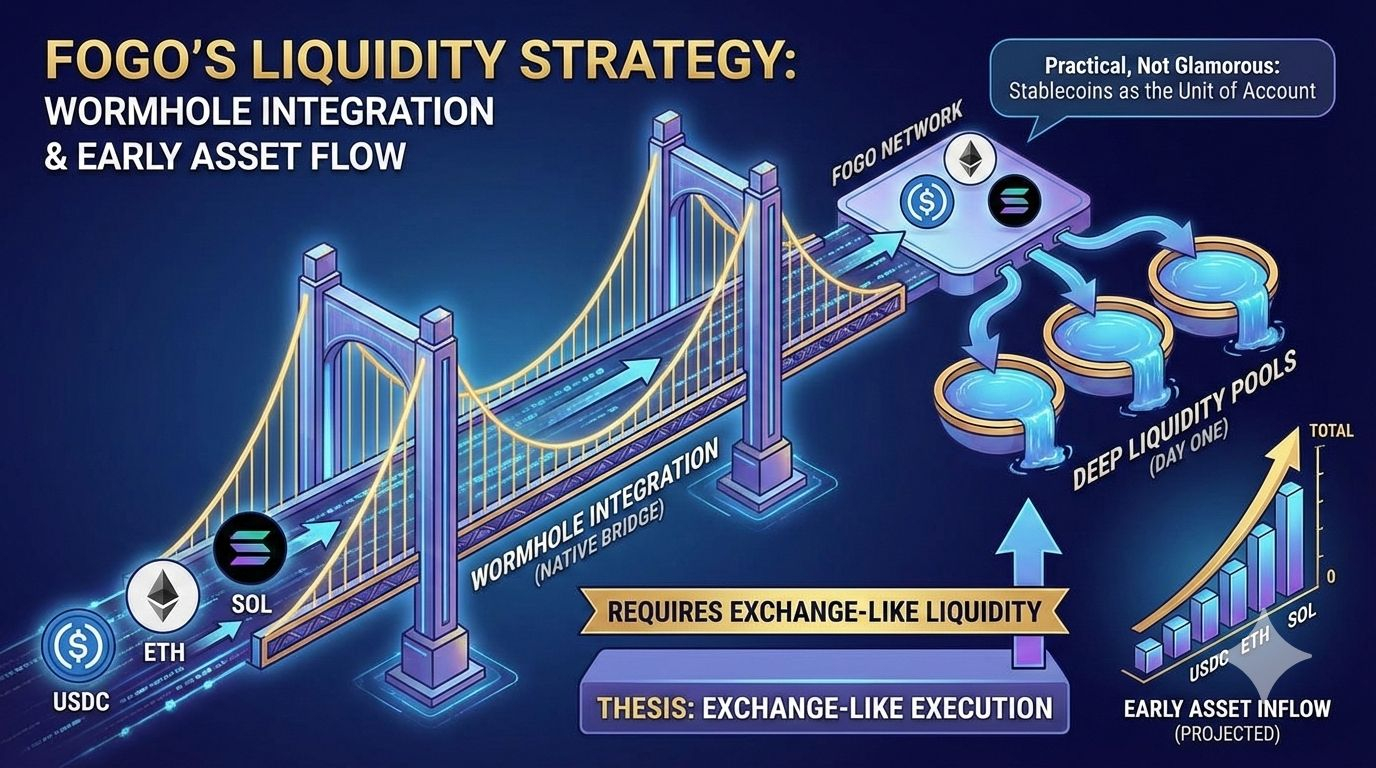
Then there’s liquidity, which is where most performance narratives fall apart. Speed is irrelevant if there’s nothing meaningful to trade. That’s why the Wormhole integration stood out to me. Positioning Wormhole as the native bridge means assets like USDC, ETH, and SOL can move onto Fogo early. That’s not glamorous, but it’s practical. If your thesis is “exchange-like execution,” you need exchange-like liquidity from day one. Stablecoins especially aren’t optional; they’re the unit of account that makes everything else work.
Token design is another area where I tried to read between the lines instead of just accepting the bullet points. Yes, FOGO is used for gas, staking, and governance. That’s standard. What caught my attention was the way the tokenomics describe a “flywheel,” where ecosystem projects supported by the Foundation are expected to share value back into the network over time. That’s a bold claim because it creates accountability. Either that loop materializes in measurable ways, or it doesn’t.
The distribution details are also revealing. The tokenomics outline a 6% community airdrop, fully unlocked, with 1.5% distributed at public mainnet launch in January. Meanwhile, core contributor allocations are locked and vest over several years, and institutional unlocks begin later in 2026. Short term, that means circulating supply leans heavily toward early community participants. Long term, it means governance influence will gradually shift as larger allocations unlock. Whether that transition feels balanced or concentrated will depend on how the network evolves.
The airdrop itself wasn’t tiny. Fogo states that around 22,300 unique users qualified, with an average allocation of roughly 6,700 FOGO, fully unlocked, and a claim window running until April 15, 2026. That number matters because it forms the first real behavioral sample for the chain. Those wallets are the ones who will decide—through their actions, not their tweets—whether Fogo’s speed actually changes how they use DeFi.
Do they stay active after incentives taper off?
Do they trade more frequently because execution feels smoother?
Do they experiment with new market structures that depend on low latency?
The ecosystem gives some clues about what Fogo hopes will happen. Projects like Valiant are highlighted as attempting to combine on-chain order books with concentrated liquidity AMMs and batch auction mechanics designed to improve execution fairness. That’s a very specific direction. It suggests the chain isn’t just trying to host generic forks; it’s trying to cultivate applications that actually exploit fast block times.
Even small operational details tell a story. The mainnet documentation openly lists RPC endpoints and network identifiers. That sounds ordinary, but it signals that Fogo expects serious infrastructure users—people who verify connections, run validators, and treat the chain as production infrastructure rather than a playground.
Stepping back, what I see is a network that’s less interested in being philosophically perfect on day one and more interested in being functionally sharp. That doesn’t mean decentralization is unimportant. It means the team appears to be sequencing priorities differently: first make execution feel industrial-grade, then broaden the network footprint without breaking that promise.
The risk is obvious. If validator concentration remains tight and doesn’t meaningfully expand, critics will have a strong case. If liquidity proves transient and leaves after incentives fade, speed won’t matter. If the token “flywheel” remains theoretical, the value narrative weakens.
But if validator distribution gradually expands while latency remains stable, if bridged assets stay and deepen liquidity pools, and if execution-centric apps actually gain traction because users prefer how they feel—then Fogo may end up occupying a very specific niche. Not just “another SVM chain,” but a chain where on-chain markets behave closer to how traders expect markets to behave.
For me, that’s the real test. Not whether Fogo is fast on paper, but whether it quietly changes how people interact with on-chain finance because it removes friction they’ve subconsciously accepted for years.