The Majority of traders do not lose due to being wrong. They miss out because they are late by a fraction of a second.
You read the move correctly. You click at the right time. But the fill comes back worse than expected. Not dramatically worse. Just enough to chip away at edge. Over time, that small gap compounds.
That gap has a structure. It’s called latency.
In fast markets, time is not neutral. If your order sits in transit for even a short window, someone else can treat it as information. If confirmation timing is inconsistent, that uncertainty becomes tradable. The result isn’t just slippage. It’s a hidden tax on intent.
Fogo is built around that idea.
Instead of treating speed as a marketing metric, it treats latency as a market design problem. The focus is not simply on processing more transactions. It’s on tightening the decision-to-finality loop. Shortening it. Making it more predictable.
That difference matters.
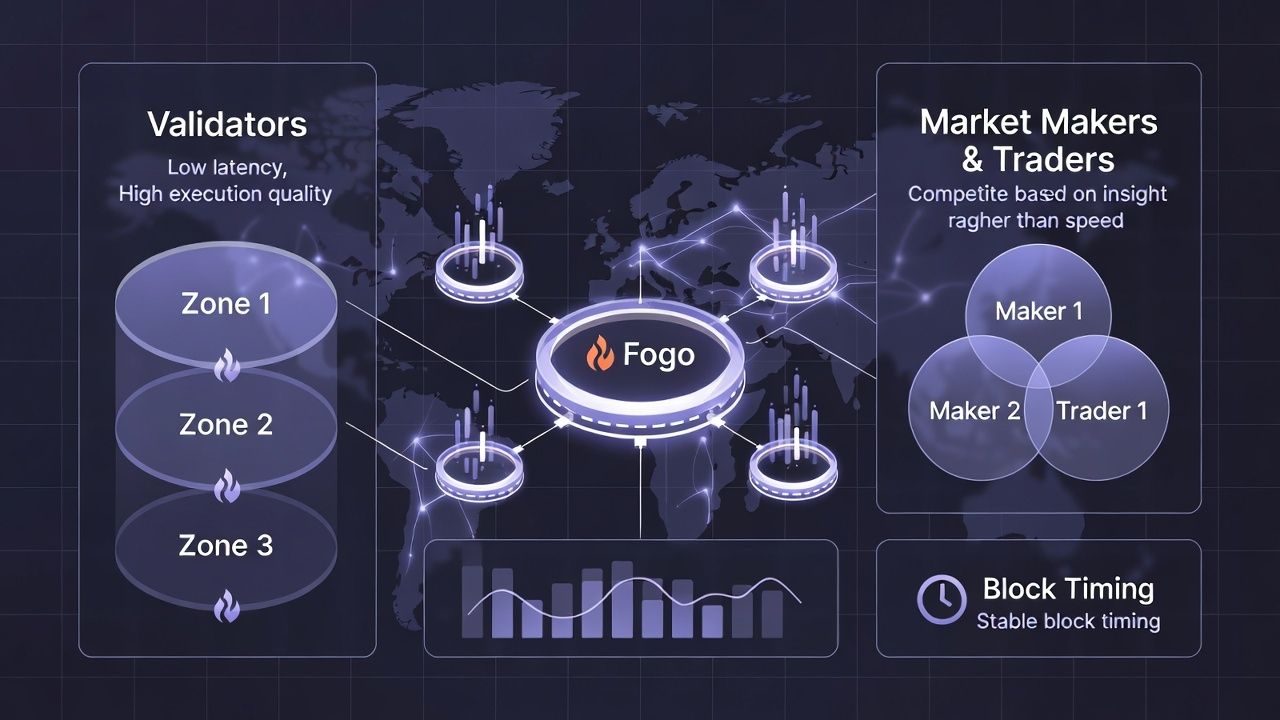
Fogo’s core direction is a colocated SVM-based Layer 1. In simple terms, the validators that determine ordering and finality are designed to operate in tightly controlled zones rather than being loosely scattered across the globe. The goal is not just lower average latency. It is lower jitter. Fewer unpredictable spikes. More consistent timing.
Traders can adapt to known delay. What hurts is inconsistent delay.
When latency varies from moment to moment, market makers widen spreads. Liquidity thins. Orders feel like coin flips. The venue slowly becomes hostile to size. Not because participants are malicious. Because the structure leaks time.
Fogo is trying to close that leak.
From a supply perspective, the native token underpins gas, staking, and governance. That is standard architecture for an L1. The more important question is how incentives align with execution quality. If validator rewards depend on maintaining performance standards and network stability, then infrastructure quality becomes economically enforced, not just technically suggested.
That alignment will matter more than token distribution headlines.
On-chain data at this stage is less about volume and more about behavior. What you want to see is stable block timing. Consistent finality. Narrow variance in transaction confirmation under load. If those distributions tighten over time, that signals structural improvement. If spreads compress and liquidity deepens on applications built on Fogo, that is the real validation.
Because execution quality shows up in outcomes, not dashboards.
The ecosystem strategy reflects this execution-first lens. Rather than chasing every possible use case, the positioning leans toward trading environments. That includes order book-based systems and high-frequency use cases where milliseconds directly impact profitability. If the base layer reduces timing randomness, applications on top inherit that advantage.
This is closer to venue design than generic blockchain scaling.
Compared to general-purpose chains that optimize for throughput, Fogo’s bet is narrower but sharper. High throughput alone does not guarantee good execution. If the intent window remains large, more transactions simply mean more opportunities to trade against exposed orders. Throughput measures capacity. Execution quality measures fairness under speed.
That distinction is subtle but important.
There are tradeoffs.
Colocation concentrates the hot path of the network. Some will view that as a compromise on geographic decentralization. It introduces governance questions around validator access and infrastructure standards. It may also resemble traditional finance colocation models, which carry their own debates about fairness.
These are not minor considerations.
There is also adoption risk. Execution improvements matter only if real liquidity migrates. Market makers and traders respond to incentives and outcomes, not narratives. If spreads tighten and fills improve, they will participate. If not, capital will stay where it is.
Infrastructure alone does not guarantee flow.
Still, the underlying thesis is strong.
Markets reward clarity of “now.” The tighter and more consistent the system’s sense of present time, the harder it becomes to profit from pure timing advantage. That shifts edge back toward information and judgment instead of connectivity and delay exploitation.
That shift changes behavior.
Traders size up when fills feel reliable. Market makers quote tighter when they trust the venue. Liquidity deepens when participants believe they are competing on insight, not on milliseconds.
Fogo is not promising a perfect market. No system can eliminate asymmetry. But by targeting latency as an economic leak rather than a technical inconvenience, it reframes what Layer 1 competition could look like.
Not who processes the most transactions.
But who makes intent cost less.
If that design holds under real market stress, the impact will not be a headline metric. It will be a feeling traders recognize immediately. When you click, the result matches your expectation more often than not.
And in trading, that consistency is everything.