Most people look at ROBO and see a token. I look at it as an evolving economic organism.
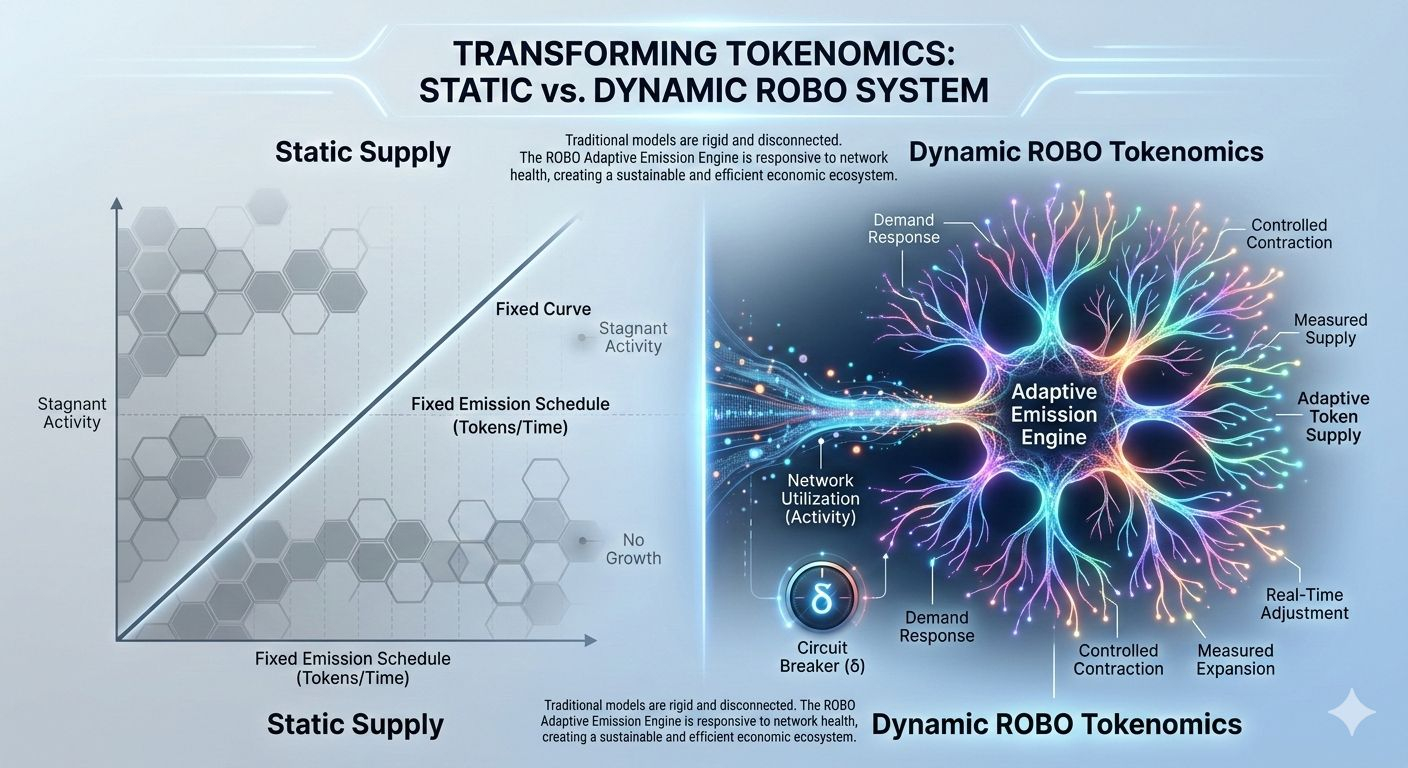
The real innovation inside ROBO is not just branding or narrative. It is how its Adaptive Emission Engine transforms token supply from a static schedule into a living monetary framework. Instead of releasing tokens blindly, ROBO embeds logic into its Emission Controller, allowing supply to react to network performance in real time.
To understand this, we need to step back.
Traditional tokenomics usually follow a fixed emission curve. Tokens are released per block, per epoch, or per year, regardless of whether the network is growing or stagnating. That means inflation continues even if demand weakens. Over time, this creates imbalance. Either holders get diluted unnecessarily, or the network struggles to incentivize participation during growth phases.
ROBO approaches this differently.
At the center of its system is Network Utilization, represented as U*. Think of U* as the optimal activity level the network aims to maintain. If real activity falls below this target, it signals underutilization. If activity goes far above it, the system may be overheating or entering inefficient congestion territory.
The Adaptive Emission Engine constantly monitors this utilization metric. Instead of locking emissions into a predetermined schedule, the Emission Controller adjusts supply depending on how close the network is to U*.
If usage is weak, emissions can contract to prevent unnecessary inflation. If the network is expanding and meaningful demand increases, emissions can scale up to support validator rewards, ecosystem incentives, or liquidity provisioning.
But ROBO does not rely on volume alone. Activity without value is noise.
That is where the Quality Threshold, Q*, becomes critical.
Q* ensures that not all activity triggers higher emissions. The system evaluates whether engagement meets predefined qualitative standards. This may include staking participation ratios, economic throughput, governance activity, or other measurable signals of real ecosystem health.
In simple terms, U* measures how active the network is. Q* measures whether that activity is economically meaningful.
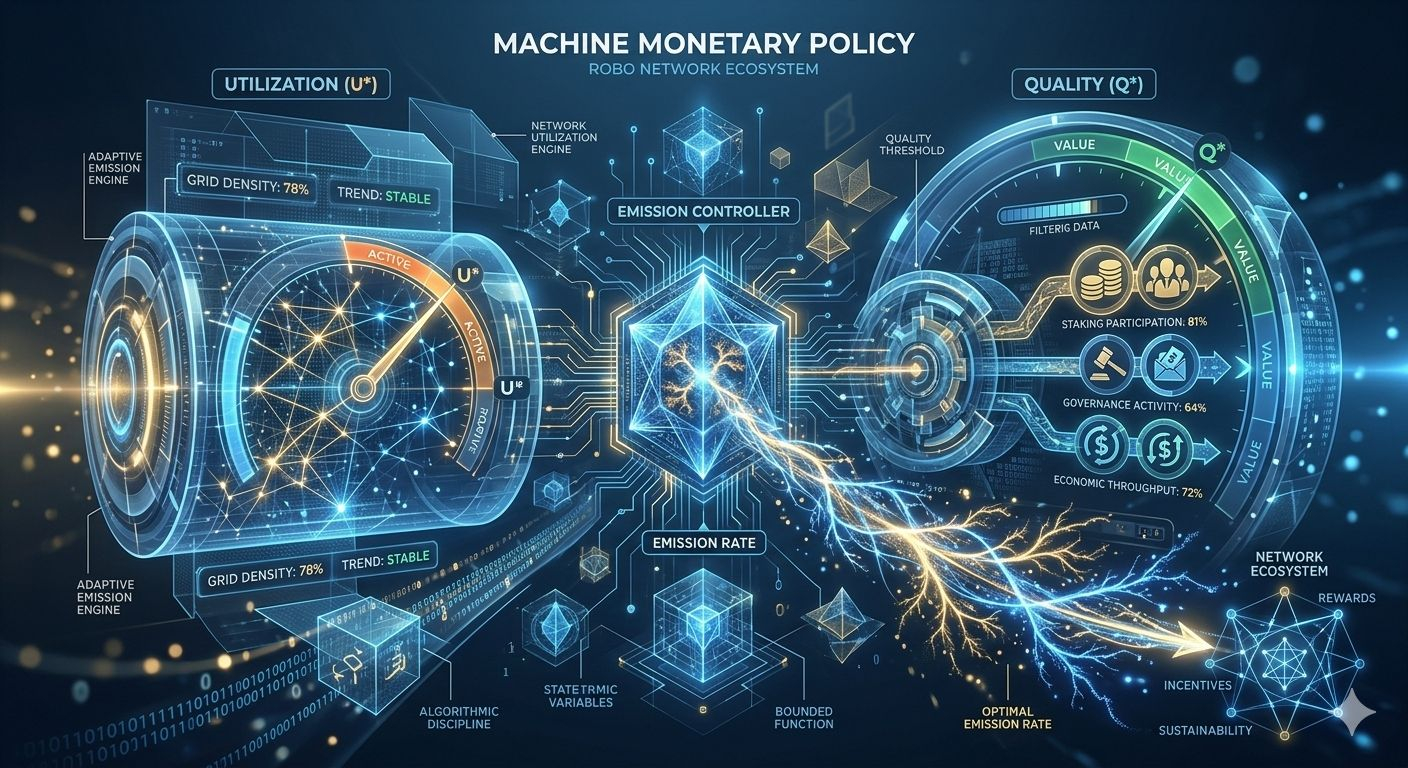
Only when both utilization and quality metrics align does the emission logic respond positively.
Then comes the most important safeguard: the Circuit Breaker, denoted as δ.
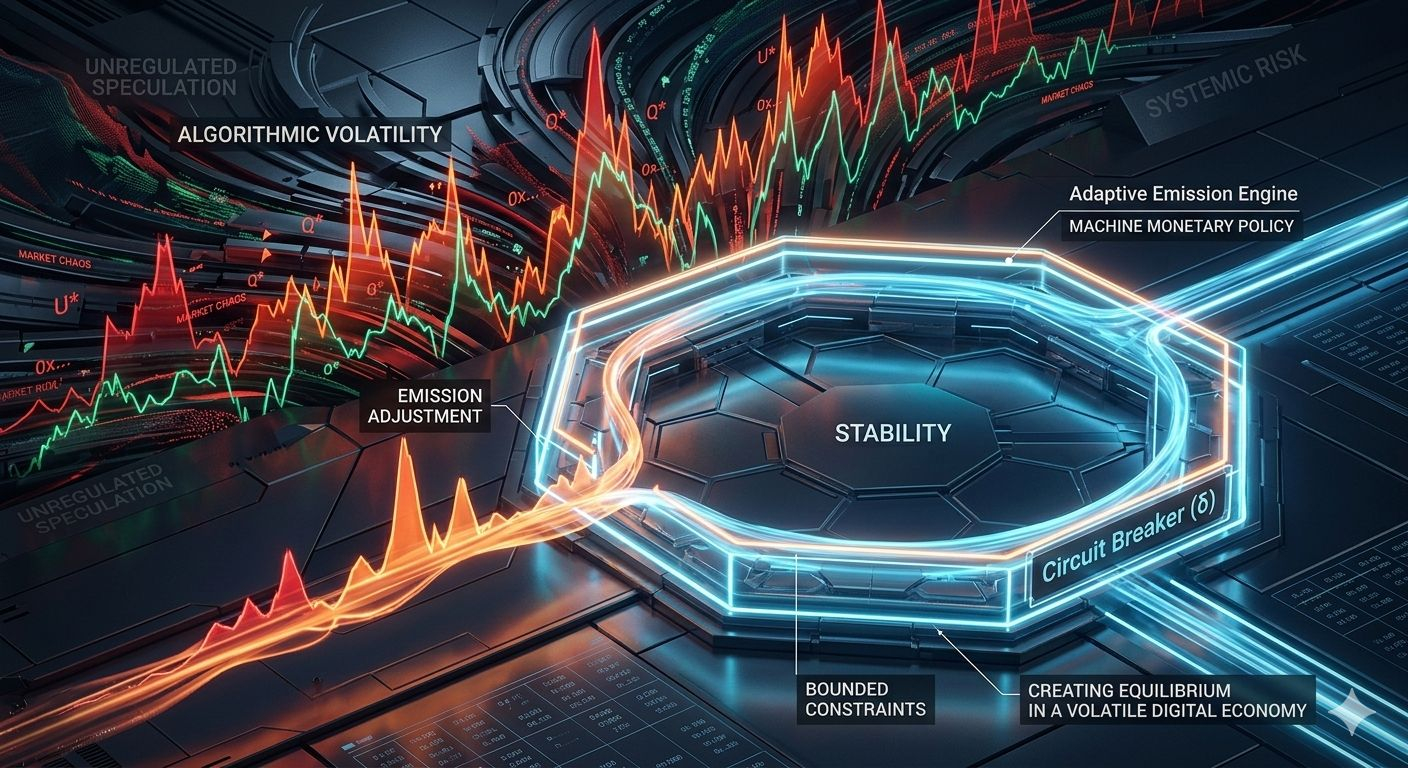
Financial systems can overreact. Algorithms can amplify volatility. The Circuit Breaker acts as a bounded constraint on emission adjustments. If metrics fluctuate too aggressively or exceed safe parameters, δ limits the magnitude of emission changes within a defined interval.
This prevents runaway inflation during speculative spikes and avoids excessive contraction during temporary slowdowns.
Together, these components create Feedback-Controlled Emissions.
From a technical perspective, this functions as a closed-loop control mechanism embedded at the protocol level. The Adaptive Emission Engine acts as the controller. Network metrics serve as state variables. The emission rate becomes the adjustable output.
Mathematically, the Emission Controller can be expressed as:
Emission Rate = f(U − U*, Q − Q*, δ)
Where f is a bounded response function that minimizes deviation from equilibrium conditions. The objective is to stabilize the system around optimal utilization while preserving long-term supply sustainability.
This is what turns ROBO into an Autonomous Economic Policy system.
Instead of relying on periodic governance votes to change inflation parameters, ROBO embeds macroeconomic logic directly into its protocol. The machine observes, calculates, and adjusts. No emotional bias. No political incentives. No delayed reactions.
It behaves like a programmable central bank, but entirely algorithmic.
The implications are significant.
In bull markets, when network activity surges above U* and passes Q*, emissions can expand in a measured way to reward contributors and sustain momentum. In weak market conditions, when utilization drops, supply growth contracts automatically, protecting holders from unnecessary dilution.
Over time, this creates supply elasticity tied directly to real demand.
From my analytical perspective, this is where ROBO separates itself conceptually.
Most projects treat tokenomics as a fundraising design problem. ROBO treats it as a control systems problem.
Static emission models assume predictable growth. Adaptive systems assume uncertainty. In volatile digital economies, uncertainty is the only constant.
The presence of the Circuit Breaker δ is particularly important to me. Algorithmic systems without constraint can destabilize quickly. By embedding bounded parameters, ROBO acknowledges that stability requires limits.
If executed properly, this model reduces reliance on governance intervention and increases predictability through transparency. Participants can understand the rules in advance. Emission is no longer arbitrary. It is conditional.
That conditionality creates discipline.
A network that does not meet its Quality Threshold does not get rewarded with expansionary supply. A network that underperforms cannot inflate its way out of weakness. Incentives are earned through measurable activity.
In the long run, Machine Monetary Policy may become standard for advanced token economies. ROBO’s Adaptive Emission Engine positions it within that evolution.
Because when supply responds intelligently to demand, tokenomics stop being marketing.
They become programmable economics.
@Fabric Foundation #ROBO $ROBO