
For years, we’ve talked about AI as a tool.
Lately, we’ve started talking about AI as an agent.
But there’s a third shift coming that almost no one is pricing in yet: machines are about to become economic participants. Not metaphors. Not helpers. Actual actors inside markets, supply chains, and digital systems.
And once I started looking at AI through that lens, I realized something unsettling — we don’t have economic infrastructure for machines. We have intelligence. We have automation. We don’t have rules.
That’s where Fabric Foundation quietly becomes one of the most important projects in this entire space.
Most people assume the next AI leap will come from better models. But historically, breakthroughs don’t scale because something is powerful — they scale because something becomes legible, governable, and interoperable. Money didn’t change the world because gold was shiny. It changed the world because we built systems around trust, identity, and exchange.
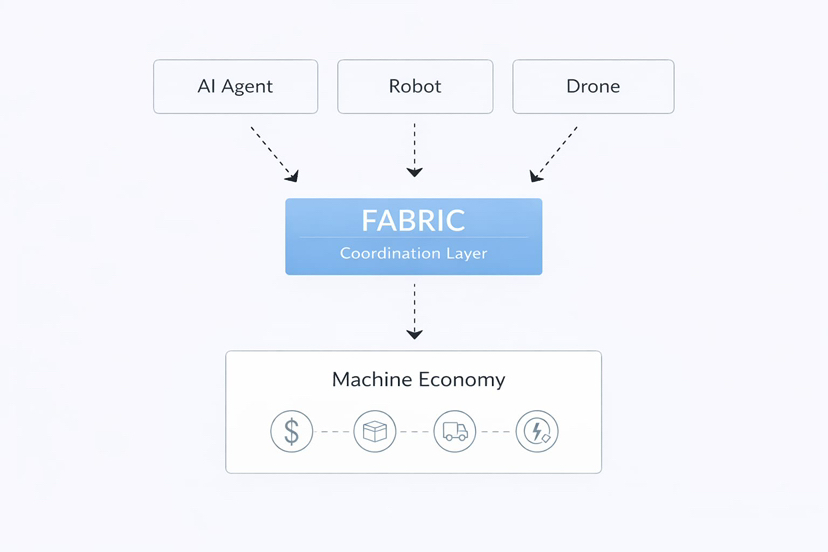
Machines are approaching the same moment.
Today, AI systems already make decisions that affect real outcomes — pricing, routing, allocation, moderation, logistics. But they do so under human umbrellas, hidden behind APIs, contracts, and institutions. That abstraction won’t hold when millions of autonomous agents start interacting directly with each other.
When machines negotiate tasks, bid for resources, coordinate logistics, or share workloads, the question stops being “Is the model accurate?” and becomes “Who is this agent, what can it do, and why should others trust it?”
Fabric approaches this problem from first principles.
Instead of building applications, Fabric focuses on machine identity, coordination, and verification — the primitives required for any real machine economy to exist. Not a centralized controller. Not a platform that owns the agents. A neutral coordination layer where machines can prove who they are, understand shared context, and act without collapsing into conflict.
This is a very different framing from typical robotics narratives. Fabric doesn’t assume a single owner, vendor, or operator. It assumes plurality — many machines, many builders, many incentives. That assumption matters because coordination systems always fail when they’re designed for ideal conditions instead of adversarial ones.
Think about scale for a moment. If even a fraction of industrial automation becomes autonomous, we’re not talking about dozens of agents — we’re talking about millions. Warehouses. Power grids. Transportation fleets. Data centers. Each optimized locally, but dependent globally.
In those systems, uncoordinated optimization creates systemic risk. One agent chasing efficiency can starve another of resources. One timing mismatch can cascade into delays, outages, or losses. This is exactly how financial flash crashes happen — not because systems are dumb, but because they move faster than coordination mechanisms.
Fabric is trying to solve that problem before it becomes visible.
What I find compelling is that Fabric doesn’t rely on intelligence to behave nicely. It assumes machines will be rational, competitive, and sometimes misaligned — and builds coordination accordingly. That’s closer to how real systems behave. It’s also why the project feels more like infrastructure than ideology.
There’s a strong connection here to the work coming from OpenMind, particularly around making robots and agents interoperable across hardware and environments. But Fabric goes a layer deeper — into how those agents coexist once interoperability is achieved.
The uncomfortable truth is this: once machines can act autonomously, governance becomes a technical problem. You can’t regulate millions of agents manually. You need embedded coordination, shared protocols, and verifiable behavior at the system level.
Fabric feels like an early attempt to encode those constraints directly into the network.
This isn’t about controlling machines. It’s about preventing emergent chaos. The same way TCP/IP didn’t control the internet but made it usable, coordination layers don’t limit intelligence — they make it scalable.
What stands out to me most is how unglamorous this work is. No flashy demos. No viral benchmarks. Just infrastructure that only becomes visible when it’s missing. That’s usually how you recognize something foundational.
If AI is entering an economic phase — not just a computational one — then Fabric isn’t optional. It’s prerequisite.
I’m curious how others see this.
Do you think machines should participate in markets directly?
And if they do, who writes the rules — humans, protocols, or something in between?
Drop your thoughts. This conversation is just getting started.