
We’ve all seen the flashy demos of general-purpose robots, but nobody is talking about the "day after" problem.
Imagine a robot makes a mistake in a public space. Not a Hollywood-style explosion, just a simple operational error. Immediately, the finger-pointing starts: Who updated the model? What dataset was used? Did anyone sign off on the safety constraints? In a closed system, you just have to "trust" the company. In a multi-vendor world, that trust doesn't scale.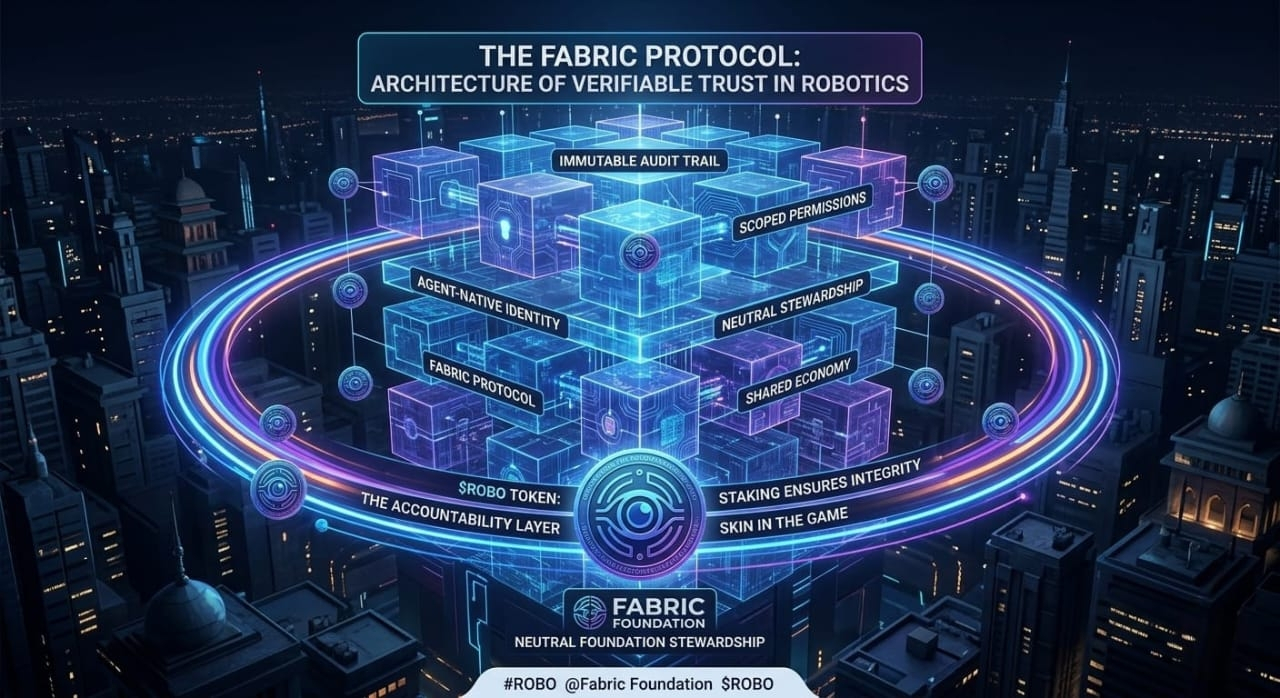
This is exactly where Fabric Protocol steps in. It’s not trying to put "robots on-chain" for the sake of a trend; it’s building the accountability backbone for the next era of automation.
In software, you can "move fast and break things." In robotics, "breaking things" involves physical mass and real-world consequences. Fabric’s ledger isn't there to control the robot's motors (latency would kill that); it’s there to serve as an immutable audit trail. * It records what was approved and who deployed it.
It provides verifiable attestations rather than private, tweakable logs.
It moves us from "Trust us, it's safe" to "Here is the proof of the process."
The "Agent-Native" approach is the real game-changer here. A robot isn't just a user account; it’s an actor that needs:
Scoped Permissions: Rights that can be revoked instantly.
Proof of Policy: Verification that the robot is actually running the mandatory safety modules.
Non-Rewriteable History: An audit trail that can’t be "cleaned up" after an accident.
If you look at the $ROBO token, don't think of it as a simple payment coin. Think of it as Skin in the Game. By tying participation to staking, Fabric creates enforceable consequences. If a party bypasses the rules or provides false attestations, there is a financial downside. It’s a bonding mechanism that ensures everyone—from developers to reviewers—actually follows the governance loop.
Robotics is too critical to be controlled by a single corporate roadmap. The Fabric Foundation exists to maintain a neutral "control plane." By keeping the focus on coordination and infrastructure rather than hardware ownership or revenue sharing, they avoid a lot of legal mess and stay focused on what matters: Standards.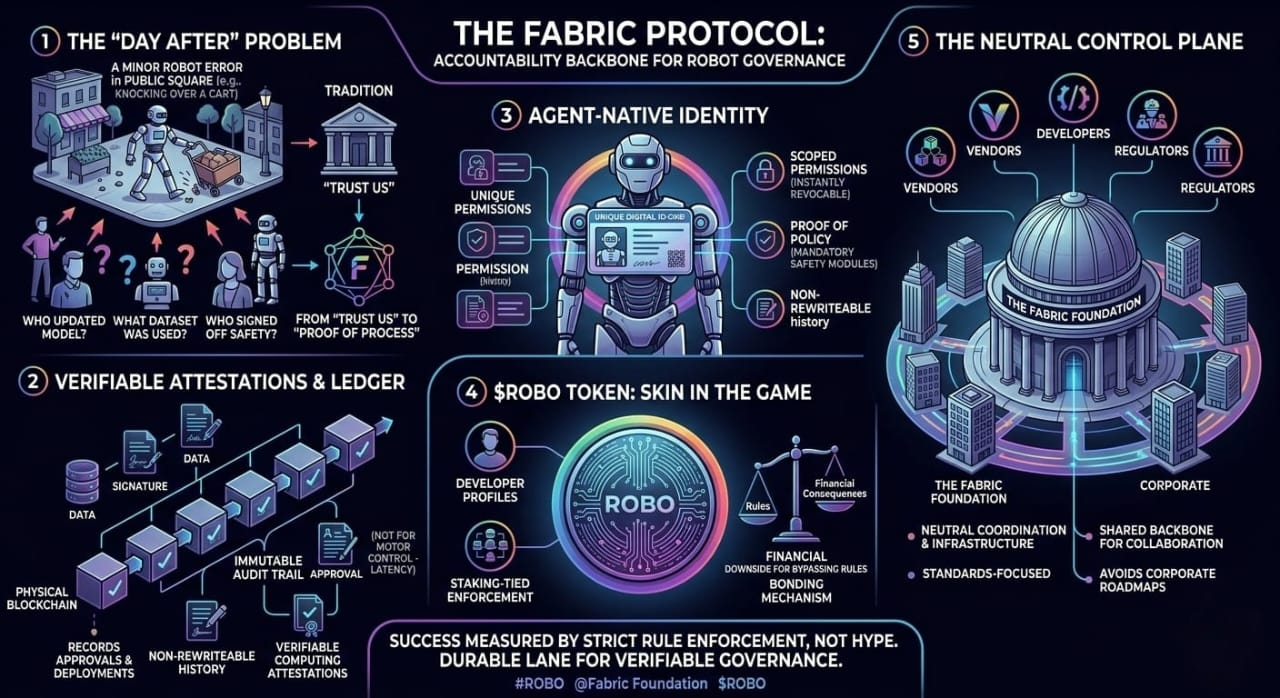
Fabric isn't just a "robot narrative." It’s a narrow, durable lane for verifiable robot governance. It’s the shared backbone that allows different organizations to collaborate on robots without needing to blindly trust one another.
The success of Fabric won't be measured by hype, but by how strictly it can enforce its governance rules when the stakes are high.
#ROBO #FabricProtocol #BinanceSquare @Fabric Foundation $ROBO