
I’ve been in crypto long enough that I don’t really react to announcements anymore. I read them, I sit with them, and I try to imagine what they’ll look like six months after the noise fades. That’s usually when you find out whether something actually mattered.
When I came across Fabric Protocol’s decision to separate validators from RPC and indexer nodes, I didn’t feel that rush people sometimes get with new infrastructure plays. What I felt was… relief. It sounded like someone finally admitting that maybe we’ve been overloading validators for years and pretending it’s fine.
I’ve seen this play out too many times. A chain launches. Everything feels smooth. The community grows. A few big DeFi apps take off or a hyped mint happens. Suddenly wallets start timing out, block explorers freeze, and Twitter fills with “the chain is down” posts. Meanwhile, the core consensus layer might actually still be running. It’s the data side — the RPC calls, the indexing, the constant requests from bots and dashboards — that’s suffocating.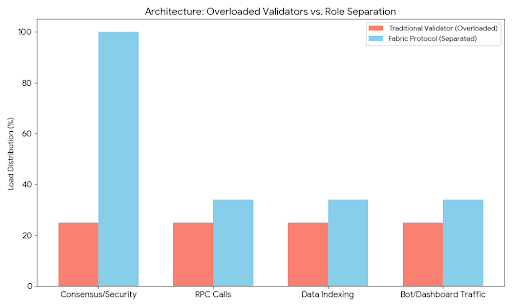
Validators were never meant to be customer support agents for the entire ecosystem. Their job is security and consensus. That’s heavy enough. Asking them to also handle massive amounts of user-facing data traffic feels like asking a pilot to also serve drinks mid-flight.
So when Fabric says, “Let validators validate, and let RPC and indexer nodes handle the data load,” it feels less like innovation and more like common sense. And sometimes common sense is the real upgrade.
I’ve noticed that most users don’t care about block times or consensus models. They care about whether their wallet loads instantly. They care about whether they can check a transaction without refreshing ten times. Those small friction points shape perception. If the experience feels smooth, people assume the chain is strong. If it feels clunky, they leave — even if the underlying tech is solid.
Separating these roles could make things more stable when activity spikes. And that’s where networks usually break. It’s not during quiet weeks. It’s when volatility hits, when bots wake up, when everyone tries to move at once. I’ve seen chains that looked unstoppable suddenly look fragile under pressure.
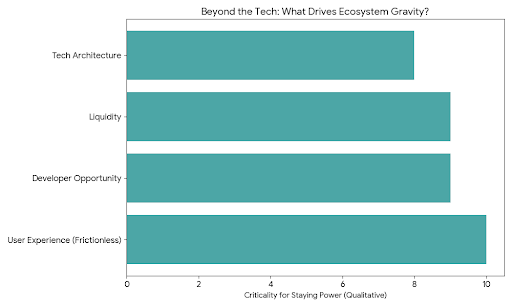
But I’ve also learned that architecture alone doesn’t build an ecosystem. Liquidity doesn’t flow just because something is well designed. Developers don’t migrate purely for cleaner node structure. There has to be gravity — users, capital, opportunity.
That’s the part I’m still thinking about. Will this structure make developers feel safer building there long term? Will infrastructure providers actually run RPC and indexer nodes in a decentralized way, or will it slowly concentrate into a few big players like we’ve seen elsewhere? I’ve watched enough cycles to know that incentives shape everything. If running these nodes isn’t sustainable, participation shrinks once token prices cool down.
What feels mature about Fabric’s approach is that it’s not chasing loud throughput headlines. It’s trying to clean up something structural. That tells me the team has probably watched the same bottlenecks I’ve watched over the years. They’ve seen validators overloaded. They’ve seen public RPC endpoints collapse under demand.
Still, I can’t help but wonder how this holds up when the spotlight moves on. Early excitement is easy. Real staying power is harder. I’ve seen technically strong projects fade simply because attention shifted somewhere shinier.
Right now, I don’t feel hyped. I feel curious. I want to see how it behaves when real users show up. I want to see if apps launch and stay. I want to see if liquidity sticks around after incentives normalize.
Maybe this separation will quietly make the network feel more reliable over time. Maybe users won’t even notice — and that might actually be a good sign. In crypto, the best infrastructure is often the kind nobody has to think about.
So I’m not leaning bullish or bearish. I’m just watching, like I usually do. The announcement is one thing. The real test is what happens when the traffic comes and the system has to carry weight.