
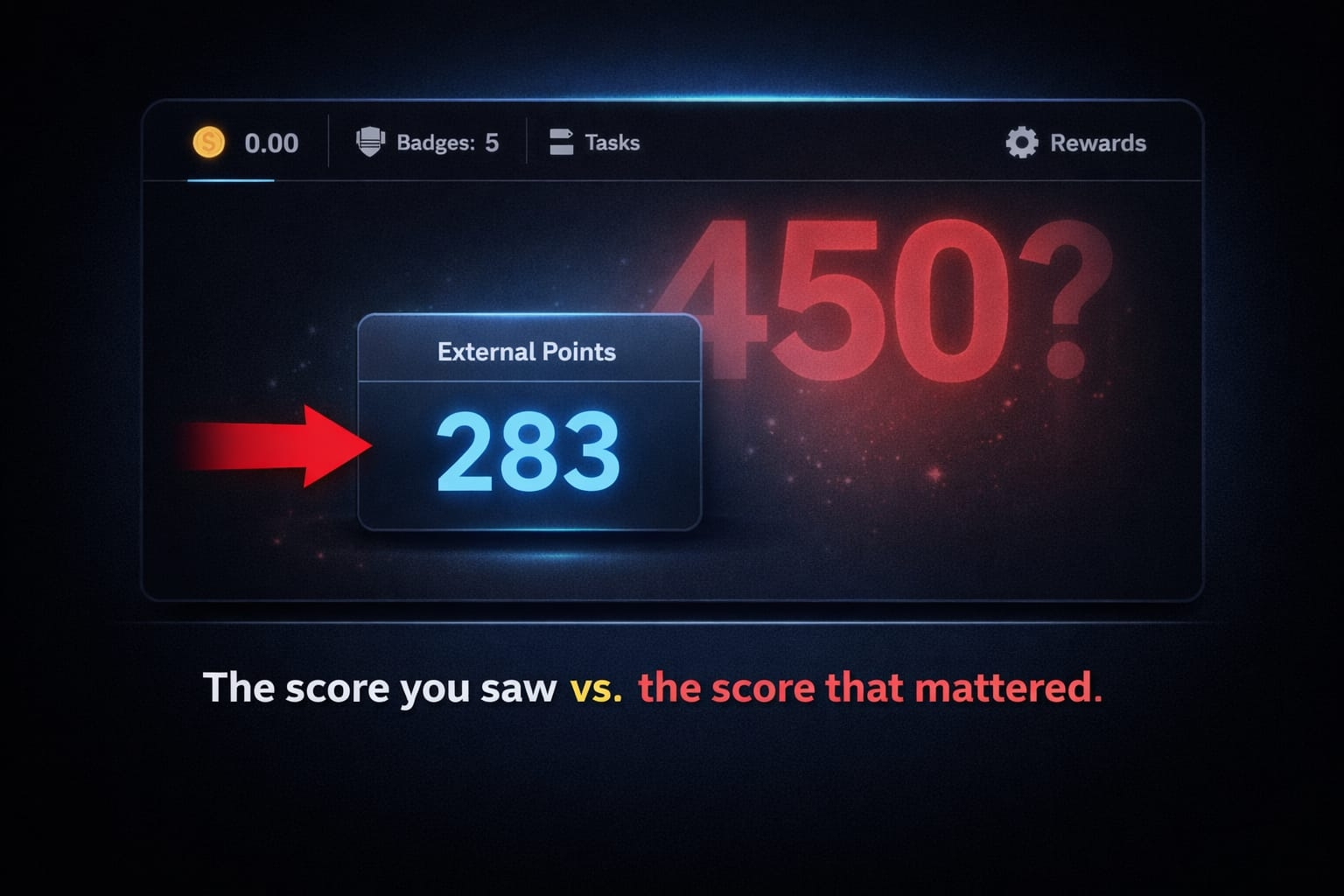
𝘐𝘧 𝘺𝘰𝘶 𝘸𝘢𝘵𝘤𝘩𝘦𝘥 𝘺𝘰𝘶𝘳 𝘥𝘢𝘴𝘩𝘣𝘰𝘢𝘳𝘥 𝘥𝘶𝘳𝘪𝘯𝘨 𝘵𝘩𝘦 𝘍𝘢𝘣𝘳𝘪𝘤 𝘍𝘰𝘶𝘯𝘥𝘢𝘵𝘪𝘰𝘯 𝘢𝘪𝘳𝘥𝘳𝘰𝘱 𝘪𝘯 𝘍𝘦𝘣𝘳𝘶𝘢𝘳𝘺 2026, 𝘐 𝘩𝘢𝘷𝘦 𝘴𝘰𝘮𝘦 𝘯𝘦𝘸𝘴 𝘧𝘰𝘳 𝘺𝘰𝘶: 𝘺𝘰𝘶 𝘸𝘦𝘳𝘦 𝘭𝘰𝘰𝘬𝘪𝘯𝘨 𝘢𝘵 𝘵𝘩𝘦 𝘸𝘳𝘰𝘯𝘨 𝘯𝘶𝘮𝘣𝘦𝘳. 𝘈𝘤𝘤𝘰𝘳𝘥𝘪𝘯𝘨 𝘵𝘰 𝘰𝘧𝘧𝘪𝘤𝘪𝘢𝘭 𝘢𝘯𝘯𝘰𝘶𝘯𝘤𝘦𝘮𝘦𝘯𝘵𝘴 𝘧𝘳𝘰𝘮 𝘵𝘩𝘦 𝘍𝘢𝘣𝘳𝘪𝘤 𝘍𝘰𝘶𝘯𝘥𝘢𝘵𝘪𝘰𝘯 𝘰𝘯 𝘟 𝘢𝘯𝘥 𝘵𝘩𝘦𝘪𝘳 𝘍𝘈𝘘, 𝘵𝘩𝘦 𝘳𝘦𝘢𝘭 𝘯𝘶𝘮𝘣𝘦𝘳 𝘵𝘩𝘢𝘵 𝘥𝘦𝘵𝘦𝘳𝘮𝘪𝘯𝘦𝘥 𝘦𝘭𝘪𝘨𝘪𝘣𝘪𝘭𝘪𝘵𝘺 𝘸𝘢𝘴𝘯'𝘵 𝘰𝘯 𝘺𝘰𝘶𝘳 𝘥𝘢𝘴𝘩𝘣𝘰𝘢𝘳𝘥 𝘢𝘵 𝘢𝘭𝘭—𝘪𝘵 𝘸𝘢𝘴 450.
 Introduction: The Dashboard That Fooled Everyone
Let me take you back to February 2026. During the February 2026 airdrop, thousands of people—over 31,000 participants to be exact were staring at their Fabric Foundation dashboards, watching their points grow. The dashboard showed something called "external application points." For many users, that number sat somewhere between 250 and 300. It looked promising. It looked like qualification was just around the corner.
But here's what most people didn't know: that dashboard number told an incomplete story. It showed one thing, but the real decision was being made somewhere else entirely. Behind the scenes, the Fabric Foundation was running a completely separate system. They called it the Internal Comprehensive Scoring System. And it had nothing to do with the pretty numbers on your dashboard.
Today, I'm going to explain exactly how that internal system worked. By the time you finish reading this, you'll understand why some people with 300 points got nothing, while others with lower dashboard scores walked away with ROBO tokens. Let's start with the most important number you've never heard of: 450.
Part 1: The Number That Actually Mattered Here's the first thing you need to understand. The dashboard showed one score. The internal system had a completely different score. And only one of them determined whether you got the airdrop.
Official announcements from the Fabric Foundation later confirmed what many suspected: to qualify for the ROBO airdrop, your internal score needed to be 450 or higher.
Let me say that again because it's important. Not 250. Not 300. 450.
Now, here's where it gets confusing. The dashboard typically showed 250 to 300 points for users who eventually qualified. But here's the catch—qualification wasn't guaranteed even if your dashboard looked good. Some people with 280 dashboard points got in. Others with 320 dashboard points were left out. Why? Because their internal score told a different story.
Think of it like this: your dashboard score was like a movie trailer. It showed you the highlights. But the internal score was the full movie. And only the people who watched the internal system knew how the story really ended.
So what went into this secret internal score? That's what we're going to unpack next.
Part 2: The Invisible Resume—Your On-Chain Identity : The internal scoring system didn't just look at whether you had a wallet. It looked at what kind of person was behind that wallet. And it did this by examining something called your "on-chain behavior."
Let me explain what that means in plain English. Every transaction you make on the blockchain leaves a trail. It's like a digital fingerprint. The Fabric Foundation didn't just check if you were active; they checked what you were active in.
Here's what they were looking for: First, they wanted to see if you had any "crypto AI-related" activity. This is important because Fabric isn't just another crypto project. It's building infrastructure for AI and robotics. They wanted people who actually cared about that space not just random crypto users chasing airdrops.
So their system scanned your wallet for interactions with specific AI protocols. If you'd been using other AI projects, trading AI-related tokens, or participating in AI-focused communities on-chain, that counted in your favor.
Second, they checked for badges. Now, I don't mean physical badges you wear. I mean digital badges from partner ecosystems like Kaito and Surf. These badges were proof that you were genuinely engaged in the AI-crypto niche. Think of them like loyalty stamps the more relevant badges you had, the more the system trusted that you were a real participant, not just a farmer.
Here's the key point: your wallet became your resume. Every interaction, every badge, every connection to the AI ecosystem was like a line on that resume. And the internal scoring system read every single line.
 Part 3: The Human Test—Off-Chain Activities That Proved You Were Real
Now, here's where things get really interesting. The internal system didn't stop at your blockchain activity. It also looked at what you did outside the chain. And this is where Fabric showed just how serious they were about separating real humans from automated bots.
Let me walk you through the three main off-chain activities that fed into your secret score.
The Robot Arena Video Evaluations - This is probably the most unique requirement I've ever seen in an airdrop.
Fabric has something called the Robot Arena. It's exactly what it sounds like a platform where users can watch and evaluate robot performances. Think of it like being a judge on a talent show, except the contestants are robots.
During the airdrop period, users were asked to submit video evaluations of robot performance. But here's the catch: it wasn't enough to just submit evaluations. The system checked for high volume and accurate ratings.
Let me translate that. You couldn't just click through quickly and submit random feedback. The system knew if you were actually watching the videos. It knew if your ratings made sense compared to what other humans were saying. If you tried to game it, the system caught you.
This was brilliant because it did something that blockchain alone can't do: it proved you were a thinking, paying-attention human being.
Active Discord Membership - Next up: Discord. And I want to be very clear about what "active" meant in this context. Simply joining the Fabric Discord server and never saying anything? That didn't count. Dropping a few random emojis once a week? Also didn't count.
The internal system tracked consistent, non-spam engagement. That means:
· Regular participation in conversations
· Meaningful contributions to discussions
· Being part of the community over time, not just during airdrop season
The system could tell the difference between someone who actually cared about robotics and AI, and someone who was just there to farm points. It was like having a very smart teacher watching a classroom... they know which students are actually paying attention.
Daily Consecutive Logins - Finally, the system tracked something simple but powerful: consistency. This wasn't about logging in once and earning a million points. It was about showing up day after day after day. The internal scoring system rewarded long-term commitment over short-term bursts of activity.
Think of it like this: if you logged in 100 times in one week and then disappeared, that looked suspicious. But if you logged in once every day for three months, that looked like genuine interest. The system wanted the second person.
Sources didn't specify exactly how many consecutive days counted but the pattern was clear: consistency over weeks mattered more than intensity over a few days.
And here's the kicker: even if you logged in every day, there was a daily point cap. You couldn't earn infinite points by staying logged in for 24 hours straight. Once you hit the daily limit, any additional activity stopped counting. This prevented people from running bots that just sat there collecting points automatically.
 Part 4: The Anti-Sybil Forensics Lab—How They Caught the Farmers
Now let me tell you about the security measures. Because Fabric didn't just build a scoring system they built a fortress around it.
Here are the specific rules that kept the airdrop fair:
The 1:1:1 Rule - Every wallet could only be linked to one X account (formerly Twitter) and one Discord account. That's it. No exceptions.
This might sound simple, but it was devastating for farmers. You see, airdrop farmers often create dozens or hundreds of fake accounts, all controlled by one person. They link each wallet to a different fake social account and try to claim multiple times.
The 1:1:1 rule made that impossible. If the system detected that one person was trying to link multiple wallets to different social accounts, it flagged them immediately. And flagging meant one thing: disqualification.
The Daily Point Cap - I mentioned this briefly, but it deserves its own section.
Every day, there was a maximum number of points you could earn. If you tried to earn more than that, the extra points were simply truncated. They disappeared. They didn't roll over to the next day. They were gone forever.
Why did they do this? Because bots don't sleep. A human might earn their daily points and stop. A bot would keep going 24/7, trying to accumulate as much as possible. The daily cap ensured that even the most sophisticated bot couldn't out-earn a consistent human.
Cross-Referencing Partner Ecosystems Finally, the system cross-referenced your wallet activity across multiple partner ecosystems. This included platforms like Kaito and Surf.
Here's why this mattered: a farmer might create a wallet, do some minimal activity on Fabric, and hope to qualify. But if that same wallet had no history on other AI-crypto platforms, that was a red flag. Real users tend to be active across multiple projects in their area of interest. Farmers tend to focus on one project at a time.
By checking your activity across the ecosystem, Fabric could tell who was genuinely interested in AI and robotics, and who was just there for the token.
 Part 5: Why All of This Matters for ROBO's Future
So now you know how the internal scoring system worked. But let me ask you the obvious question: why did they go through all this trouble?
The answer tells you everything you need to know about the Fabric Foundation and the ROBO token.
For context, Fabric Foundation isn't just running airdrops; they're building critical infrastructure for the robot economy. ROBO serves as the coordination layer for machine-to-machine payments, robot identities, and decentralized AI systems. The 450-point system wasn't just about tokens; it was about finding the right people to help govern that future.
Fabric isn't building a short-term project. They're building infrastructure for the robot economy something that could take decades to fully develop. For that kind of long-term vision, they don't need millions of random wallets. They need a committed, high-quality community of people who actually believe in the mission.
The 450-point system was designed to find those people. It filtered out:
· The farmers who just wanted tokens to sell immediately
· The bots that tried to game the system
· The casual users who showed up for a week and then disappeared
What remained was a group of people who had proven, through months of consistent activity and genuine engagement, that they cared about the future of robotics and AI.
Those are exactly the kind of people you want holding your governance tokens. Those are the people who will actually vote on proposals, contribute to discussions, and help shape the direction of the network.
So when you hear about the 450-point threshold, don't think of it as just an airdrop story. Think of it as the foundation of the Fabric community. The people who passed this test are the ones who will likely be governing the network for years to come.
 Conclusion: The Dashboard Was Just the Beginning
Let me leave you with this thought. If you watched your dashboard during the airdrop, you were seeing a shadow. The real action was happening in the internal scoring system a complex, multi-layered evaluation that looked at your on-chain history, your off-chain engagement, your consistency, and your humanity.
The 450-point threshold wasn't just a number. It was a filter. It separated the committed from the casual, the genuine from the fake, the believers from the farmers.
And now that the airdrop is over and the community is formed, those 450-point earners are the ones who will help build the robot economy. They're the early believers who proved they deserved a seat at the table.
The dashboard told an incomplete story. But the 450-point system revealed the truth. And the truth was simple: if you wanted to be part of Fabric's future, you had to earn it.
Did you qualify for the airdrop? Were you one of the 450-point earners? Let me know in the comments. I'd love to hear your story.

