
Most mornings I start by scanning validator dashboards before reading headlines. Incentives usually reveal more about a network than announcements ever do. Participation patterns, reward behavior, uptime consistency. These are the signals that tend to matter when evaluating infrastructure.
That routine has recently made me think more about a quieter problem inside the AI ecosystem: mistakes.
Not dramatic failures. The kind that make headlines. I mean the smaller, more frequent errors that appear when AI systems generate outputs that are plausible but not entirely reliable. Anyone who uses AI tools regularly has experienced it. A confident answer that turns out to be slightly wrong. A generated dataset with subtle inaccuracies. A reasoning chain that appears coherent but doesn’t fully hold under inspection.
The issue isn’t capability. Modern models are increasingly powerful. The issue is verification.
Most AI systems today still operate on a trust based model. The system produces an answer, and users either accept it or manually check it. As AI moves deeper into operational environments automation systems, financial tools, robotics coordination, enterprise workflows that assumption becomes more fragile.
This is where @Mira - Trust Layer of AI design direction becomes interesting.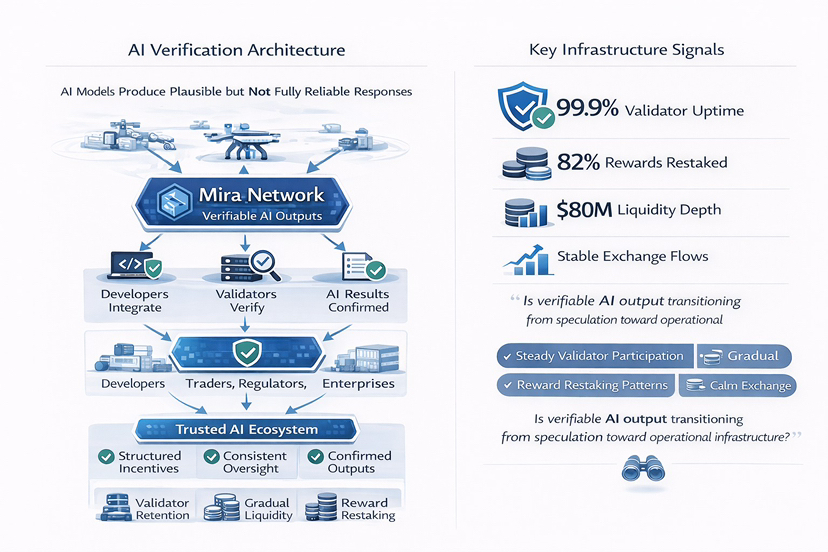
Rather than attempting to compete in the race for better models, Mira appears to focus on a verification layer for AI outputs. The idea is structurally simple: instead of treating AI responses as inherently trustworthy, the network introduces mechanisms for independent verification through distributed participants.
It is not a dramatic shift on the surface. But it changes an important assumption about how AI systems operate. Outputs become something that can be validated rather than simply accepted.
What makes this direction worth watching is not the concept alone. It is the behavior beginning to form around it.
In infrastructure networks, product design tends to reveal itself through participation patterns. Tooling evolves. APIs stabilize. Verification requests become routine rather than occasional.
The early signs around Mira seem to follow that pattern. Developer activity appears oriented toward integrating verification into data pipelines and AI-assisted systems. Validator participation remains steady across reward cycles. Participants responsible for verifying outputs maintain consistent uptime rather than reacting purely to short-term incentive spikes.
None of these signals are dramatic individually. But infrastructure rarely announces itself loudly.
The more interesting shift appears in how incentives shape behavior.
Verification networks require participants who are motivated to check work carefully rather than simply maximize throughput.
Actors focused purely on short-term extraction tend to move quickly when reward structures fluctuate. Infrastructure participants behave differently. They prioritize stability because external systems begin depending on the services they provide.
Validator participation is often the first place this difference becomes visible. Networks that rely on verification infrastructure typically show steady validator retention rather than rapid rotation. Operators invest in reliability. Uptime becomes a priority. Reputation becomes meaningful.
Liquidity patterns can offer another window into network health.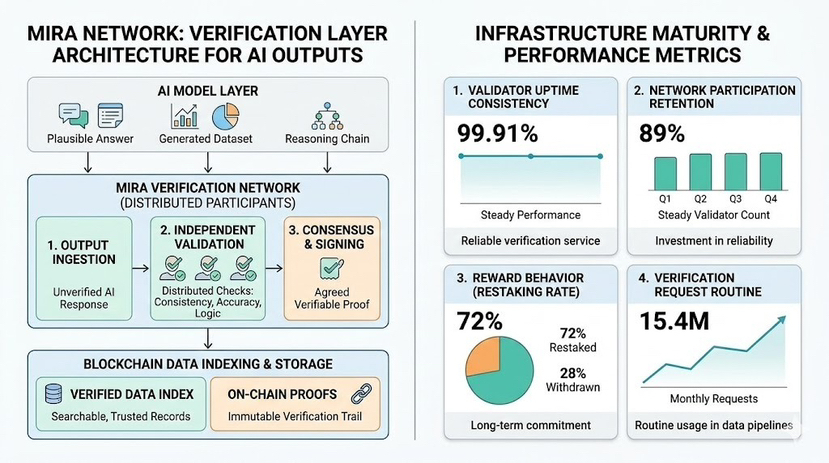
Speculative environments tend to produce fast liquidity cycles. Capital flows in during narrative peaks and exits just as quickly. Infrastructure adoption often produces slower patterns. Liquidity pools deepen gradually. Participants restake rewards rather than immediately withdrawing them. Exchange flows become less reactive to narrative cycles.
These are not guarantees of long-term success. But they often indicate that a network is beginning to move from experimentation toward operational relevance.
From a long-term capital perspective, this distinction matters.
Infrastructure networks tend to attract a different type of participant over time. Validators behave more like service providers than traders. Liquidity providers adopt longer time horizons. Developers integrate tools because they reduce operational uncertainty rather than because they align with current narratives.
If #Mira verification layer becomes embedded within AI workflows, its importance may become less visible over time.
That is often how infrastructure evolves.
The most important systems rarely remain visible once they mature. Domain name systems. Payment settlement layers. At maturity, the infrastructure disappears into the background because it simply works.
The same pattern could eventually apply to AI verification.
As AI systems begin operating in environments where mistakes carry economic consequences, verification may become a routine requirement rather than a feature. Developers may treat output validation the same way they treat logging, authentication, or database replication today.
At that point the network providing those services would look less like an experimental crypto project and more like a coordination layer embedded within broader digital systems.
Of course, several uncertainties remain.
AI adoption continues to evolve quickly, and verification layers will only matter if AI outputs become integrated into decision-making environments where errors carry real costs. Enterprises may prefer centralized verification systems. Regulatory frameworks may shape how verification networks operate.
Infrastructure projects often take longer to mature than markets initially expect.
AI systems are increasingly capable. They generate information, coordinate actions, and influence decisions. Yet the mechanisms responsible for verifying those outputs remain underdeveloped.
Mira appears to be exploring that gap.
From an analytical perspective, the most important signals will not come from announcements or narratives. They will appear in participation patterns. Validator retention.
The quieter signals.
Because infrastructure usually reveals itself gradually, through behavior that becomes routine long before it becomes widely recognized.
And if AI verification eventually becomes a background service rather than a headline feature, networks focused on that layer may end up looking less like speculation and more like something closer to digital infrastructure.
The question, as always, is whether those behavioral signals persist long enough to become durable.
#MarketPullback #TRUMP #BTC #Ethereum

