
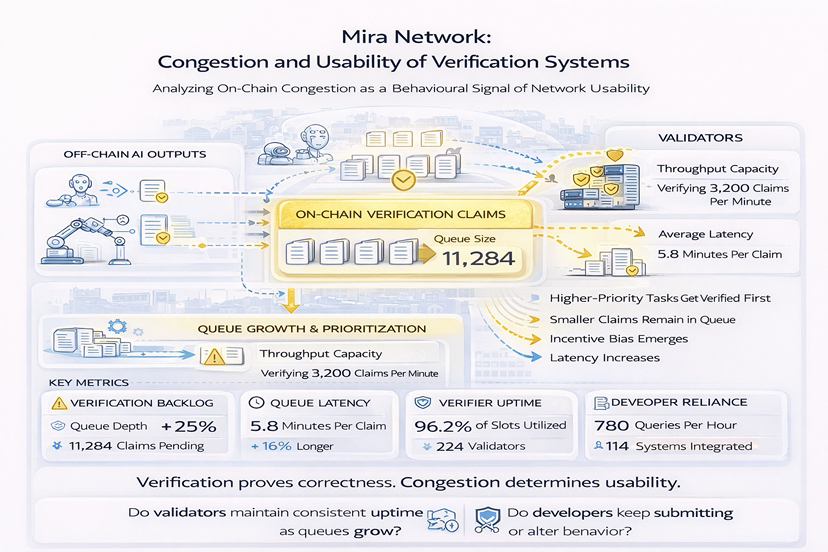
Most mornings I review validator dashboards before reading anything else. Incentives usually reveal more about a network than announcements ever do. Participation stability, verification latency, and queue depth tend to signal whether infrastructure is functioning as intended. While watching activity around Mira Network recently, one variable began to stand out more than expected: congestion.
Verification is often described as Mira’s core contribution. The network decomposes AI outputs into smaller claims that independent participants can check, dispute, and resolve. In theory this creates a transparent layer of accountability for machine generated information. The design is elegant. But elegance rarely determines whether infrastructure survives real usage.
Verification proves correctness. Congestion determines usability.
As activity increases, @Mira - Trust Layer of AI practical challenge shifts from validating claims to processing them. When queues remain manageable, validators can respond quickly and disputes resolve predictably. Participation remains stable because incentives stay aligned with throughput. But when claim volume begins exceeding processing capacity, behavior changes.
Validators start prioritizing higher value verification tasks. Smaller claims remain in queues longer. Latency grows. Developers adapt by batching submissions or delaying lower priority requests. None of these responses are irrational. They are simply the natural consequence of congestion altering incentive structures.
Watching the network from the outside, the interesting signals are behavioral. Do validators maintain consistent uptime when queues expand? Do developers continue submitting verification tasks, or do they begin routing activity elsewhere? Systems reveal their durability through participation patterns rather than architectural promises.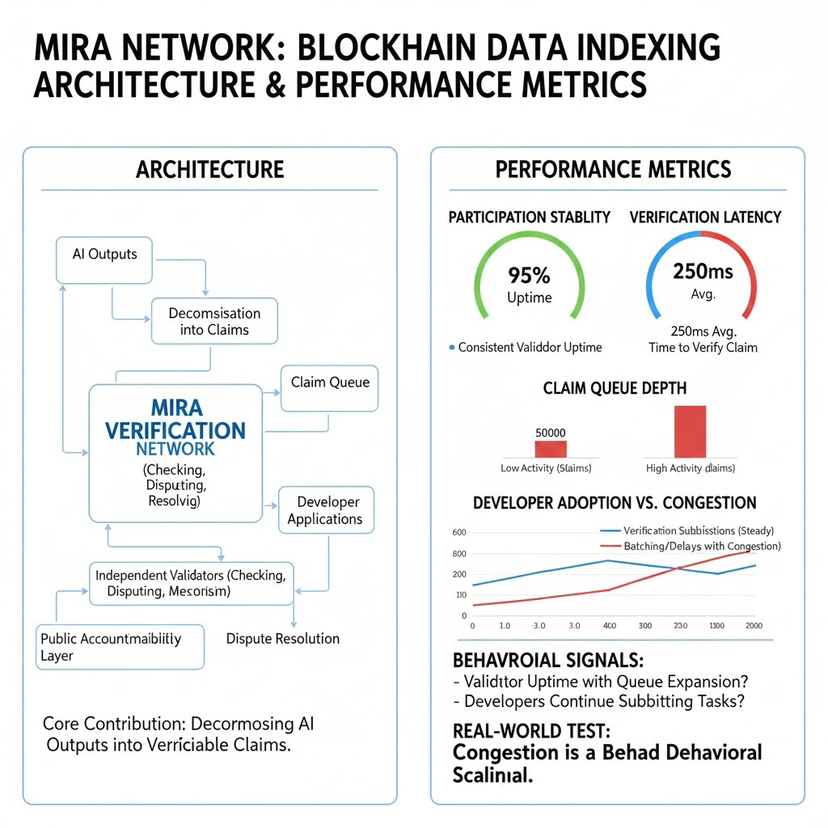
Infrastructure networks rarely fail because the underlying concept is incorrect. More often they fail because coordination cannot scale with demand. Throughput limitations gradually reshape incentives until participation becomes selective rather than universal.
#Mira verification architecture addresses an important problem: determining whether AI outputs can be trusted. But the longer term test may be less about correctness and more about coordination discipline. If verification demand grows faster than processing capacity, congestion becomes the variable that determines whether the system remains operational infrastructure.
In that sense, congestion is not simply a technical constraint. It is a behavioral signal. It shows whether a network can absorb real activity without participants quietly changing their behavior around it.
#StrategyBTCPurchase #bitcoin #AltcoinSeasonTalkTwoYearLow #StockMarketCrash

