
When I first started reading about Mira Network, I expected to be interested mainly in the technology behind it because most conversations around artificial intelligence and blockchain usually focus on the technical breakthroughs, the speed of systems, or the capabilities of new protocols, but something else caught my attention before any of that because I noticed that the team behind Mira had already created something called the Mira Foundation, and that small detail made me pause and think much more deeply about what they are actually trying to build and how they see the future of their network unfolding over time.
I’m used to seeing many new projects appear in the technology space, especially in the AI and crypto world where teams often focus heavily on launching a protocol quickly and maintaining as much control as possible over it in the early stages, but what surprised me about Mira Network is that they decided to establish a foundation relatively early and fund it with around ten million dollars, and that kind of decision doesn’t just happen randomly because it usually reflects a deeper mindset from the builders about the role their technology could play in the future.
When a team creates a foundation connected to a protocol, it often signals that they are thinking about the long-term life of the network rather than only focusing on the initial launch or the first wave of attention that new technologies often receive, because a foundation typically exists to support the ecosystem itself rather than the original company or group that built the technology in the first place, and that shift in structure quietly changes the direction of how a project might evolve over time.
As I looked more closely at this decision, I realized that what they’re doing suggests something important about their philosophy because instead of holding on tightly to every part of the ecosystem they created, they are setting up a structure that can eventually support developers, researchers, and contributors who were not part of the original team, and that approach often helps a network grow in ways that a single group of builders could never achieve on their own.
In the world of technology, especially when artificial intelligence systems are becoming more powerful and more integrated into everyday tools, there is a growing conversation about trust and governance because people are starting to realize that the systems shaping information and decision-making cannot simply remain under the control of one small group forever, and that is why the idea of a foundation supporting a broader ecosystem becomes such an interesting signal when it appears early in the life of a project.
The Mira Foundation itself appears to be designed as a structure that can help guide and support the long-term development of the Mira ecosystem, and the fact that it was funded with roughly ten million dollars shows that the builders are willing to commit real resources to that vision rather than simply describing it as an idea or future possibility, because funding a foundation means they are preparing for years of work, research, and experimentation from people who may eventually expand the network far beyond its original boundaries.
When I think about why this matters, I realize that protocols rarely become meaningful infrastructure if they are only maintained by their original creators, because the most influential technological systems usually grow when independent developers begin exploring them, researchers start testing new possibilities, and communities form around the shared idea that the technology can serve a broader purpose than the original launch ever imagined.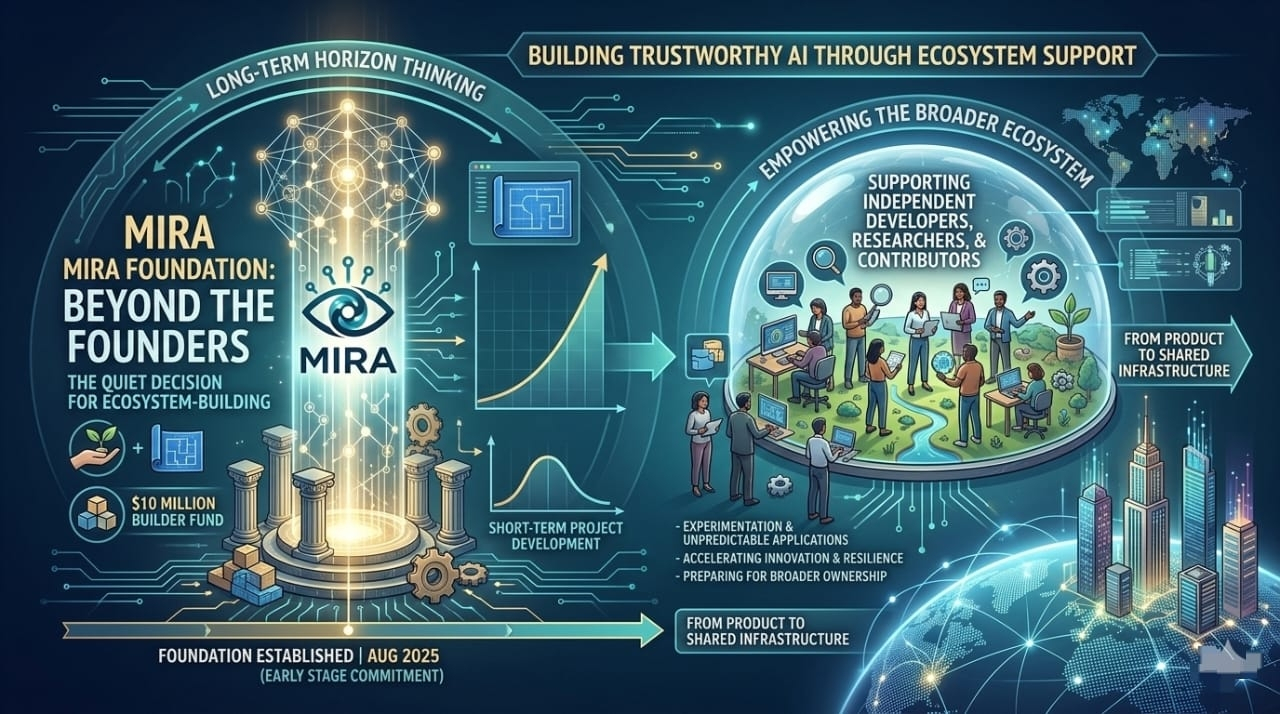
That is also why the Builder Fund connected to the foundation feels like an important piece of the overall structure, because supporting builders means encouraging experimentation and giving developers the ability to explore new applications that the initial team might never have predicted, and ecosystems often become powerful precisely because different people approach the same technology from completely different perspectives.
When developers begin to interact with a protocol in their own way, they often discover new use cases, new methods of improving the system, and sometimes even entirely new industries that can emerge around the technology, and that kind of organic growth is very difficult to create if the project remains tightly controlled by a small central group that must approve every idea or direction.
Another detail that made me think more deeply about Mira Network is the timing of the foundation itself because it was established in August 2025, and that timing suggests the builders were already thinking about the long-term structure of the ecosystem at a stage when many projects are still focused primarily on development and early adoption, which makes the decision feel less like a reaction to success and more like part of the original design philosophy behind the network.
I’m often interested in the small structural choices that teams make because they sometimes reveal more about the future of a project than the marketing or the technical documents that accompany it, and creating a foundation early suggests that the builders might already be imagining a future where Mira becomes part of the underlying infrastructure supporting trustworthy artificial intelligence systems.
Artificial intelligence is becoming deeply integrated into research, analysis, and everyday digital tools, but one of the biggest challenges surrounding these systems is the issue of trust because AI models can generate large amounts of information quickly while still being capable of producing mistakes, biases, or conclusions that are difficult to verify, and that growing trust problem is exactly the kind of challenge that networks like Mira appear to be trying to address.
If artificial intelligence continues to expand into areas such as decision-making, research analysis, and automated information systems, then society will likely need new forms of infrastructure that can help verify, validate, and organize the outputs of those systems, and that possibility is part of what makes the long-term vision of Mira Network interesting to think about.
When I step back and look at the entire structure being built around the protocol, including the foundation, the builder support programs, and the early investment into ecosystem growth, it starts to feel less like a short-term project and more like something designed with patience and long-term development in mind, because building infrastructure often requires years of gradual expansion before the true impact of the technology becomes visible.
The presence of a foundation also changes the way people might perceive the project because it suggests that the network is meant to exist independently from the original builders over time, which can help create confidence among developers and researchers who may want to contribute their own work to the ecosystem without feeling that they are simply helping to strengthen a company that controls everything.
Of course, creating a foundation does not automatically guarantee success, because many factors still influence whether a technological ecosystem can grow and remain relevant over time, including developer interest, real-world use cases, and the ability of the protocol to solve meaningful problems that people genuinely care about.
However, the existence of a foundation often provides a stable structure that allows experimentation to continue even when the original development team shifts its focus or evolves into something different, and that kind of resilience can become important when technologies pass through multiple phases of growth and change.
Another interesting aspect of this structure is how it could influence the way developers and researchers interact with the Mira ecosystem in the future, because when a project openly supports independent builders, it creates an environment where people feel encouraged to test ideas, develop tools, and explore possibilities that might eventually expand the network into directions that were never part of the initial roadmap.
Sometimes the most powerful ecosystems are not the ones that start with the most attention or excitement, but the ones that quietly build a foundation strong enough to support years of experimentation and development from many different contributors around the world.
As I think about Mira Network from that perspective, the technology itself becomes only one part of a larger story because the decisions around governance, funding, and ecosystem structure often shape the long-term destiny of a protocol just as much as the algorithms or systems that power it.
It is still early in the life of Mira Network, and like many emerging technologies it will face challenges, uncertainty, and the unpredictable nature of innovation, but the presence of the Mira Foundation and the resources committed to it suggest that the builders are preparing for a future where the network could evolve gradually rather than chasing short bursts of attention.
In many ways, the quiet creation of a foundation might be one of the most meaningful signals about how the team sees the future of what they are building, because it shows a willingness to think beyond the original creators and imagine a network that could eventually belong to a much broader community of developers, researchers, and contributors.
When I look at it from that angle, Mira Network feels less like a project designed for a single moment and more like an early attempt to build part of the infrastructure that could support trustworthy artificial intelligence systems in the years ahead, and sometimes the most important decisions in technology are not the ones that create immediate excitement but the ones that quietly prepare a system to grow long after the original builders step back.
#Mira @Mira - Trust Layer of AI $MIRA
