
 When I first started exploring blockchain, the one idea everyone kept repeating was transparency. Everything on-chain, visible to everyone, forever. At first that sounded like the perfect system — trust without intermediaries.
But the more time I spent researching the space, the more I realized something important: total transparency isn’t always practical.
Businesses, institutions, and even individuals don’t always want their financial activity exposed to the entire internet. Imagine a company negotiating contracts while every payment, salary, and supplier transaction is publicly visible. In many real-world scenarios, that level of openness becomes a disadvantage rather than a strength.
This is where Midnight Network started to catch my attention.
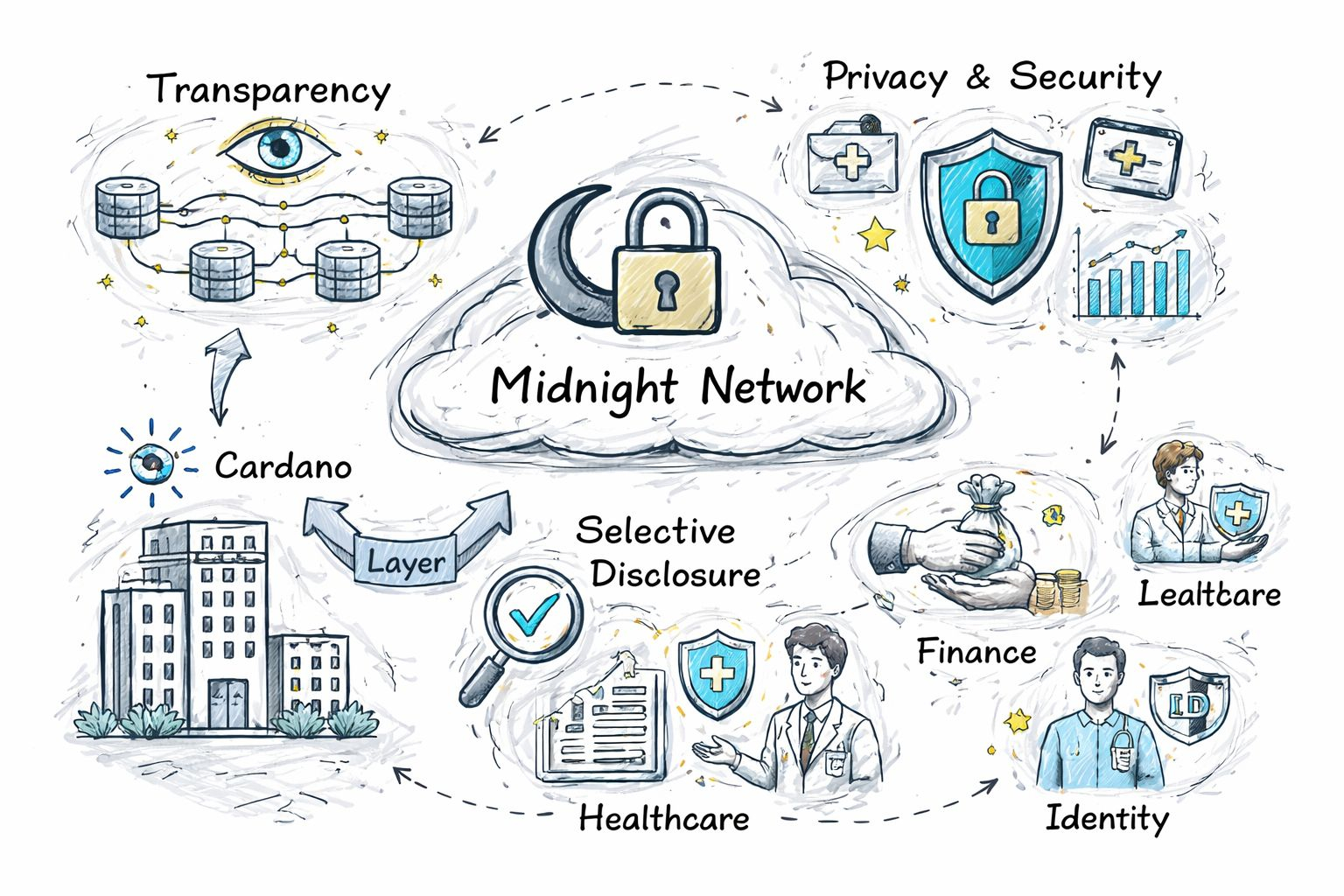
Midnight is designed as a privacy-focused blockchain that allows developers to build decentralized applications while protecting sensitive data. Instead of forcing everything to be public, it gives users the ability to keep certain information confidential while still proving that the transaction or computation is valid.
In simple terms, Midnight tries to balance two things that usually conflict in blockchain: privacy and verifiability.
One of the most interesting aspects of Midnight is its connection to Cardano. Rather than replacing existing blockchains, it acts as a complementary layer. Developers can build applications that interact with Cardano while using Midnight for privacy-preserving smart contracts.
This approach opens the door to many real-world use cases. Financial services could process transactions without revealing sensitive details. Healthcare applications could store patient data securely while still verifying authenticity. Even identity systems could allow users to prove who they are without exposing all their personal information.
Another concept Midnight introduces is the idea of selective disclosure. Instead of revealing everything, users can prove specific facts about their data. For example, proving they meet certain requirements without exposing the underlying information itself.
In a world where data has become one of the most valuable resources, this model starts to make a lot of sense.
The blockchain industry spent years focusing on transparency as the ultimate solution. Midnight suggests a more balanced future — one where privacy is not the opposite of trust, but a necessary part of it.
And if blockchain is going to power real economies instead of just crypto trading, that balance may turn out to be essential.