
Most blockchains use a single token for everything.
On Ethereum, ETH pays for gas.
On Solana, SOL does the same.
@MidnightNetwork takes a different approach.
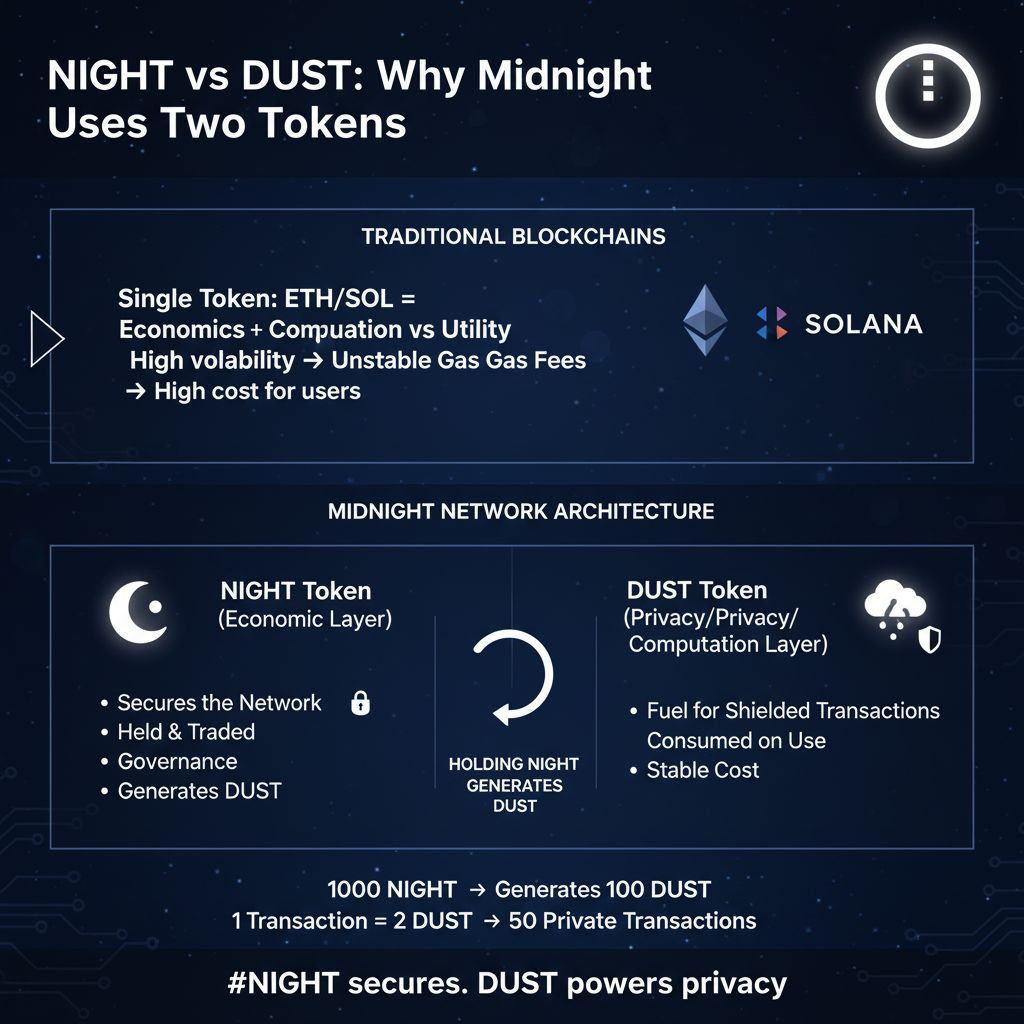
Instead of one token handling both economics and computation, Midnight separates the system into two layers: $NIGHT and DUST. This design is meant to support privacy focused applications without breaking the economic model of the network.
The real problem: speculation vs utility
Most people assume gas tokens exist purely for paying transaction fees. In reality, they also become speculative assets. When price volatility hits, it affects the cost of using the network itself.
We’ve seen this many times:
ETH gas spikes during bull markets
small DeFi users get priced out
applications become harder to use precisely when demand increases
The root issue is simple. The same token is trying to serve two completely different roles:
A speculative store of value
A stable resource for computation
How the NIGHT–DUST model works
In Midnight’s architecture, NIGHT represents economic ownership of the network.
It’s the token people hold, trade, and use for governance.
But private computation doesn’t consume NIGHT directly.
Instead, holding NIGHT generates DUST, which is used as the fuel for shielded transactions.
Think of it like this:
NIGHT → economic layer
DUST → privacy computation layer
DUST is non transferable and gets consumed when private transactions are executed.
So speculation happens in one layer, while computation happens in another.
That separation is the core idea.
A simple example:
Imagine a user holds 1,000 NIGHT. Over time, that balance generates 100 units of DUST.
Now the user wants to run private transactions. Each transaction costs 2 DUST. So their 100 DUST allows them to perform 50 private transactions. Notice what’s happening here.
The user doesn’t need to constantly buy tokens from the market to run privacy features. They simply hold the asset that secures the network, and that ownership produces the fuel needed for private computation.
This changes the incentive structure.
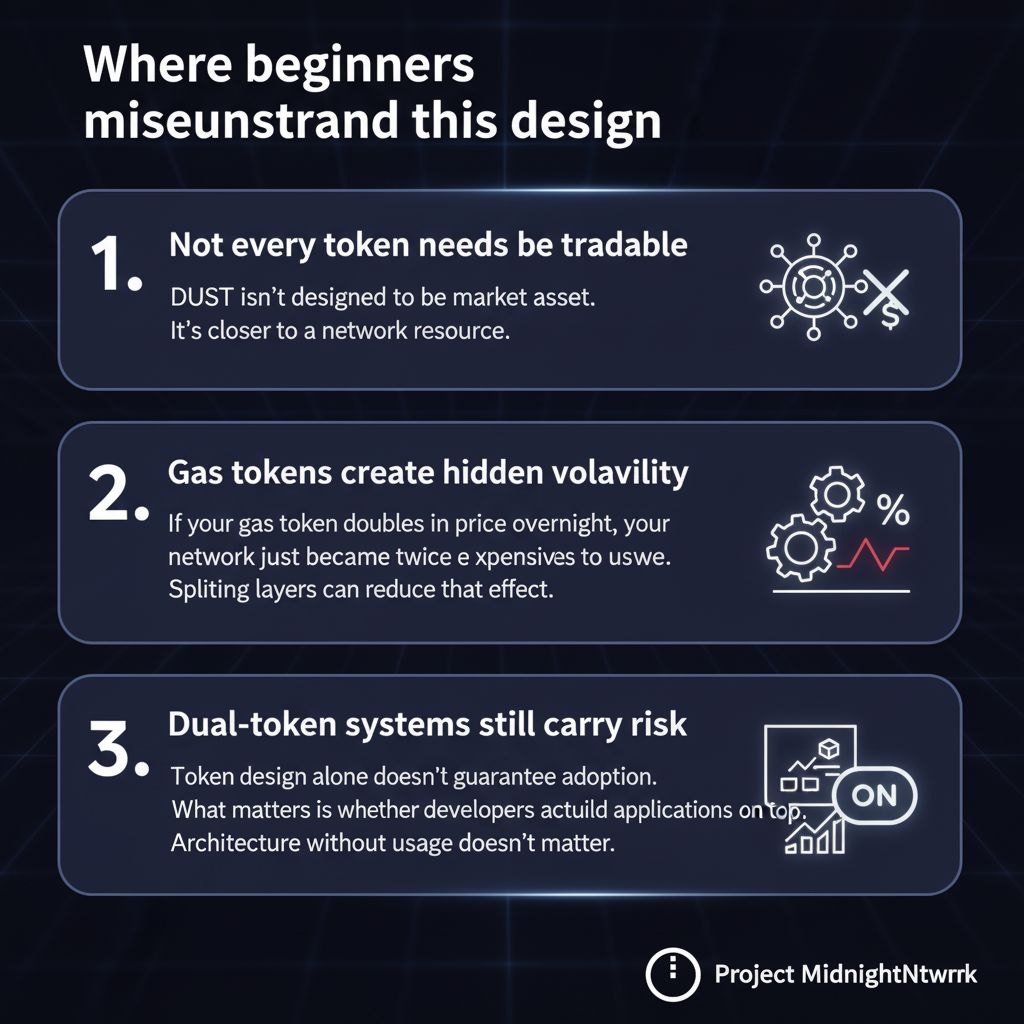
Where beginners misunderstand this design
When people see a dual-token system, they often assume it’s unnecessary complexity. Sometimes that’s true.
But beginners also miss a few key points:
1. Not every token needs to be tradable
2. Gas tokens create hidden volatility
3. Dual-token systems still carry risk
By doing this, Midnight aims to keep the cost of private computation more stable, which could enable applications like private DeFi, confidential transactions, and identity based systems.
In short:
#night secures the network.
DUST powers its privacy.