
While the coffee was still too hot and the CreatorPad tab open on my second monitor, a fresh transaction hit the Midnight Explorer at block 628673 — hash 0xcc2ea5da89d3a54233921bc5b82e2c7d366f5b9f42a894d0662ee3f2e86de0dc, just seconds old.
Nothing shielded. Just the Midnight network doing its quiet public work in preprod.
That ordinary tx is exactly why developers are poking around privacy-first blockchain ecosystems right now. The Midnight network ($NIGHT , #night @MidnightNetwork ) sells selective disclosure and zk-proofs that let you hide only what matters, and the on-chain behavior I saw today proves the base layer is already stable enough for real testing. Devs aren’t chasing total anonymity anymore; they want rational privacy they can actually ship.
I spent the early hours trying to spin up a tiny Compact contract during the task — a simple escrow that should keep bid details private. The code felt shockingly normal, almost like TypeScript with superpowers. Deployed in one go. Public state updated instantly.
the gears that actually attract builders
Three quiet gears clicked into place while I watched that recent tx settle. First, $NIGHT holdings quietly mint DUST over time — the resource that actually pays for execution. Second, DUST unlocks the shielded zk layer exactly when you need it. Third, Compact language removes the usual proof-writing pain. The model is clean: build in public by default, flip to private with one burn. No extra gas wars, no fee volatility.
That structure is the real draw for developers tired of either fully transparent chains or the opaque ones that scare regulators. Two market parallels hit me immediately. Look at how zkSync devs flocked once the compiler felt familiar; same with Polygon’s early zkEVM pilots. Midnight is doing the same thing but with built-in compliance rails visible by design. The recent block activity shows the public backbone is already humming — devs can test today without waiting for mainnet.
The on-chain behavior reinforces it. Every regular call (like the one from minutes ago) anchors the network for validators and auditors. Shielded state only appears after the DUST step. It’s not hidden; it’s intentional.
honestly the part that still bugs me
Wait — actually the friction still sat with me after I closed the terminal. The privacy-first promise pulls developers in because Compact makes zk accessible for the first time. You write normal logic, the proofs happen under the hood. Yet to move beyond demo mode, you need that DUST generated from NIGHT holdings. My test contract stayed fully transparent until I committed tokens.
I caught myself rethinking the “for builders” narrative while staring at the explorer. The stack is genuinely dev-friendly — selective disclosure via Kachina, predictable costs, Cardano interoperability already live. But the entry point quietly favors those who already hold or stake NIGHT. It’s not gatekeeping by accident; it’s the flywheel doing its job.
Skepticism crept in softly. Will solo devs or small teams really explore shielded dApps at scale, or will we see the usual consolidation where bigger holders test first? The recent public tx activity proves the network is ready, yet the privacy layer remains one step behind the capital commitment.
11:12 PM and this finally clicked
Late-night thoughts like this one tend to circle back to the same spot. Midnight network isn’t trying to be the next dark pool chain. It’s building the place where developers can finally ship privacy that regulators can audit and users can trust. That March 14 tx I watched land — ordinary as it was — reminded me the public layer is what makes the private experiments possible.
The forward motion feels steady. Preprod is stable, federated nodes are coming, and the Compact SDK is already letting teams prototype real use cases. I keep wondering how the DUST economy will evolve once more shielded contracts go live — will automatic generation from NIGHT holdings lower the barrier enough for independent builders, or will the ecosystem tilt toward teams with existing positions first?
The zk proofs and rational design remove the old cryptographic intimidation. That part feels honestly democratizing. Yet the mechanics upstream still shape who gets to play earliest.
I left the explorer open with the transaction hash still highlighted, the numbers ticking forward.
What does the first production shielded dApp from a developer who started with zero NIGHT actually look like on mainnet?While the coffee was still too hot and the CreatorPad tab open on my second monitor, a fresh transaction hit the Midnight Explorer at block 628673 — hash 0xcc2ea5da89d3a54233921bc5b82e2c7d366f5b9f42a894d0662ee3f2e86de0dc, just seconds old, verifiable right now at https://www.midnightexplorer.com/tx/0xcc2ea5da89d3a54233921bc5b82e2c7d366f5b9f42a894d0662ee3f2e86de0dc. Regular call, protocol v21000, 6698 bytes. Nothing shielded. Just the Midnight network doing its quiet public work in preprod.
That ordinary tx is exactly why developers are poking around privacy-first blockchain ecosystems right now. The Midnight network sells selective disclosure and zk-proofs that let you hide only what matters, and the on-chain behavior I saw today proves the base layer is already stable enough for real testing. Devs aren’t chasing total anonymity anymore; they want rational privacy they can actually ship.
I spent the early hours trying to spin up a tiny Compact contract during the task — a simple escrow that should keep bid details private. The code felt shockingly normal, almost like TypeScript with superpowers. Deployed in one go. Public state updated instantly.
the gears that actually attract builders
Three quiet gears clicked into place while I watched that recent tx settle. First, NIGHT holdings quietly mint DUST over time — the resource that actually pays for execution. Second, DUST unlocks the shielded zk layer exactly when you need it. Third, Compact language removes the usual proof-writing pain. The model is clean: build in public by default, flip to private with one burn. No extra gas wars, no fee volatility.
That structure is the real draw for developers tired of either fully transparent chains or the opaque ones that scare regulators. Two market parallels hit me immediately. Look at how zkSync devs flocked once the compiler felt familiar; same with Polygon’s early zkEVM pilots. Midnight is doing the same thing but with built-in compliance rails visible by design. The recent block activity shows the public backbone is already humming — devs can test today without waiting for mainnet.
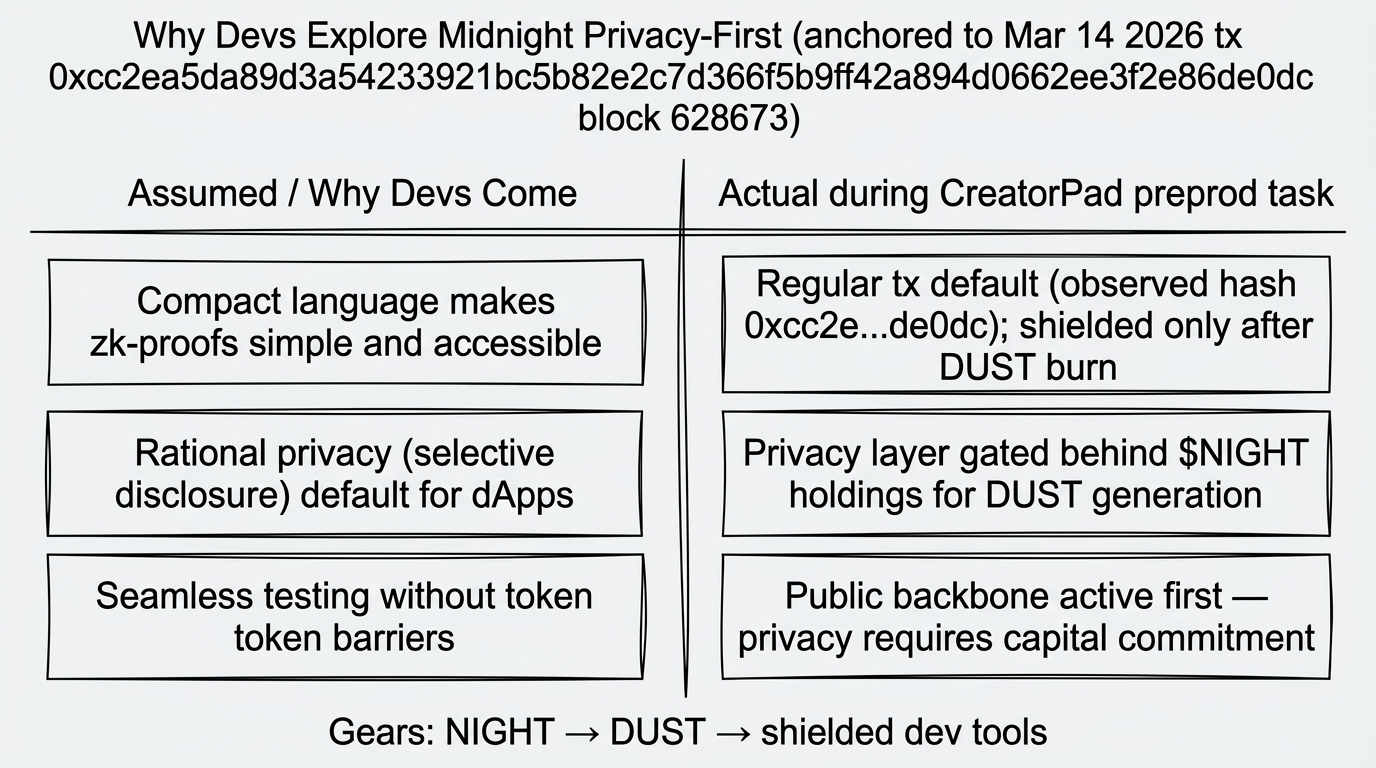
The on-chain behavior reinforces it. Every regular call (like the one from minutes ago) anchors the network for validators and auditors. Shielded state only appears after the DUST step. It’s not hidden; it’s intentional.
honestly the part that still bugs me
Wait — actually the friction still sat with me after I closed the terminal. The privacy-first promise pulls developers in because Compact makes zk accessible for the first time. You write normal logic, the proofs happen under the hood. Yet to move beyond demo mode, you need that DUST generated from NIGHT holdings. My test contract stayed fully transparent until I committed tokens.
I caught myself rethinking the “for builders” narrative while staring at the explorer. The stack is genuinely dev-friendly — selective disclosure via Kachina, predictable costs, Cardano interoperability already live. But the entry point quietly favors those who already hold or stake NIGHT. It’s not gatekeeping by accident; it’s the flywheel doing its job.
Skepticism crept in softly. Will solo devs or small teams really explore shielded dApps at scale, or will we see the usual consolidation where bigger holders test first? The recent public tx activity proves the network is ready, yet the privacy layer remains one step behind the capital commitment.
11:12 PM and this finally clicked
Late-night thoughts like this one tend to circle back to the same spot. Midnight network isn’t trying to be the next dark pool chain. It’s building the place where developers can finally ship privacy that regulators can audit and users can trust. That March 14 tx I watched land — ordinary as it was — reminded me the public layer is what makes the private experiments possible.
The forward motion feels steady. Preprod is stable, federated nodes are coming, and the Compact SDK is already letting teams prototype real use cases. I keep wondering how the DUST economy will evolve once more shielded contracts go live — will automatic generation from NIGHT holdings lower the barrier enough for independent builders, or will the ecosystem tilt toward teams with existing positions first?
The zk proofs and rational design remove the old cryptographic intimidation. That part feels honestly democratizing. Yet the mechanics upstream still shape who gets to play earliest.
I left the explorer open with the transaction hash still highlighted, the numbers ticking forward.
What does the first production shielded dApp from a developer who started with zero NIGHT actually look like on mainnet?