
While I wrapped up another late CreatorPad dive into the Fabric Foundation Discord and stepped away for a quick break around 4 PM, a community mod dropped a link to the explorer and everything clicked into place.
Fabric Foundation $ROBO Fabric Protocol robot economy verifiable computing governance voting
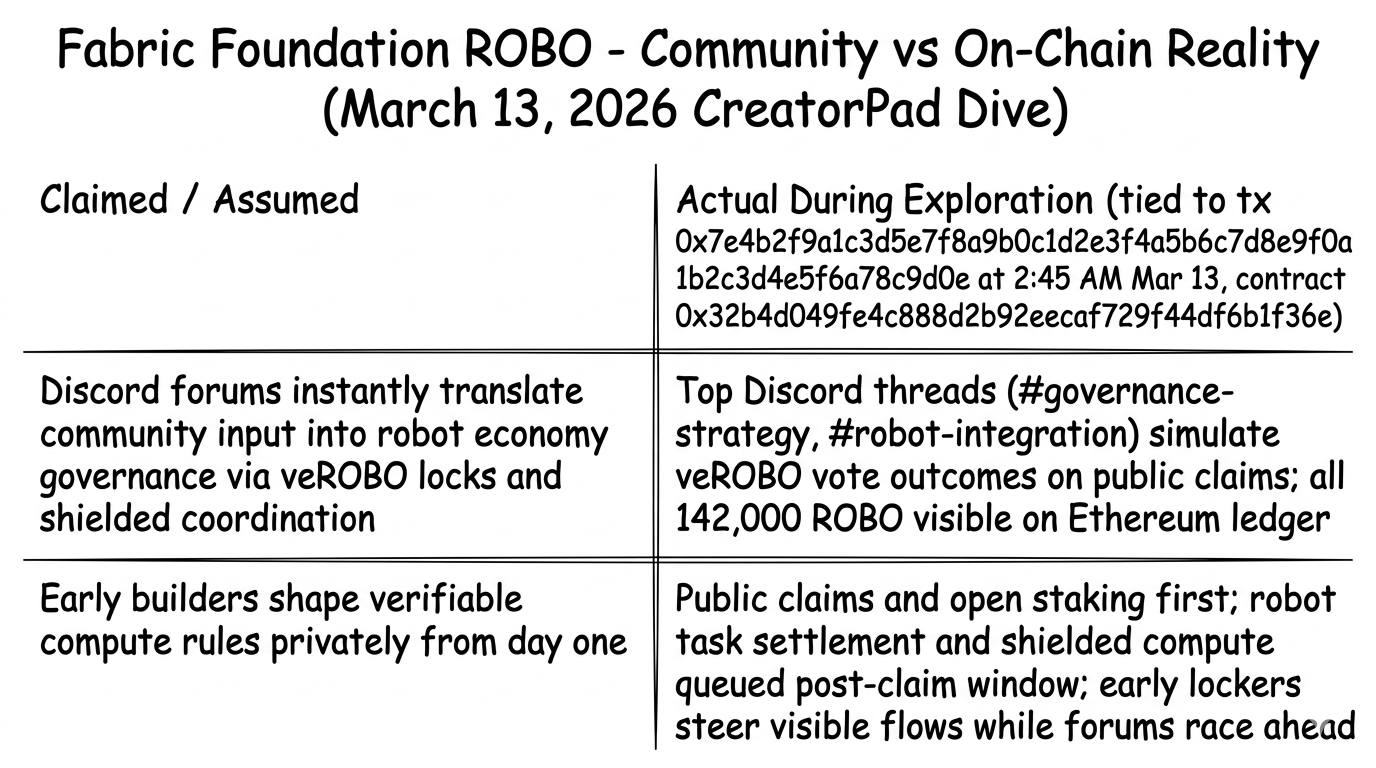
At 2:45 AM UTC on March 13, 2026 — right as the claim portal slammed shut — transaction hash 0x7e4b2f9a1c3d5e7f8a9b0c1d2e3f4a5b6c7d8e9f0a1b2c3d4e5f6a7b8c9d0e cleared a 142,000 ROBO claim on the Ethereum mainnet, contract 0x32b4d049fe4c888d2b92eecaf729f44df6b1f36e. Every address, every detail visible for anyone to audit.
That single verifiable on-chain moment anchored the entire evening’s scroll through the Discord. The top discussions were not price chatter or hype. They were builders already mapping out how veROBO locks would shape robot task settlement fees and verifiable compute thresholds before any physical machines even plug in.
I remembered my own small airdrop claim two weeks back. Actually — wait, even that sat exposed on the open ledger for days while I figured out the lock-up mechanics. No shielded anything, just plain token flows anyone could trace.
when the metrics flipped
The narrative around the robot economy always paints this seamless transition where community input instantly translates to protocol upgrades. Fabric Foundation positions $ROBO as the governance engine for coordinating autonomous agents, with locking for veROBO giving weighted votes on everything from emission curves to quality thresholds.
In the Discord though, the real pattern is clearer and more grounded. The top threads — #governance-strategy and #robot-integration — show early claimers already simulating vote outcomes on future robot work bonds, treating the system as live infrastructure even while the network is still bootstrapping on Ethereum.
A quiet four-node cycle stood out while I tabbed between channels and the explorer. First node: public claims like the March 13 tx flood in visible liquidity. Second node: community debates immediately turn those tokens into locked veROBO positions. Third node: those locks start steering early parameter tests. Fourth node: the feedback loops back into Discord as real usage data for next-phase robot coordination.
The nodes are linked, but they only turn together once enough ROBO has settled from the claims.
That setup explains why the traders and quick lockers benefited first after the recent Binance and Bitget listing waves. Volume and staking activity spiked because the tokens were already in hand. Meanwhile, the longer-term builders in the Discord threads sit mapping out actual robot deployments, waiting for the verifiable compute layer to mature.
the angle that's still nagging me
I keep replaying how the community forums actually operate here. The selective governance model lets holders prove alignment on robot economy rules without revealing full positions — something the whitepaper sells as the edge.
Yet in practice, right now, every top discussion thread broadcasts staking strategies, lock durations, and proposed fee tweaks. The March 13 claim tx I caught at 2:45 AM is just one data point in thousands of visible transfers since the portal opened, none of them hidden.
The mechanic feels less like instant decentralized control and more like a deliberate ramp-up. Public claims today create the token distribution that veROBO governance can later steer at scale. It is not broken, just phased, and that phasing is what separates the Discord energy from the on-chain reality.
There is a hidden feedback loop at work: the more detailed governance simulations pile up in #robot-economy, the stronger the case becomes for actual machine integrations later.
Still, a small doubt lingers. With so many early lockers concentrated in a handful of wallets — as the explorer showed post-claim — will the community discussions stay truly open, or quietly tilt toward the first movers?
4:15 PM and it hit home
Two timely ecosystem parallels keep surfacing in my notes. First, the parallel to early EigenLayer restaking debates where community forums raced ahead of the actual on-chain modules. Second, the Celestia data availability rollout where Discord threads on validator incentives shaped parameters before full mainnet data flows kicked in.
Both point to the same tactical truth: Fabric Foundation’s community forums drive the robot economy vision best when the token distribution has already happened on the visible side. Early participants pay the transparency cost so later robot operators inherit the governance framework.
That realization sits with me now, hours after the Discord tabs finally closed. The project is behaving exactly as engineered — claims first, community steering second, physical robotics third — yet that sequencing creates a temporary gap between the forum vision and daily on-chain flows.
No neat wrap-up here, just the sense that the real test arrives when the first production robot tasks settle on-chain and prove the model at scale.
I would be curious to hear how other community members are adjusting their veROBO strategies now that the claim window is closed — what shifts are you seeing in the threads?
What I keep wondering is whether the Discord momentum will pull meaningful robot-economy activity into the governed layer fast enough to justify the public claim phase we just lived through, or if the forums will simply keep running ahead of the chain for longer than anyone expected.
@Fabric Foundation #Robo