
Token distribution models are rarely subjected to rigorous analytical scrutiny outside of short-term trading communities and speculative circles. This lack of focus overlooks the strategic complexity of the Midnight Network’s Glacier Drop, a mechanism designed to establish eligibility for millions of self-custody wallets across eight major blockchains. By extending the NIGHT token distribution to existing participants in ecosystems like Bitcoin, Ethereum, and Solana, the protocol implements a specific structural choice to bootstrap network decentralization. This approach avoids the traditional reliance on venture capital allocations, aiming instead for a broad, pre-existing base of stakeholders from the moment of architectural activation.
The initial mechanics of the Glacier Drop center on a comprehensive snapshot phase, which serves as the foundation for the eventual NIGHT supply. A primary distinction of this model is the decision to distribute 100% of the token supply to the community, deliberately excluding insider allocations or private sale tranches. From a game-theoretic perspective, this represents a calculated risk mitigation strategy during the network's most vulnerable nascent phase. By removing the sell-pressure often associated with early-stage investors and ensuring that no single entity holds a dominant, non-market-acquired position, the protocol attempts to solve the "cold start" problem of decentralization through radical inclusion.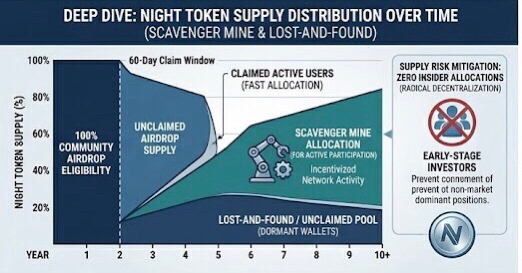
The operational transition of the Glacier Drop is structured into three distinct stages: a 60-day claim window, a subsequent Scavenger Mine phase, and a multi-year Lost-and-Found period. This tiered timeline is designed to capture active participants first while providing a long-term recovery path for dormant users. Crucially, the participation requirements do not necessitate the movement or locking of assets on the original chains. Users maintain their existing holdings and continue to accrue native staking rewards on their home networks. Participation is limited to signing a cryptographic message to prove custody, ensuring that the acquisition of NIGHT tokens does not require the sacrifice of liquidity or opportunity costs on other platforms.
From an incentive design perspective, this lowers the participation threshold significantly. By drawing from a pool of qualified, veteran users across diverse ecosystems, Midnight creates a realistic path to rapid decentralization that is mathematically improbable when recruiting a community from scratch. The model acknowledges that the most valuable network participants are those already integrated into the security and governance of established Layer 1s. Leveraging these existing populations allows Midnight to bypass the high customer acquisition costs and sybil-resistance challenges that typically plague new network launches.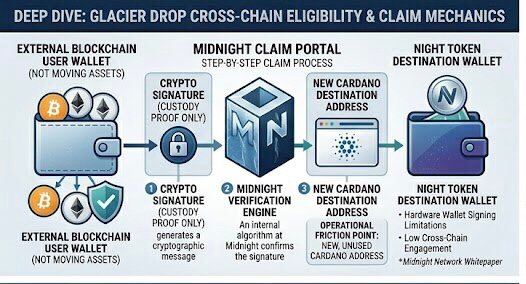
When compared to the coordination designs of other Layer 1 launches, the Glacier Drop represents a departure from standard industry practice. Many projects attempt to build sovereign communities from zero, frequently resulting in highly centralized ownership clusters and echo-chamber governance. Midnight sidesteps this structural flaw by inheriting the results of years of distribution work performed by other networks. Rather than trying to replicate the organic growth of Bitcoin or Cardano, Midnight treats those existing distributions as a foundational layer upon which it can immediately deploy its privacy-preserving smart contract functionality.
A few things deserve continued scrutiny here. The model introduces significant operational friction and technical risks that could impede its theoretical efficiency. Hardware wallet signing limitations across multiple chains present a hurdle for the less technically inclined, and the requirement for entirely new, unused Cardano destination addresses adds a layer of manual complexity. Furthermore, the risk of low cross-chain engagement remains; if users on Solana or Ethereum perceive the claim process as too burdensome relative to the perceived value of NIGHT, the intended decentralization may remain unrealized, leading to a concentrated supply among a subset of power users.
These friction points do not undermine the underlying logic of the approach. The Glacier Drop trades theoretical purity for operational realism, prioritizing a wide net over a frictionless experience. It acknowledges that building a decentralized network requires more than just code; it requires a distribution of power that is already battle-tested. If this model works as designed, Midnight inherits years of cross-chain distribution work from day one. That’s not a small thing.
@MidnightNetwork $NIGHT #night
