
Privacy is a feature. What @MidnightNetwork is actually building is something closer to a programmable data governance layer - and that distinction matters more than most people realize.
Let me explain why I think the framing changes what you should pay attention to.
Most privacy-focused blockchains start from the same assumption: hide the transaction. Monero hides sender, receiver, amount. Zcash shields the value. Various L2 mixers obscure the trail after the fact. The mental model is cryptographic concealment - take an existing transaction structure and wrap it in enough math to make it unreadable.
Midnight's architecture starts from a different question entirely. Not "how do we hide the transaction?" but "what data should exist on-chain in the first place?"
That reframe drives every technical decision in the protocol.
The Compact language - Midnight's TypeScript-based smart contract DSL - separates the application layer from the data layer at compile time. When a developer writes a Compact contract, they're explicitly defining what information lives on the public ledger versus what stays on the user's local machine. The ZK proof doesn't obscure existing data. It substitutes a cryptographic attestation for the data itself. The sensitive information never touches the chain.
The practical difference is significant. On a standard public blockchain DApp, every interaction leaves metadata - wallet address, timestamp, contract call, value. Even if the value is encrypted, the interaction pattern is visible and correlatable. On Midnight, a user interacting with a DApp sends proofs, not data. The public ledger records that a valid interaction occurred, not what that interaction contained.
This is what the whitepaper means by "rational privacy" - selective disclosure by design, not concealment by default. An operator can configure their application to reveal certain data points to regulators while keeping everything else shielded. A healthcare DApp could prove a user meets an eligibility threshold without revealing their medical records. A KYC layer could attest that an address passed verification without exposing the underlying identity documents.
The ZK architecture itself uses the Halo2 framework with BLS12-381 curves - a well-established cryptographic stack that supports recursive proofs and cross-chain integration with non-ZK chains like Cardano and Ethereum. This matters because it means Midnight's proof system can interoperate with existing infrastructure rather than requiring a parallel ecosystem from scratch.
The DUST resource ties directly into this design philosophy. Transaction fees on Midnight are paid in DUST - a shielded, non-transferable resource generated continuously by NIGHT balances. Because DUST is shielded, paying transaction fees doesn't create a visible on-chain event that an observer could use to correlate wallet activity. The fee payment is part of the privacy guarantee, not an exception to it.
One NIGHT holder can designate their DUST generation to any address - including addresses they don't control. This enables a sponsorship model where DApp operators absorb transaction costs on behalf of users who don't hold NIGHT at all. The end user interacts with a Midnight application the same way they'd interact with a Web2 product - no wallet setup, no token purchase, no awareness that a blockchain is involved. The operator's NIGHT balance funds the operation invisibly.
The parts that deserve more scrutiny: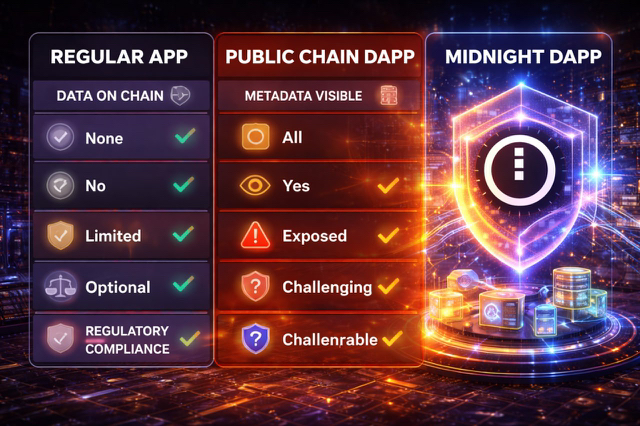
The Compact language is still early. TypeScript familiarity lowers the learning curve, but writing correct ZK circuits requires a different mental model than standard application development. The compiler abstracts much of this - but "abstracts" is doing a lot of work in that sentence. Developers building complex shielded state machines will hit edge cases that documentation doesn't yet cover.
The proof generation cost is also worth watching. ZK proofs are computationally expensive to generate on the user's machine. The Midnight architecture places proof generation client-side - which protects privacy but means user hardware becomes a meaningful variable in transaction experience. On low-powered devices, proof generation time could create latency that undermines the Web2-like UX the sponsorship model promises.
Testnet is live. The architecture is coherent and the design tradeoffs are documented transparently in the whitepaper - which is more than most protocols offer at this stage.
But the gap between "coherent architecture" and "production-grade infrastructure" is where most interesting blockchain projects either prove themselves or quietly stall. That's the part still worth watching carefully with $NIGHT
