
When I first sat down with my team to review our AI predictions, I realized something crucial: the models weren’t the problem. The real issue was proving to external partners that the outputs were trustworthy. Fast predictions and high accuracy meant little if no one outside our infrastructure could independently verify them. That’s when we decided to integrate @undefined with $NIGHT as a decentralized verification layer and it completely reshaped how we think about operational trust in AI.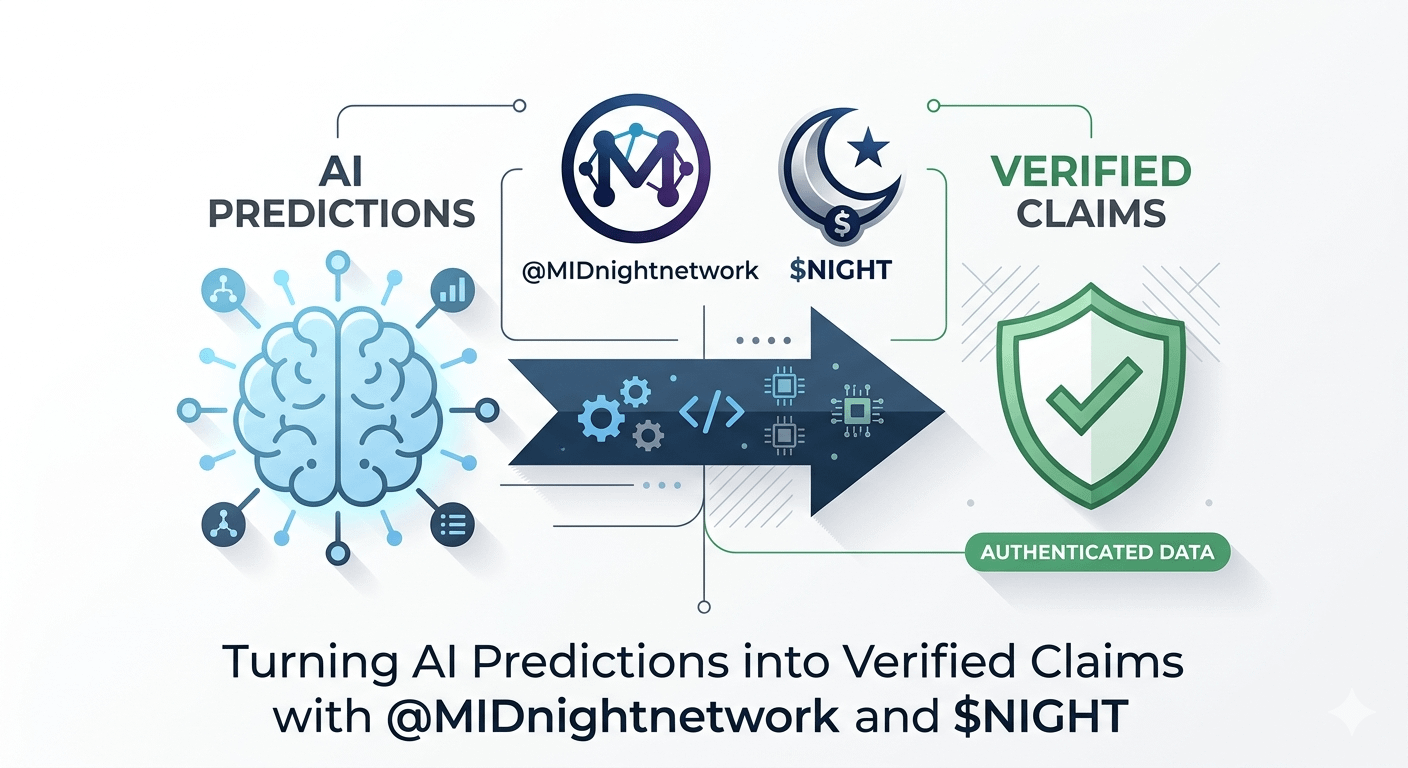
Our environment monitors transactional behavior across multiple payment platforms. The AI stack is conventional: a combination of classifiers, anomaly detectors, and a few custom heuristics. Internal benchmarks showed about 92% classification accuracy, which seemed sufficient. Yet, accuracy alone didn’t convince our partners. Every few weeks when models were retrained, the question arose: how do we verify a decision wasn’t inadvertently influenced by misconfiguration or drift?
Initially, we relied on traditional logging. Each prediction recorded a model hash, timestamp, and feature snapshot. Internally it was fine, but this approach required external parties to trust our servers. That lack of independent verification was a concern. With @MIDnightnetwork, we redefined each prediction as a claim rather than a final verdict.
Each claim is wrapped in a lightweight verification object containing the model hash, input metadata, and a compressed explanation vector. Our middleware then pushes these objects to validators coordinating through $NIGHT. Validators do not recompute the AI output doing so would be inefficient. Instead, they confirm reproducibility conditions: whether the model hash matches a registered artifact, whether input features adhere to the declared schema, and whether the output distribution is statistically consistent with recent predictions. Once these checks pass across multiple validators, the claim achieves decentralized consensus.
We tested this system in production over twelve days, processing roughly 900,000 predictions. Latency increased modestly averaging 280–340 milliseconds per claim depending on validator response times but the delay was negligible for our throughput. What surprised us most were the anomalies the verification layer flagged. A minor update to input normalization went unnoticed by internal monitoring, but validators immediately reported discrepancies. That single incident underscored the value of decentralized claim verification.
Validator diversity became another experiment. Rather than identical checks everywhere, some nodes applied stricter thresholds on statistical consistency. Consensus usually formed after three to five confirmations. When disagreements occurred, they weren’t discarded. Instead, they were logged and analyzed, providing early warning signals of data drift. Over several days, disagreement rates climbed from 0.7% to 2.5%, preceding any flags from standard monitoring systems.
There are tradeoffs. Anchoring verification through $NIGHT introduces some variability in transaction throughput, so we batch claims in small groups. Batching reduced verification overhead by about 36%, though confirmations arrived slightly later than if processed individually. Another consideration is interpretability: decentralized verification confirms process integrity, not absolute correctness. Some stakeholders initially expected deeper explanations for each prediction, so we had to clarify the system’s scope.
Operational benefits, however, were clear. External partners now reference blockchain-anchored verification rather than relying solely on internal logs. Discussions shifted from infrastructure reliability to model behavior itself. Over time, the verification data itself became a diagnostic tool. Patterns of disagreement and validation disputes provided insight into model drift long before traditional metrics flagged any problem.
From an engineering perspective, the most compelling aspect of @undefined is its placement in the architecture. Sitting between AI output and downstream decision-making, it transforms predictions from assertions into verifiable claims. This design reduces dependency on any single organization’s infrastructure while maintaining accountability.
Skepticism remains. Verification networks introduce coordination overhead, and not every AI deployment justifies this complexity. Small internal tools may not require decentralized claims. Yet for environments where AI affects multiple stakeholders, relying solely on internal logs is increasingly insufficient.
The core insight we’ve learned is subtle: AI generates predictions extremely quickly, but trust forms slowly. Decentralized claim verification with $NIGHT doesn’t inherently improve the model’s intelligence, but it makes the entire system accountable and auditable. This quiet shift from prediction to verified claim changes the conversation around AI deployment.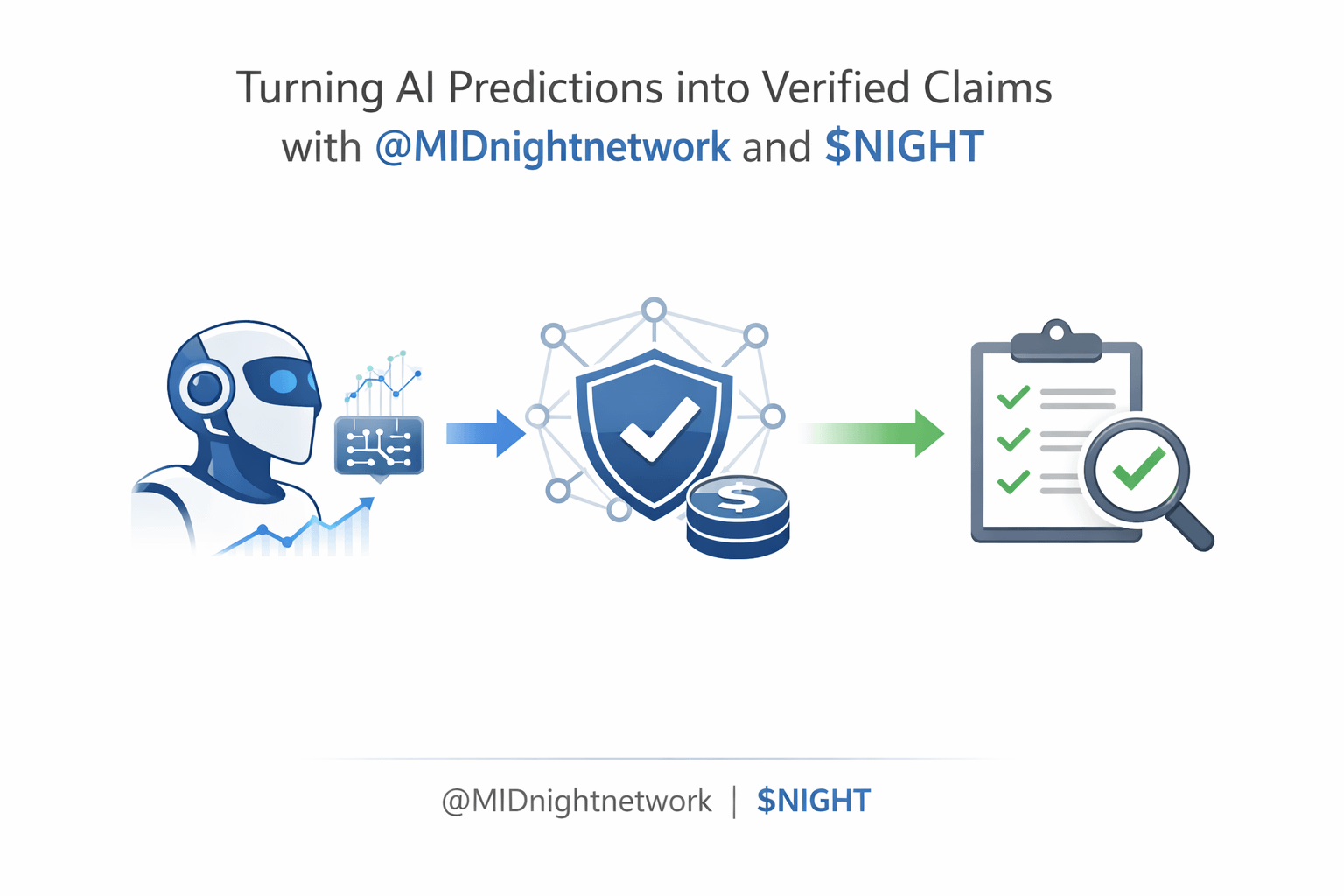
Integrating @undefined has given us operational confidence at a scale that would have been difficult otherwise. Reliable, verifiable claims ensure stakeholders can act on AI outputs with clarity, and the system continues to provide early warning signals for drift or misconfiguration. Over time, this foundation may redefine how trust is embedded into AI pipelines not as a layer added afterward, but as an integral property of the system itself.