

Let me put it in the simplest way.
Most people still think AI is just a smarter screen.
A better chatbot.
A better writing tool.
A better coding assistant.
Useful, yes.
But still trapped inside the screen.
Now imagine a different scene.
You wake up one morning and check your phone.
There’s a message.
Not from your employee.
Not from your accountant.
Not from your delivery driver.
It’s from your robot.
It says:
“Boss, I finished today’s work.
I paid for my own navigation update.
I bought extra battery charging time.
I paid the API fee I needed.
After costs, I made a profit today.”
That sounds like science fiction.
But that’s exactly the kind of future Fabric Protocol and $ROBO are betting on.
And that’s why I think ROBO is not just another random AI token.
The crypto market right now still treats most AI coins the same way:
Is volume strong?
Did the listing happen?
Can the price bounce?
Is this week bullish or bearish?
And yes, that matters.
Even for ROBO, the market is still trading it like an altcoin in the short term. As of mid-March 2026, ROBO has been trading around the high-$0.03 to low-$0.04 range, with 24-hour volume around $50M–$60M, which tells you the market is paying attention even while price action stays volatile.
But price is not the real story here.
The real story is this:
What happens when machines stop being tools and start becoming economic actors?
That’s the whole Fabric idea.
Today, a robot can work.
It can move boxes.
It can inspect a warehouse.
It can deliver something.
It can run tasks with AI.
But in the old system, the robot is still just a machine owned and controlled by someone else.
It doesn’t have identity.
It doesn’t settle its own payments.
It doesn’t prove its own work.
It doesn’t participate in the economy by itself.
Fabric is trying to build that missing layer.
The official Fabric blog keeps repeating the same core point: the bottleneck in robotics is no longer only the robot itself, but the infrastructure around identity, payments, and coordination at scale.
That sounds technical, so let me make it plain.
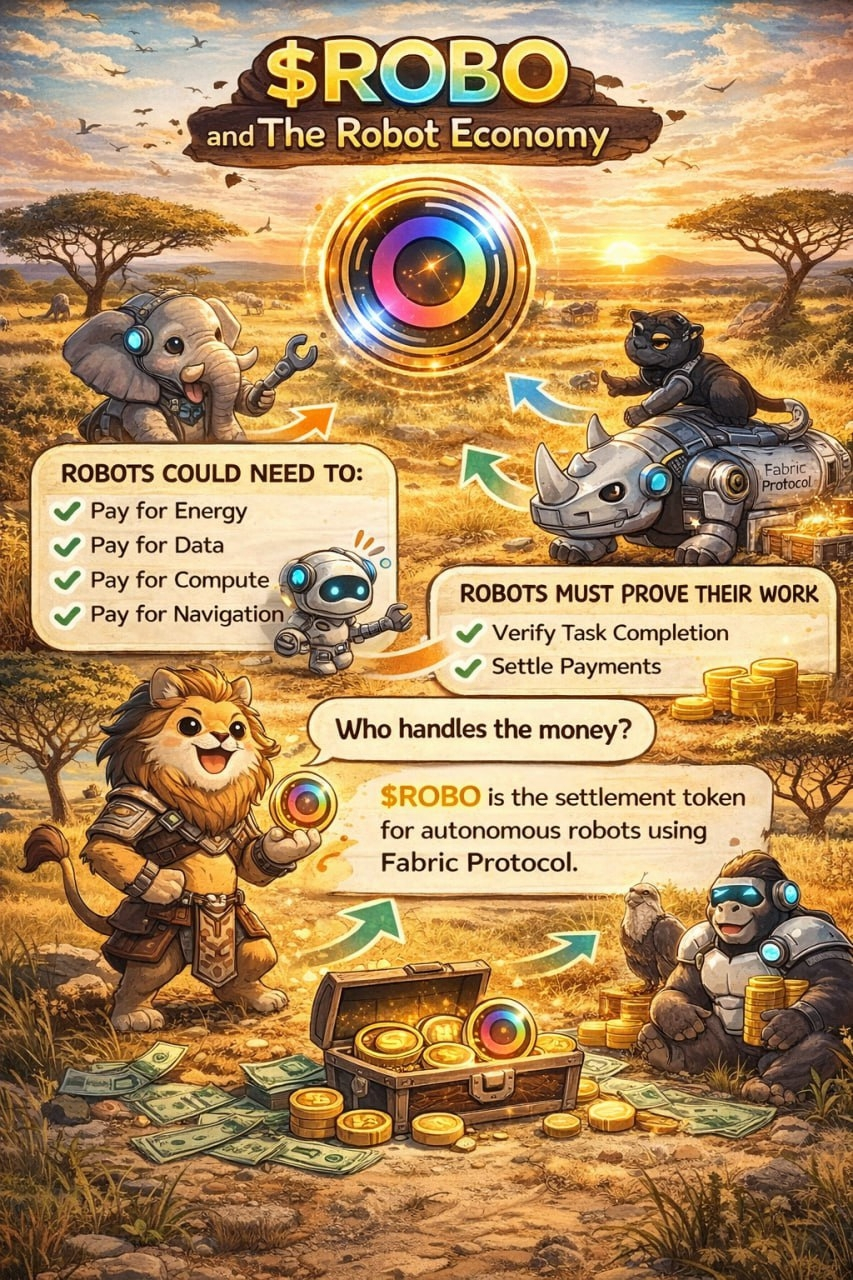
A future robot may need to:
pay for electricity,
pay for data,
pay for compute,
pay for navigation,
pay for software access,
prove that it actually completed the task.
If millions of machines are doing that, the old financial system starts looking clumsy.
Banks were built for people and companies.
Robots may need something faster, smaller, automatic, and always on.
That is where $ROBO comes in.
Fabric says ROBO is the utility and governance token inside that machine economy. In simple terms, it is part of the payment and coordination layer for autonomous machines.
This is why I think ROBO feels different from most “AI hype” coins.
A lot of AI tokens are really bets on attention.
ROBO is trying to be a bet on infrastructure.
And in crypto, infrastructure plays are often boring at first.
Until one day, they’re not.
The market is still undecided.
Short term, people will still trade ROBO like any other narrative asset. If Bitcoin sneezes, altcoins wobble. If AI heat returns, ROBO may move with that wave. If risk appetite dries up, it can get sold just like everything else. Recent data shows ROBO has been under pressure over the last week even while trading activity stayed elevated.
But long term, the question is bigger than this week’s candle.
It’s this:
If AI really moves into the physical world, who handles the money flow between machines?
That question is no longer silly.
And if the answer ends up being “a new machine payment and coordination layer,” then ROBO might be early to a category most of the market still doesn’t fully understand.
That’s the story I keep coming back to.
Not “Will robots get smarter?”
They probably will.
The more important question is:
When robots become useful enough, will they start earning, paying, and coordinating value on their own?
If the answer is no, ROBO is just another token.
If the answer is yes, then maybe Fabric is not building a trend.
Maybe it’s building the accounting system for the robot economy.
#robo $ROBO @Fabric Foundation
