
Earlier today while reviewing a few blockchain architecture discussions, something interesting kept appearing in developer conversations.
Not a new token launch.
Not another DeFi protocol.
Instead, people were quietly talking about Fabric.
At first glance, it doesn’t look like the typical crypto infrastructure project. It isn’t built around speculation or retail trading. In fact, the design philosophy behind Fabric focuses on something most public chains struggle with:
controlled participation and enterprise-grade infrastructure.
To understand why that matters, it helps to look at how Fabric networks are structured.
Unlike public blockchains where anyone can join anonymously, Fabric networks operate with known identities and permissioned participation. Each participant must authenticate through a membership system before interacting with the network.
That one design decision changes the entire architecture.
Instead of relying on anonymous validators competing through open consensus, Fabric separates the blockchain process into specialized roles. Peer nodes execute smart contracts (called chaincode), while ordering nodes organize transactions and ensure ledger consistency. 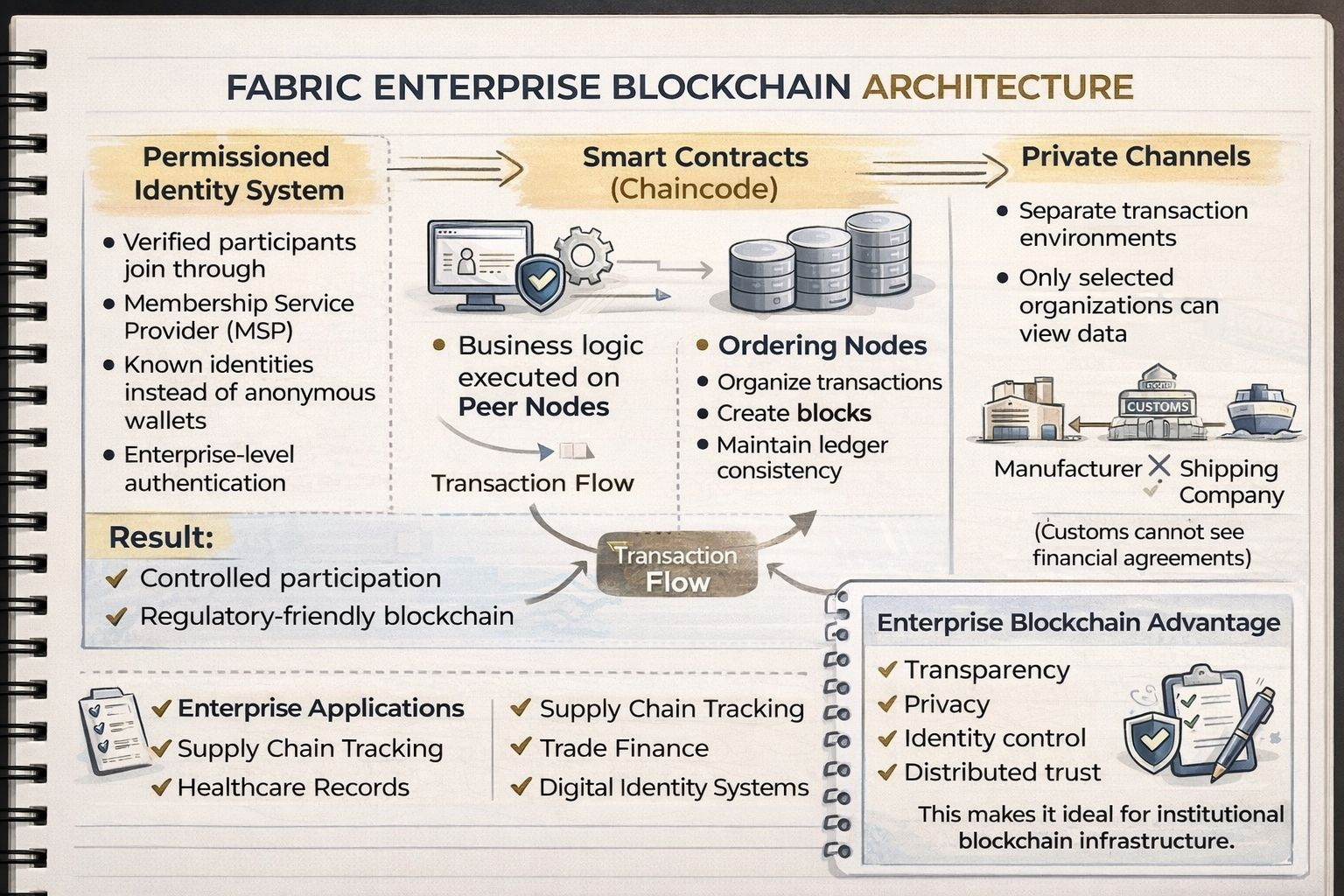
In other words, the network behaves less like a permissionless market and more like a distributed operating system for organizations.
This architecture reveals why Fabric appears so often in enterprise blockchain deployments.
Many industries want the transparency of blockchain but cannot expose sensitive data publicly. Fabric addresses this through private channels and isolated transaction environments, allowing only selected participants to see certain transactions.
A practical example is supply-chain coordination.
Imagine a logistics network where manufacturers, shipping companies, and customs authorities all share a ledger. Each participant needs visibility into the shipment process, but not every participant should see the financial agreements between other parties.
Fabric’s channel structure allows exactly that.
Transactions can be verified by the network while still keeping certain information visible only to specific members.
That design reveals something deeper about blockchain evolution.
The early era of crypto focused heavily on open networks and anonymous participation. But as the technology matured, another category of blockchain began emerging — infrastructure designed for organizations that need transparency, auditability, and privacy simultaneously.
Fabric sits squarely in that category.
And that shift may explain why enterprise blockchain adoption often happens quietly.
While retail markets focus on tokens and price charts, many large institutions experiment with blockchain systems that operate behind the scenes.
Fabric represents one of those foundational layers.
Not a visible DeFi ecosystem.
Not a speculative token economy.
But a modular blockchain architecture built for organizations that need distributed systems without giving up control over identity and data.
Which raises a subtle question about the future of blockchain infrastructure.
If public networks represent the open financial layer of Web3, then platforms like @Fabric Foundation might quietly become the institutional layer connecting real-world systems to distributed ledgers.
And if that trend continues, some of the most important blockchain infrastructure may end up being the technology people rarely talk about.