

If you look past the noise, Fabric Foundation is one of those projects that doesn’t try to impress with hype, it tries to solve something very specific: how machines—AI agents and robots—can actually participate in an economy instead of just executing commands. And with the latest updates, it’s clear this is no longer just a concept sitting in a whitepaper.
Over the past few weeks, the project has moved fast. The launch of the $ROBO token in late February 2026 marked the real starting point, not just for trading but for the entire system coming alive. The airdrop went live, users claimed tokens, and shortly after that, listings rolled out across major exchanges including Binance and Kraken, giving the asset real liquidity and market access. That sequence matters because it shows coordination: distribution → liquidity → participation.
But what actually makes Fabric different isn’t the token launch. It’s what the token is supposed to do.
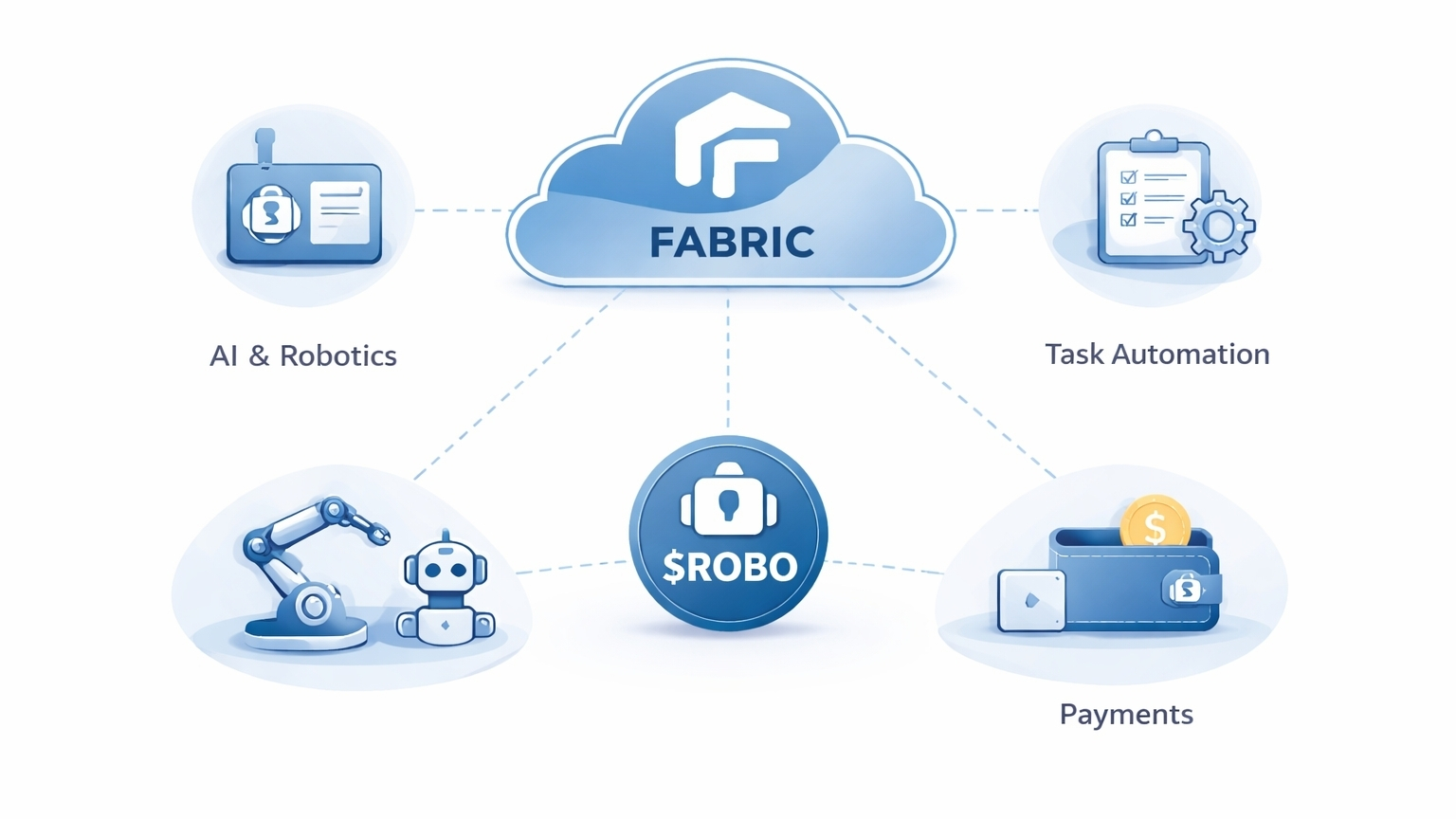
At its core, Fabric is trying to build a system where machines have three things they’ve never really had before: identity, the ability to earn, and the ability to pay. Right now, robots and AI systems are isolated tools. They perform tasks, but they don’t own anything, they don’t transact, and they don’t exist economically. Fabric changes that by giving them onchain identities and wallets, allowing them to interact with other machines and even humans in a structured way.
The way it works is surprisingly straightforward when you strip it down. A robot or AI agent gets an onchain identity. It performs a task—this could be data processing, physical work, or coordination. That task gets verified through the network, and once validated, payment is settled using $ROBO. Everything is recorded onchain, so there’s a transparent record of what happened and who contributed.
This is where the idea becomes interesting. Instead of humans coordinating every system manually, you start to get machine-to-machine interaction, where systems can request work, complete it, and settle payments without constant human involvement. Fabric basically acts as the coordination layer that connects all of this.
The roadmap shows they’re taking this step by step. Early 2026 is about launching the base infrastructure and enabling identity + task settlement. Then it moves toward incentivizing real contributions and scaling coordination between multiple machines. It’s not trying to jump straight into a fully autonomous economy—it’s building the rails first.
From a market perspective, the attention is already there. The token saw strong early trading activity and high volume relative to its market cap, which shows interest, but also signals that speculation is still a big part of the current phase. That’s normal for a new project, but it also means the real test hasn’t happened yet.
And that’s where my view sits.
I don’t see Fabric Foundation as just another AI narrative play. The direction actually makes sense. If AI is moving beyond software into physical systems, then those systems need infrastructure to operate economically. Payments, identity, coordination—these aren’t optional layers, they’re required.
But execution is everything here.
It’s one thing to design a system where robots can transact. It’s another to get real machines, real developers, and real use cases to plug into it. Most projects stop at the framework stage. Very few reach actual usage.
What I like about Fabric is that it’s focusing on infrastructure before storytelling. The token isn’t positioned as the end product, it’s a tool inside a larger system. That’s a better starting point than most projects that build narratives first and utility later.
At the same time, the challenge is massive. Coordinating machines across different environments, verifying tasks, and making it reliable enough for real-world use is not a simple problem. This isn’t just crypto—it’s robotics, AI, and distributed systems all at once.
So the way I see it is simple:
Right now, Fabric Foundation is building the rails for something that doesn’t fully exist yet. The early signs—launch, listings, initial infrastructure—are strong. But the real signal will come when we start seeing actual machine activity happening on the network, not just token movement.
If they get there, this becomes foundational.
If they don’t, it stays a well-designed idea.
But compared to most projects in the market right now, at least this one is trying to build something that connects to the real world—and that alone already puts it in a different category.