

What continued to impress me about Fabric is how quickly the initial involvement in new machine networks is ripped off the actual work and converted into paper positioning.
That is the part people skip.
Nothing has yet been done by a robot. No service record. No useful uptime. There is no evidence of the machine being able to support a workflow during pressure. And yet the original charge round it usually goes. Who got in early. Who owns the upside. Who makes claim to the work one hasn't made. The machine remains on the brink of activation and the entire dialogue is already losing focus and direction towards coordination and paper exposure.
That is where the robot story began losing some ground on me.
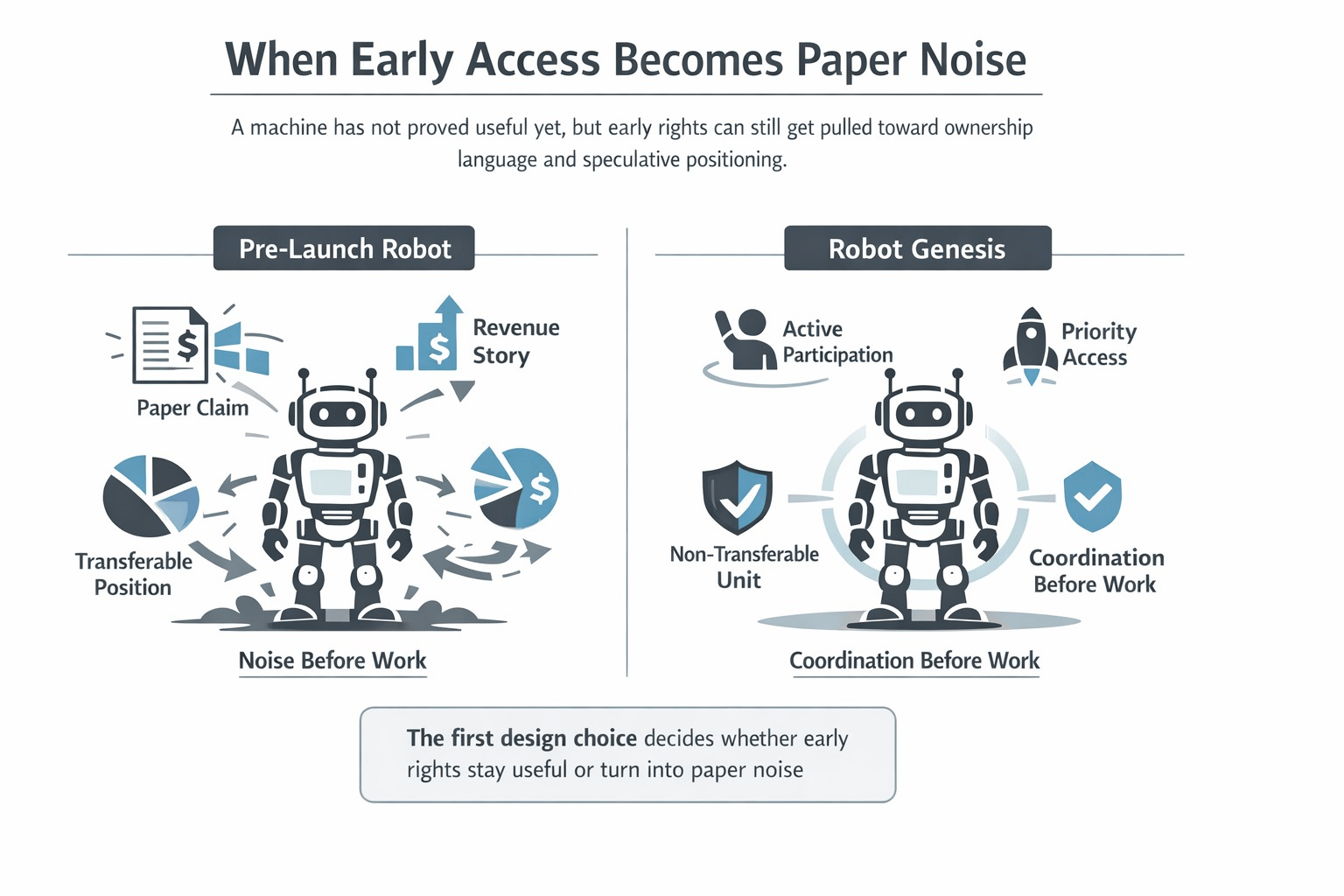
The layer of launch begins to teach itself the wrong lesson because early rights whose buyers were originally scarce and precious are now readily bought and sold or even traded like property. The network prevents queries of questions who is making a machine useful and puts questions of who can claim the cleanest claim over the machine before usefulness is even established. This is a misrepresentation of the entire initial stage. Work cannot keep up with attention. Positioning is made purer than contribution. And what ought to have been an inter-lacing issue is another competition to financing the first layer before the machine has made any money off it.
That is when I began to feel different about Fabric.
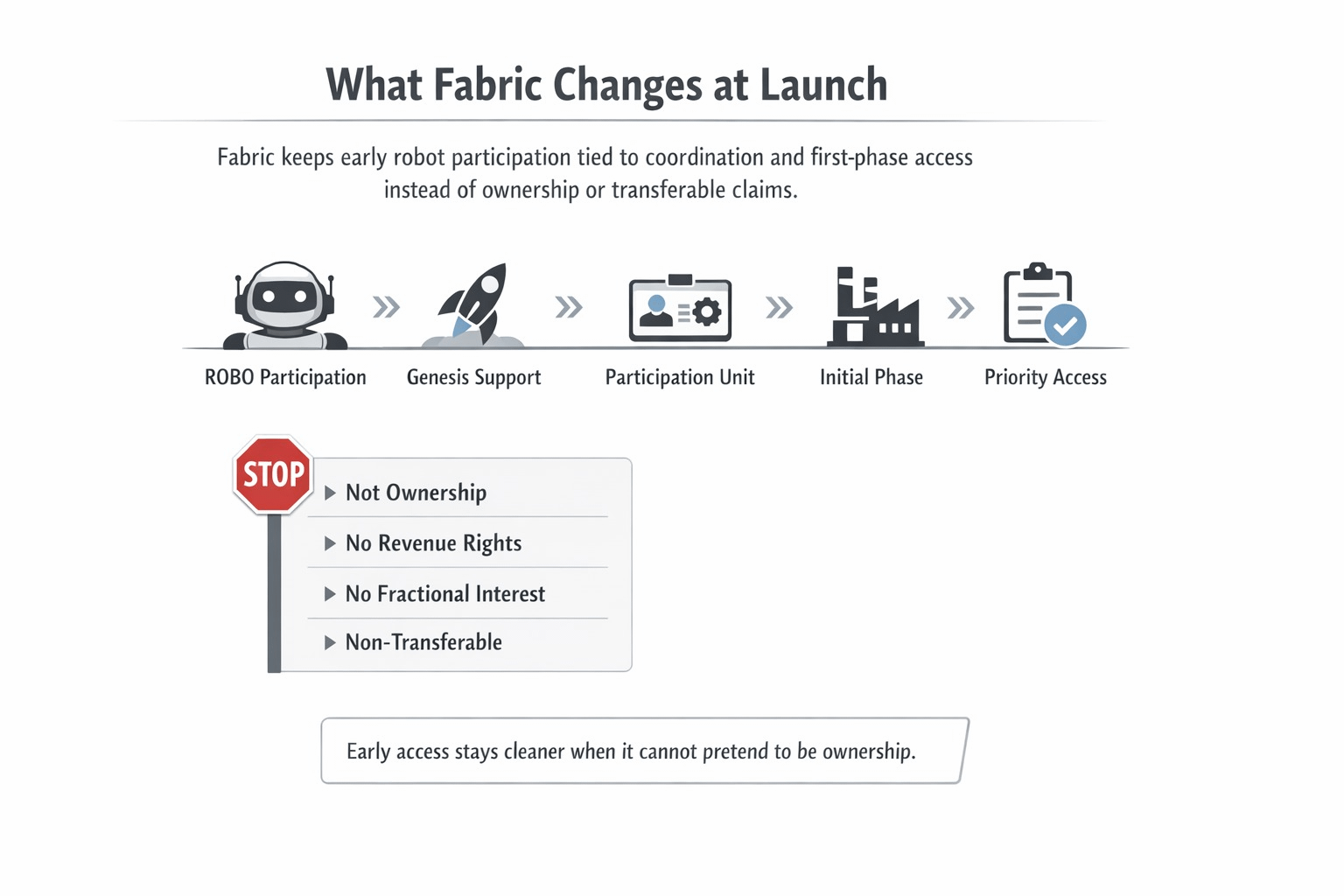
What resonated was the purposeful divide between early participation and ownership language which is deliberately created in the project. Public design of the robot genesis provides priority access weighting of participants during the first phase of operation of a robot although such units of participation are explicitly non-transferable and do not constitute a right to ownership, revenue, and/or fractional ownership. That single limitation was of significance to me, since it shifts the definition of what it means by the term getting in early. It brings the first layer nearer to coordination and more distant of paper extraction.
After that I really could not revert to the simpler form of the story.
I ceased thinking of the early robot coordination as an event of market entry and began to think of it as a design decision regarding which the network wants to be rewarded first. That transformed the classification on my part. Many systems claim to desire participation, and they really let participation become a commercialized possession and then show the work. Fabric is different, as the right at the beginning is smaller. It is linked with involvement and first-stage entry, and not possession of a share of the machine.
It is a very uncomfortable design indeed.
Since it provokes a purer question. When the machine is not a paper asset and the right of early is not transferable, then why are you here? To assist organize robot creation as well as initial task circulation or simply to wave the initial narrative wave? It is a more difficult question to be answered honestly and this is why the building attracted my attention.
It also altered my beginning reading of $ROBO.
I no longer considered $ROBO as something that would make the robot launch more investable. The token was more intelligible to me after I regarded it as the rail by which the network lets the initial machine coordination be established without reducing the first layer to claims of ownership. With the framing of Fabric, the focus of network services and settlement is on $ROBO, and the initial participation layer is separated between equity, debt, profit share, and hardware ownership. That makes the token less of a scramble to paper upside and more of a system that is in an attempt to keep the first useful layer in a state of cleanliness that it will actually be a part of real work eventually.
I do not yet believe that that will ensure the design will hold.
This is the section that I would continue to watch. Does the boundary between coordination and positioning remain clear when the attention becomes noisier? Do non-transferable early rights make the launch layer honest, or does the same speculation pressure seek another out? Are the first stage actually rewarding individuals who assist a robot to be made usable or is the market still learning to use the proximity to gain status prior to usefulness appearing?
These questions are relevant since after this clicked, I was not able to view the category in the same light. The actual bottleneck ceased to have the appearance of early access itself and began to have the appearance of the question of whether early access can become paper noise before the machine is earning a cent.
Many projects compensate being close to the machine.
I continue to observe those who are made to service the machine to make it useful first.
@Fabric Foundation #ROBO $ROBO