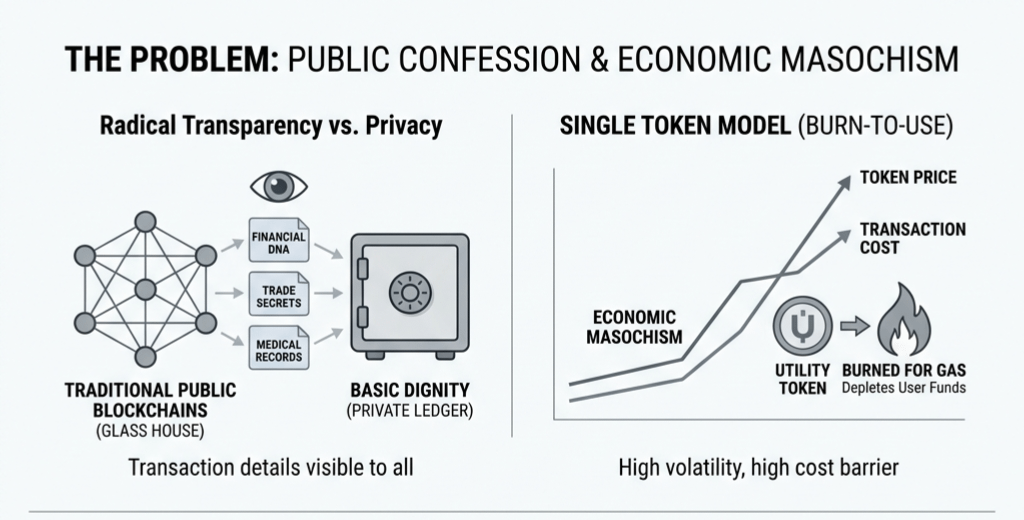
I’ve spent the better part of a decade watching the same tragedy play out in the digital asset space where we traded the privacy of a Swiss bank account for the radical transparency of a glass house. The early pioneers sold us on this idea that trustless integrity required every single one of us to broadcast our financial DNA to the entire world but they forgot that most of us don’t actually want our medical records or trade secrets etched into a public ledger for eternity. It created this massive wall between the grand vision of decentralized finance and the boring reality of corporate compliance and basic human dignity. If you want to build a world where people actually use this stuff for more than just gambling on animal coins you can't have a system that treats every transaction like a public confession.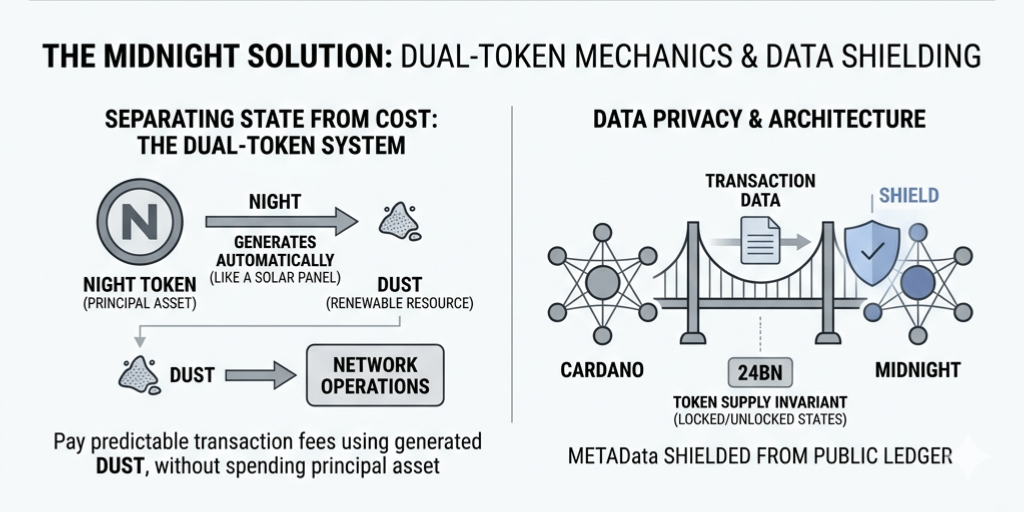
The old guard also saddled us with these single token models that are essentially an exercise in economic masochism. You want to use the network so you have to burn the very asset you’re trying to hold and every time the token price moons your transaction costs follow it into the stratosphere. It’s a broken loop that favors the insiders who got in at the ground floor while everyone else is left checking gas prices like they’re hunting for cheap fuel in a wasteland. I look at most of these ecosystems and I see silos where value goes to die because everyone is too busy trying to be the one chain to rule them all instead of actually talking to each other.
That’s why I’m looking at Midnight with a bit of cautious optimism because they’re finally separating the state of the world from the cost of doing business. They’ve moved away from the subtractive model and introduced this dual system where holding the NIGHT token doesn’t just give you a speculative asset but a renewable resource called DUST. Think of it like owning a solar panel instead of constantly buying batteries. As long as you have the NIGHT you’re generating the DUST you need to move through the network without actually spending your principal. It turns the cost of operation into something predictable rather than a volatile guessing game and it does it while keeping your metadata shielded from the prying eyes of the public square.
The technical architecture here is a bit of a tightrope walk between the Cardano and Midnight chains. They’ve set up these rigid invariants to make sure that 24 billion tokens stay 24 billion tokens regardless of which side of the bridge they’re sitting on. It’s a sophisticated dance of locked and unlocked states designed to prevent the kind of double spend disasters that have sunk lesser projects. They’re starting with a one way bridge from Cardano to keep things stable and moving toward a fully decentralized governance model once the training wheels come off. It’s an admission that you can’t just flip a switch on day one and expect a perfect democracy but you can build the infrastructure to get there.
Eventually we have to stop treating blockchains like isolated islands and start treating them like a shared utility. The vision here isn't just about one network winning the race but about creating a space where developers can sponsor their users or where you can pay for a transaction with fiat or other native tokens. It’s about moving past the winner take all mentality that has kept Web3 in its awkward teenage phase for far too long. We’re moving from the era of the walled garden to the era of the open port.
In the end we are really just choosing between a system that functions like a high stakes poker game where everyone sees your hand and a system that functions like a global shipping terminal. The old way is a spectacle of transparency that nobody can actually live in. The new way is about building the quiet machinery that lets the world move without demanding to see your papers at every turn. It is the difference between a spotlight and a lighthouse.