

I spent an hour yesterday in Midnight's Preprod explorer. Not because I had to — because I wanted to see if the numbers matched the narrative.
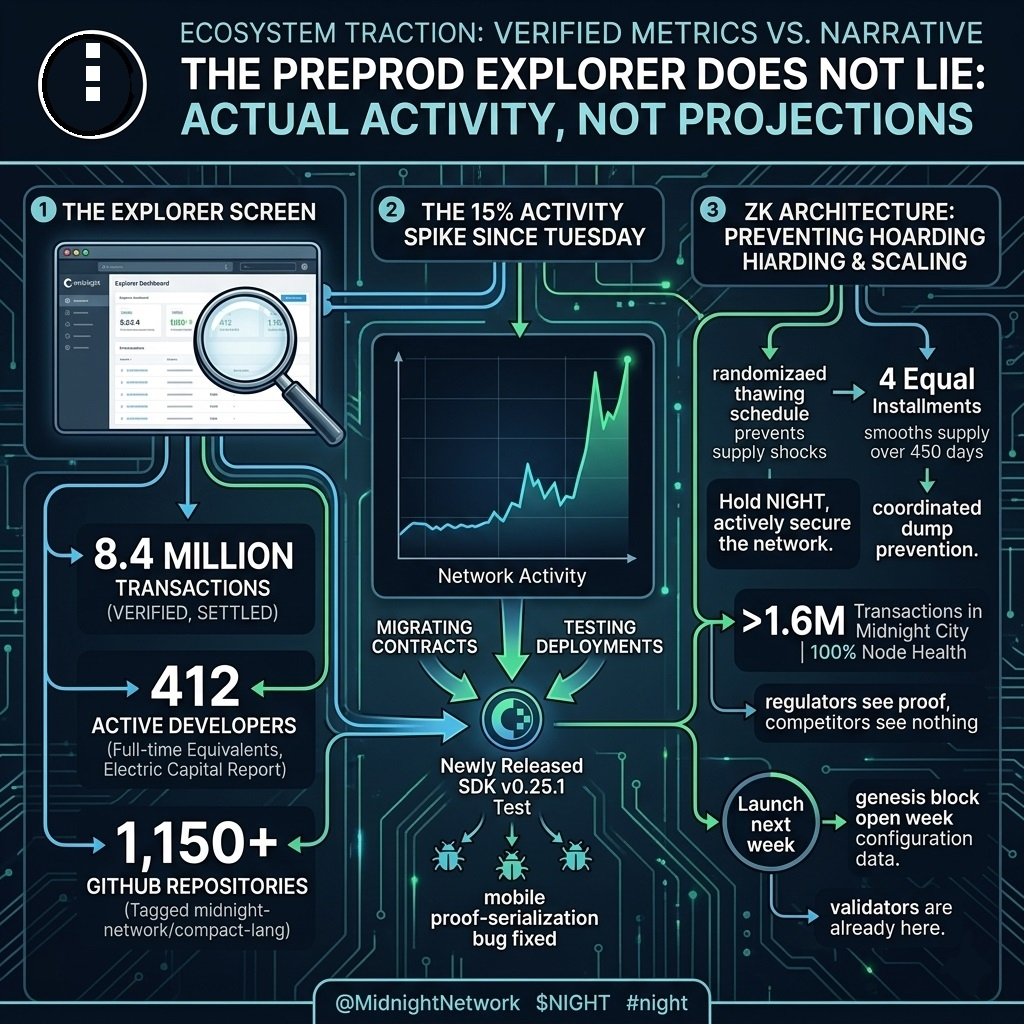
8.4 million transactions. That's the first number that stopped me.
Not theoretical TPS. Not projections. Actual transactions, processed, verified, settled.
412 active developers building on Midnight right now — full-time equivalents, according to the latest Electric Capital report.
1,150+ GitHub repositories tagged with midnight-network or compact-lang. That's not a community. That's an ecosystem.
And here's what made me look twice: a 15% spike in activity just since Tuesday. Teams migrating contracts. Testing deployments. Getting ready for what comes next.
What the Explorer Doesn't Show You
The explorer lists every transaction, every block, every proof. What it doesn't show is what those numbers mean for someone trying to build something real.
So I looked closer.
Tucked inside that activity is ShieldUSD — a privacy-first stablecoin running on Midnight's Preprod. Not as a marketing demo. As deployable code. Open source. Forkable. Ready for developers to examine, modify, and build upon.
This matters because ShieldUSD isn't just another stablecoin. It's the first to solve the trade-off that's kept institutional money off-chain for a decade.
The Trade-Off That Finally Broke
Every stablecoin until now forced a choice:
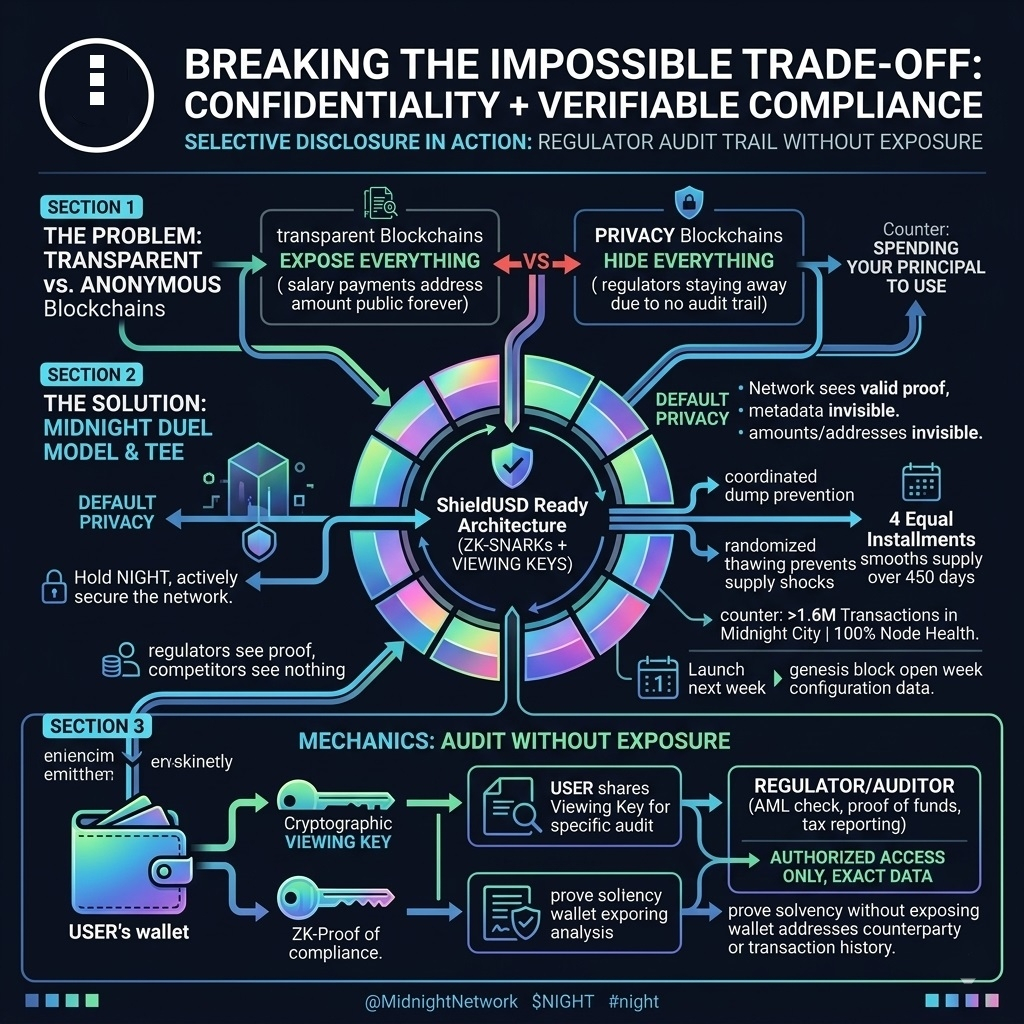
Transparent chains (USDC on Ethereum, USDT everywhere) expose everything. Your wallet. Your amount. Your counterparty. Your entire financial history — public forever.
Privacy coins (Monero, Zcash) hide everything. Which works until a regulator asks: "Prove you're not laundering money." You can't. So institutions stay away.
ShieldUSD breaks this cleanly.
It uses ZK-SNARKs to keep transactions private by default. The network sees a proof that the transaction is valid. It never sees amounts, addresses, or metadata.
But — and this is the breakthrough — every user holds a cryptographic "viewing key." When a regulator or auditor needs to verify something, the user shares that key. The regulator sees exactly what they're authorized to see. Nothing more.
The Technical Layer Behind the Numbers
Those 8.4 million transactions on Preprod weren't random tests. They were proofs.
Each one is a ZK-SNARK — around 128 bytes, verifying in milliseconds — confirming that a transaction followed the rules. Sufficient balance. No double-spend. Valid signatures. The underlying data never touches the public ledger.
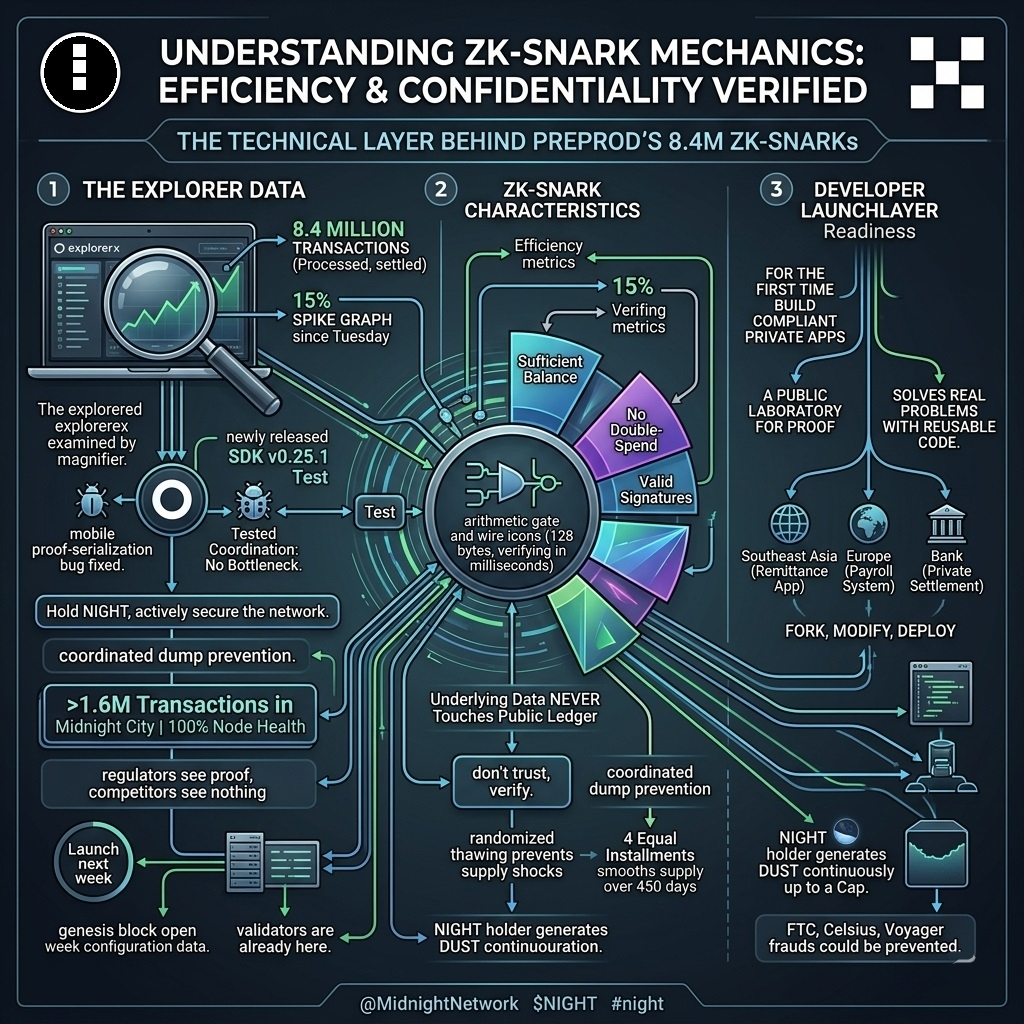
The 15% activity spike since Tuesday? That's developers testing the newly released SDK v0.25.1, which fixed a mobile proof-serialization bug. Small fix. Big signal that maintenance is active.
What This Means for Developers
For the first time, building compliant private applications doesn't require a cryptography PhD.
The ShieldUSD contract is open source. Any developer can:
Fork it
Modify it for their use case
Deploy their own version on Preprod today
A team in Southeast Asia building a remittance app can use the same pattern. A bank exploring private settlements can start from working software, not theory.
The Risk Nobody's Mentioning
Let's be honest about Preprod. It's a test environment. The contracts are minimal. The liquidity isn't there yet.
Mainnet — launching in four days — could reveal edge cases no one caught in testing.
But that's exactly why Preprod exists. To find the edge cases before they matter. Those 8.4 million transactions are the proof that the pattern works. Mainnet is where it becomes real.
Why This Changes Everything for Mainnet
When the genesis block opened earlier this week, it processed ~1,200 transactions — configuration data from the 15 federated nodes (Google Cloud, Vodafone, MoneyGram, eToro, and others).
That's the institutional layer.
Preprod's 8.4 million transactions are the developer layer.
Next week, they merge.
The Part That Should Make You Think
Here's what kept me in that explorer longer than I expected: Midnight isn't waiting for someone to build on it. The builders are already here. 412 of them, full-time, right now.
The code is written. The tests are running. The proofs are generating.
When Worldpay starts moving billions through this network — and they've already announced — it won't be a science experiment. It'll be production infrastructure running on patterns proven by millions of transactions.
What Comes Next
In four days, mainnet opens to everyone.
The question won't be "will someone build on this?" It'll be "what do you build first when privacy is programmable?"
ShieldUSD is one answer. There will be more.
And for the first time, you won't have to choose between privacy and compliance. You'll have both.