

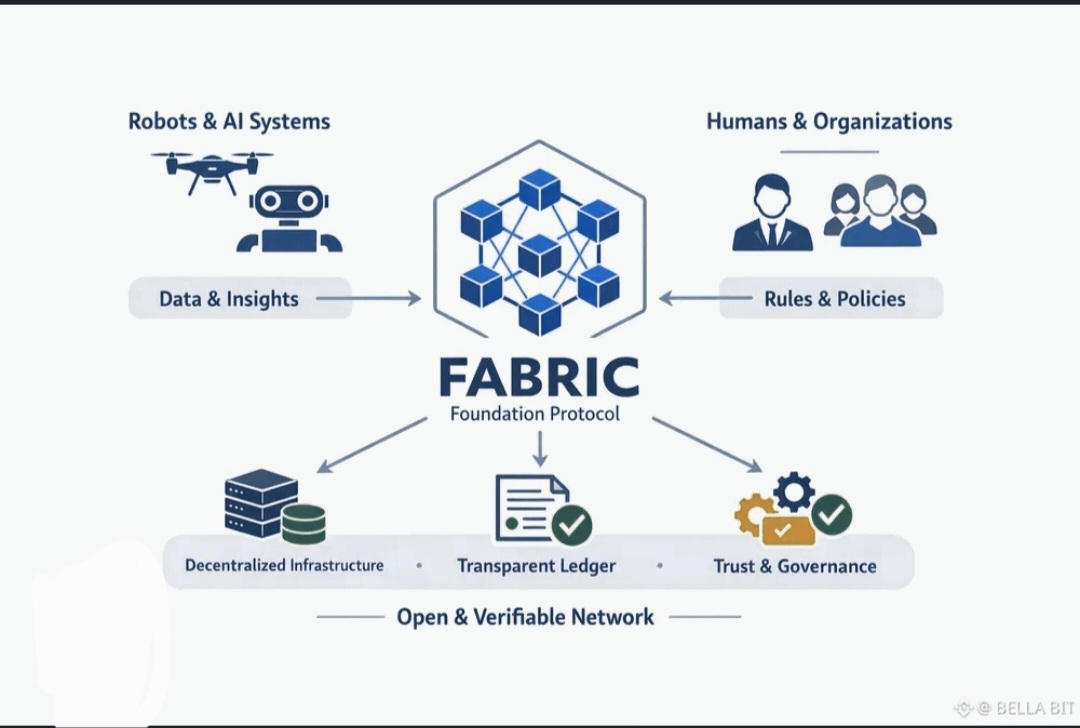
 The image presents a conceptual overview of the FABRIC Foundation Protocol, illustrating how it serves as a bridge between advanced technologies like AI-driven systems and the human structures that govern them. At its core, the diagram highlights a powerful idea: creating a unified, transparent, and decentralized ecosystem where machines and humans can interact seamlessly under shared rules and verifiable data.
At the top left, we see “Robots & AI Systems,” symbolized by a drone and a robot. These represent the rapidly expanding world of artificial intelligence, automation, and machine learning. These systems generate vast amounts of data and insights, which are critical for decision-making, optimization, and innovation. However, data alone is not enough—it needs a structured environment where it can be trusted, shared, and validated.
On the top right, the diagram introduces “Humans & Organizations,” represented by individuals and groups. These are governments, enterprises, institutions, and communities that operate based on rules and policies. Unlike machines, humans rely on governance frameworks, legal systems, and ethical standards to function effectively. The challenge in modern digital ecosystems is aligning machine-generated insights with human-defined rules in a way that is transparent and reliable.
This is where the FABRIC Foundation Protocol comes into play. Positioned at the center, it acts as the connecting layer that integrates both sides. The protocol is visually represented as a network of interconnected nodes, symbolizing a decentralized system. This design reflects how data, rules, and interactions are distributed rather than controlled by a single authority.
One of the key components highlighted is Decentralized Infrastructure. This means that instead of relying on centralized servers or institutions, the system operates across multiple nodes. This approach enhances security, reduces single points of failure, and ensures that no single entity has complete control over the network. In a world increasingly concerned with data privacy and censorship, decentralization provides a more resilient and fair structure.
Another important feature is the Transparent Ledger. This refers to a system—commonly associated with blockchain technology—where all transactions and data entries are recorded in a way that is visible and verifiable. Transparency builds trust, as participants can independently verify information without needing to rely on intermediaries. It also reduces fraud and manipulation, since every action is permanently recorded.
The diagram also emphasizes Trust & Governance, which are essential for any system involving multiple stakeholders. Trust is not just assumed; it is built through verifiable processes and consistent rules. Governance mechanisms ensure that the network evolves responsibly, with clear guidelines on how decisions are made, disputes are resolved, and updates are implemented.
At the bottom, the phrase “Open & Verifiable Network” summarizes the ultimate goal of the FABRIC protocol. “Open” implies accessibility—anyone can participate, contribute, or যাচাই (verify) the system. “Verifiable” ensures that all actions within the network can be independently checked for accuracy and authenticity. Together, these principles create an ecosystem where transparency, accountability, and collaboration are fundamental.
What makes this model particularly powerful is its ability to unify two traditionally separate domains: machine intelligence and human governance. AI systems can operate more effectively when their outputs are trusted and aligned with human rules. At the same time, humans can make better decisions when they have access to accurate, real-time data generated by intelligent systems.
In practical terms, such a protocol could be applied across various industries. In finance, it could enable secure and transparent transactions without intermediaries. In supply chains, it could track goods from origin to delivery with full visibility. In governance, it could improve accountability and reduce corruption by making public data verifiable. Even in identity systems, it could allow individuals to own and control their personal data securely.
In conclusion, the FABRIC Foundation Protocol represents a forward-thinking framework designed to connect the digital and human worlds. By combining decentralized infrastructure, transparent ledgers, and strong governance, it creates a foundation for a more trustworthy and efficient digital ecosystem. As technology continues to evolve, such models will play a crucial role in shaping how humans and machines coexist and collaborate in a shared, verifiable network.