
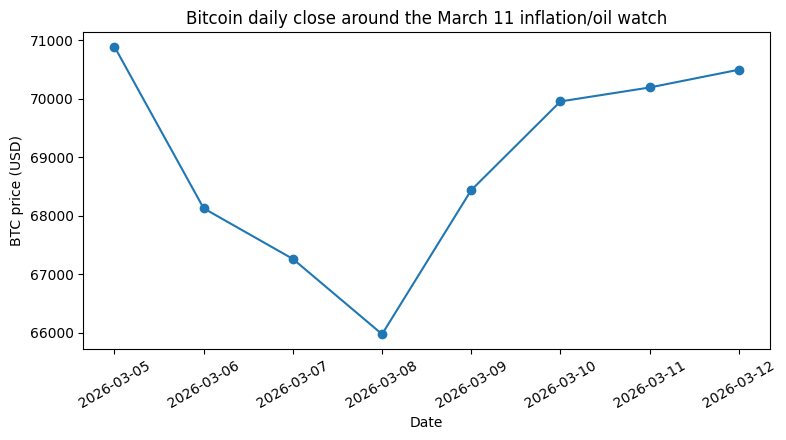
I reviewed the March 11 CNBC Crypto World story and the underlying macro backdrop. The core message still holds up: bitcoin was hovering around the psychologically important $70,000 area while traders weighed two outside forces that crypto cannot ignore for long, oil and U.S. inflation. On March 11, bitcoin closed around $70,205 after trading roughly between $68,999 and $71,338, while the February U.S. CPI report the same day showed headline inflation up 0.3% month over month and 2.4% year over year. The same CPI release also showed energy prices rising 0.6% in February, which mattered because oil was already becoming a macro stress point.
What this news meant for crypto traders
This was not really a “bitcoin-only” story. It was a liquidity story. When oil rises, markets start worrying about stickier inflation, and when inflation looks sticky, the Federal Reserve has less room to ease policy. That usually hurts risk assets first, especially the ones priced more on future liquidity than on current cash flow. Bitcoin near $70,000 was therefore acting as a macro barometer, not just a crypto chart. That is also why market commentary around the move kept emphasizing range-bound trading, ETF flows, and the importance of CPI as the next directional trigger.
The price action around the event reflects that uncertainty well. Bitcoin dropped into the mid-$65,000s by March 8, then recovered back toward $70,000 by March 10 and held near that level on March 11. That is not the behavior of a market in clean risk-on mode. It is the behavior of a market trying to decide whether macro pressure is temporary or the start of a tighter regime.
Here is the first chart for that window:
Why oil mattered more than many crypto traders expected
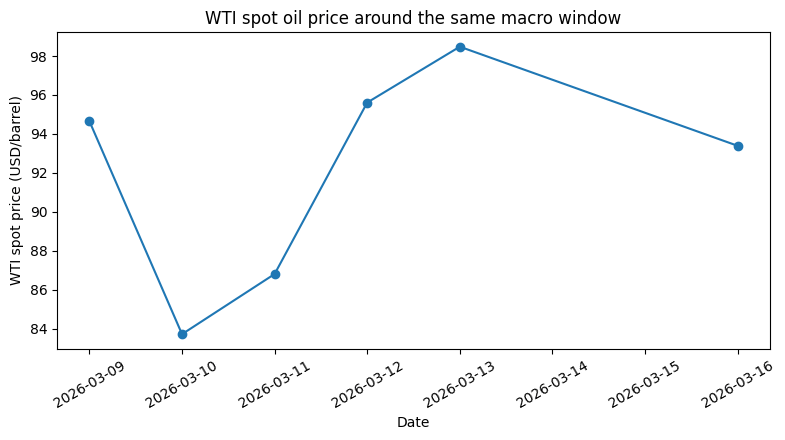
Oil was the hidden variable in this story. EIA spot data show WTI at $86.80 on March 11, but prices were volatile around that date, moving from $83.71 on March 10 to $95.61 on March 12 and $98.48 on March 13. That kind of move changes how traders think about inflation very quickly. It also explains why bitcoin could hold support but still struggle to break cleanly higher. A rising oil curve can revive inflation fears even when the latest CPI print is not a shock by itself.
That is the practical takeaway for crypto investors: higher oil does not damage bitcoin directly, but it can damage the policy backdrop that speculative assets need. If energy costs keep feeding through to transport, manufacturing, and consumer prices, markets start pricing fewer rate cuts or longer periods of restrictive policy. For bitcoin, that often means slower upside, more correlation with equities, and more sensitivity to ETF flow swings.
Here is the oil chart that belongs naturally beside that point:
WTI oil chart around the same window
Inflation was not collapsing, and that was enough to keep traders cautious
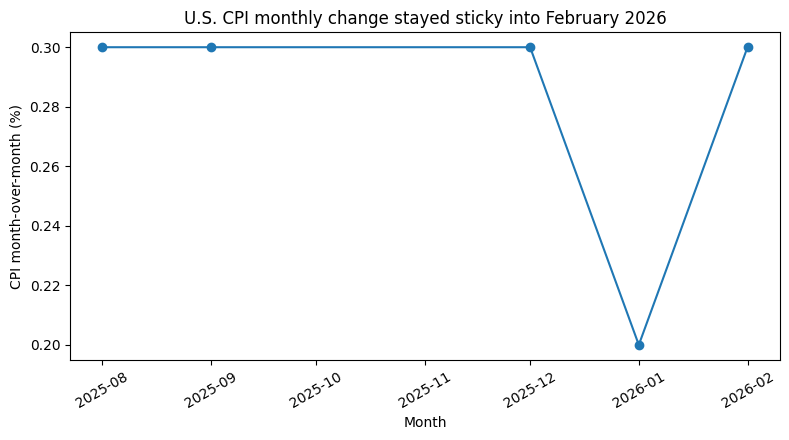
The February CPI report was not disastrous, but it was sticky enough to keep macro traders from relaxing. Headline CPI rose 0.3% in February after 0.2% in January, and the year-over-year rate held at 2.4%. Core CPI rose 0.2% on the month and 2.5% on the year. Shelter was still the largest monthly contributor, while energy also moved higher. In other words, inflation was no longer accelerating sharply, but it was not fading fast enough to hand markets an easy bullish narrative either.
For traders, that kind of print tends to create a very specific setup: support levels can hold because the data are not bad enough to force panic selling, but resistance levels can also keep rejecting because the data are not soft enough to unlock aggressive easing bets. That matches the commentary around bitcoin staying trapped near $70,000, with analysts watching roughly $69,000 as nearby support and $73,000 as a level that would signal stronger bullish control.
This CPI chart helps frame that backdrop:
Opportunities for investors and traders
The first opportunity was relative strength. Bitcoin holding near $70,000 while macro stress was building suggested that buyers were still willing to defend the asset despite higher oil, inflation worries, and ETF outflows. That matters because strong markets often reveal themselves by refusing to break when the news flow is only mixed, not clearly bullish.
The second opportunity was volatility with structure. Market commentary around the period described bitcoin as being in consolidation rather than in outright breakdown. For traders, that usually means defined levels matter more than narratives do. When the market is caught between structural demand and macro tightening, range trading and reaction trading often work better than trend-chasing.
The third opportunity was longer-horizon accumulation, but only for investors who accept macro noise. Even with short-term weakness, broader institutional rails remained in place. That does not guarantee upside, but it does mean bitcoin was not trading like an isolated speculative token. It was trading like a large macro-sensitive asset with growing mainstream participation.
Risks that deserved more attention
The obvious risk was macro spillover. If oil stayed elevated or moved higher, inflation expectations could rise again, making the Fed more cautious. That would likely pressure crypto multiples and keep bitcoin from turning a $70,000 hold into a clean breakout.
A second risk was flow fragility. Commentary around the period pointed to ETF outflows and weak absorption of broader selling pressure. In a market that increasingly depends on institutional flows, price can look stable until that demand pauses, then suddenly feel much thinner than expected.
A third risk was false confidence around headline CPI. Even when top-line inflation looks manageable, markets can turn defensive if traders think energy will make the next print worse. That is why the combination of CPI day plus oil volatility mattered more than either input alone.
Bottom line
For crypto investors, this news was really a reminder that bitcoin now trades inside a broader macro web. Near $70,000, the market was showing resilience, but not freedom. The bullish case was that bitcoin absorbed a sticky inflation print and oil-driven anxiety without losing its key range. The bearish case was that it still needed a friendlier macro backdrop to escape that range decisively. The most useful stance here is neither panic nor hype. It is to watch whether energy pressure fades, whether inflation continues to cool after February, and whether bitcoin can convert defense at $70,000 into acceptance above the next resistance zone.