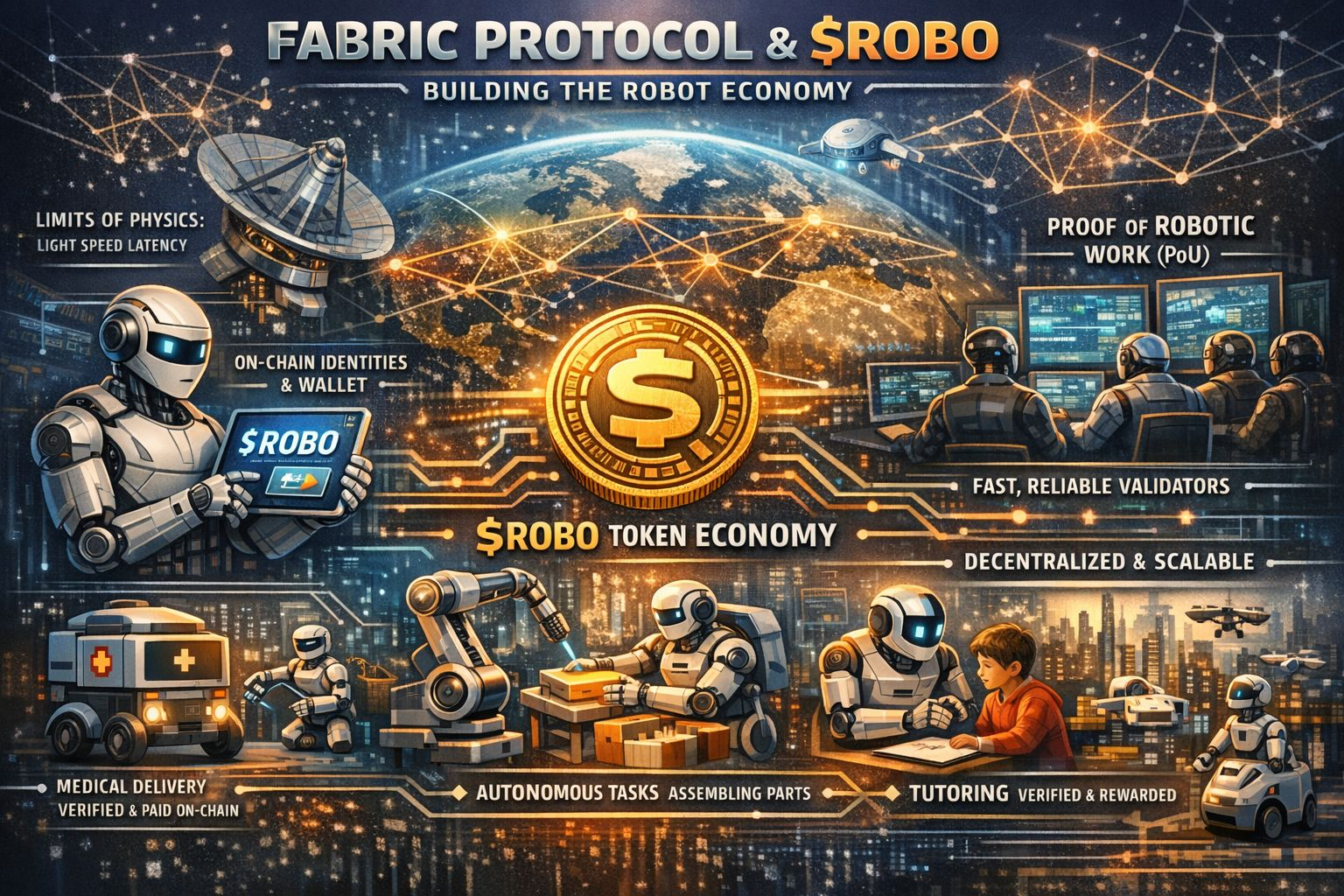
I've spent the last few years quietly watching blockchain networks evolve, and here's the truth I've come to after seeing so many projects stall: everyone obsesses over code upgrades and fancy scaling tricks, but the real bottleneck isn't the software. It's physics. Light speed is fixed. Messages still have to bounce across oceans between validators. For most chains, that means delays of seconds or more just to agree on what happened. That's fine for trading tokens, but useless when you're dealing with a robot that needs to decide in milliseconds whether to pick up a fragile object or avoid a person in a crowded room. I've realized this the hard way watching promising DePIN projects crawl under real-world pressure. That's why Fabric Protocol and its token ROBO caught my attention. It doesn't ignore the physics; it designs around them.
At its core, the Fabric Foundation is a non-profit building the open infrastructure for a true robot economy. Their Fabric Protocol gives robots something they've never had before: on-chain identities, wallets, and the ability to act as autonomous economic players. Think about it simply no more centralized servers owning the intelligence. A robot finishes a task (delivering medicine, assembling parts, or even tutoring a kid), the work gets verified on-chain, and it gets paid in ROBO straight to its digital wallet. No middlemen, no legal headaches. The token itself $ROBO handles everything practical: network fees, staking bonds, governance votes, and rewards for verified robotic work. Total supply is capped at 10 billion, with smart allocations that keep the ecosystem funded and growing without endless inflation.
What really sets Robo's approach apart is how they handle the technical side in plain, real world terms instead of abstract theory. Most blockchains chase thousands of validators for maximum security, but that creates a speed tax you can't escape physics won't let global consensus happen instantly. Fabric keeps it practical with a small, carefully bonded validator group. These aren't random nodes scattered everywhere; they're high stake participants focused on routine monitoring and quick dispute resolution. The network is optimized for low latency and efficiency, using verifiable proofs (they call it Proof of Robotic Work or PoU) so robots can prove what they did without waiting on the whole planet. Validators stake $ROBO as skin in the game, and slashing rules kick in fast for bad behavior fraud or downtime gets penalized immediately. It's not about perfect decentralization in theory; it's about speed and reliability in practice, respecting limits like bandwidth, energy use, and the physical safety robots must maintain in our messy human world.
I've come to appreciate this after observing too many networks that promised the moon but choked on real constraints. By late 2026, with the protocol live (starting on Base before its own optimized L1), we'll see the first wave of general-purpose robots registering, transacting, and earning. 2027-2028 should bring scaling: more hardware integrations, skill marketplaces where robots "buy" upgrades, and human-gated payments that keep everything safe and observable. By 2030, I genuinely believe we'll have a thriving robot economy millions of machines collaborating autonomously, solving labor shortages in healthcare, manufacturing, and beyond, all powered by $ROBO. The Foundation's vision keeps power decentralized and benefits shared, turning AI from something scary and centralized into something we all help shape.
So where do you fit in? That's the part that excites me most. You don't need to be a coder or robot builder to participate. Stake ROBO to help secure the network and earn from usage. Join governance to vote on fees or policies. Or simply hold and watch your tokens gain value as real economic activity grows protocol revenue even buys back $ROBO, creating natural demand. Early community airdrops and ecosystem funds are already rewarding contributors. I've started positioning myself because, after years of hype cycles, this feels like the first project treating the physical world seriously. The robot future is coming whether we like it or not. Fabric and $ROBO just make sure we own it together.