

I have seen crypto sell privacy the same way for years.
Same old pitch. Same dramatic words. Hide everything. Reveal nothing. Trust the mystery. Then a few months later, the product fades, the story gets recycled, and the market moves on to the next loud promise.
That is exactly why Midnight caught my attention.
What feels different to me is that Midnight does not seem obsessed with privacy as a performance. It feels more focused on something far more useful: control. And honestly, that is the part this space has been missing for a long time.
Crypto has spent years treating transparency like it is automatically a strength. On paper, that sounds noble. In reality, it often creates unnecessary exposure. Public chains made full visibility feel normal, but normal does not always mean healthy. Users reveal more than they should. Builders are forced to design inside systems that expose too much by default. Strategies become traceable. Behavior becomes trackable. Flows become visible to anyone patient enough to watch.
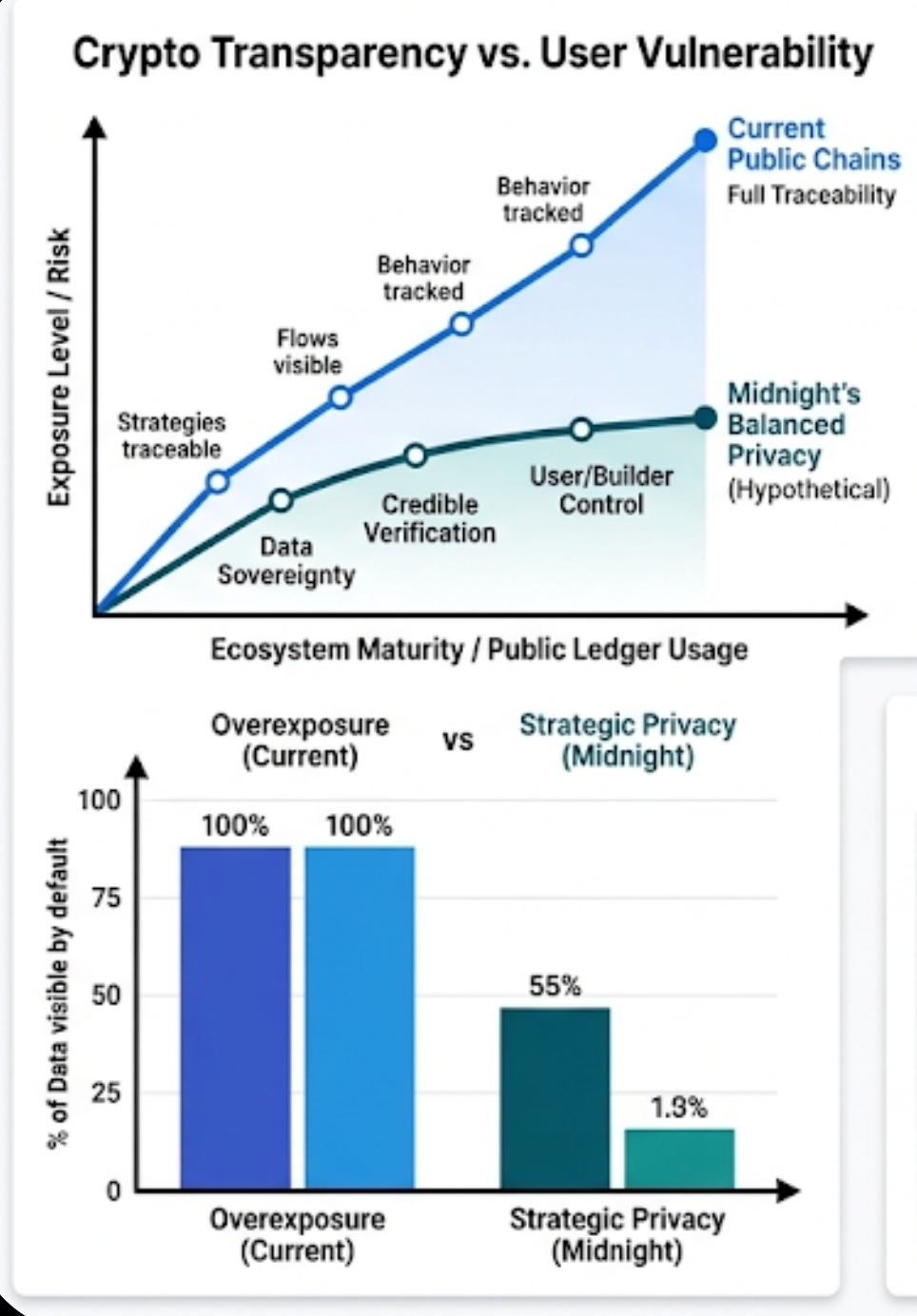
At some point, that stops feeling open and starts feeling broken.
That is where Midnight starts to feel relevant in a serious way. I do not look at it like another privacy coin trying to wrap itself in bigger infrastructure language. I look at it like a project that may actually understand the design flaw sitting in front of crypto for years: not everything should be public forever.
And that should not be a controversial idea.
What I like most is that Midnight does not seem to be pushing the usual extreme. It is not saying everything must disappear into darkness. That matters. Because the future of privacy in crypto was never going to be about turning systems into black boxes. That only creates a different kind of distrust. The smarter path is balance. Protect what should stay private, but still allow the network to verify what actually matters.
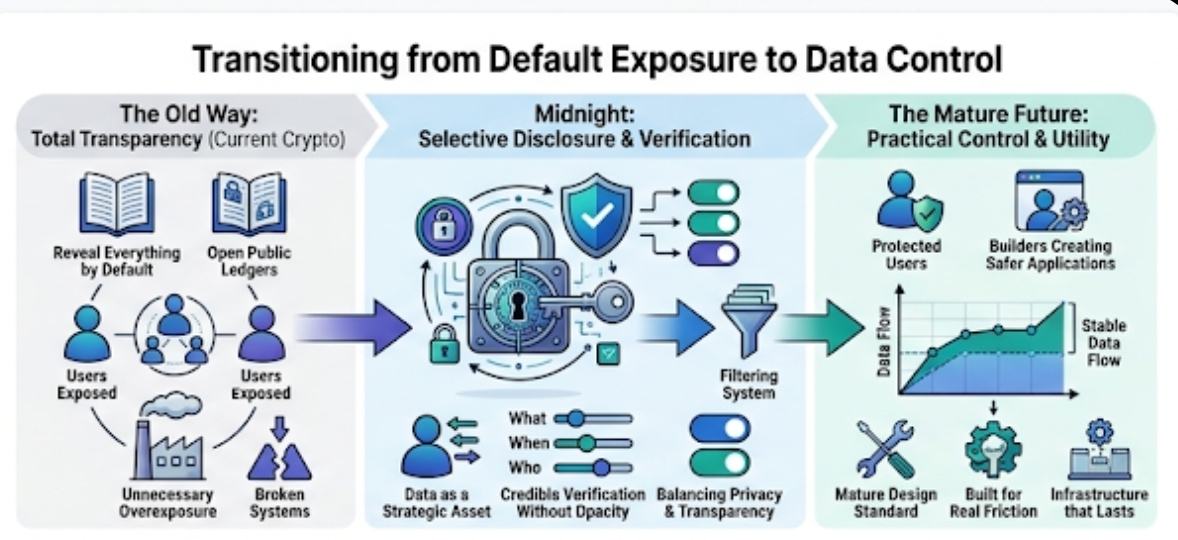
That is a much stronger idea than the old privacy narrative.
To me, Midnight looks like it is trying to sit in the uncomfortable middle ground between overexposure and opacity. That middle is harder to explain, harder to build, and definitely harder to market. But it is also where real utility usually lives. The market loves simple slogans, but infrastructure that lasts is rarely built on slogans. It is built on solving real friction.
And the friction here is real.
Crypto users today are more exposed than many of them realize. Builders are still designing applications inside systems that leak too much information by default. For all the talk about innovation, this is one of the oldest weaknesses in the space. Midnight feels important because it is not dressing that weakness up like a feature. It seems to be addressing it directly.
That does not automatically make it a winner. I have been around long enough to know that good ideas can still lose to weak execution, bad timing, or a market that gets bored the second something requires actual thought. So no, I am not romantic about it.
But I am paying attention.
Because if Midnight can make privacy usable without making the system unreadable, that matters. If it can give users and builders more control without sacrificing credibility, that matters even more. And if it succeeds, it could push crypto toward a more mature future, one where privacy is not treated like a hiding place, but like a necessary design standard.
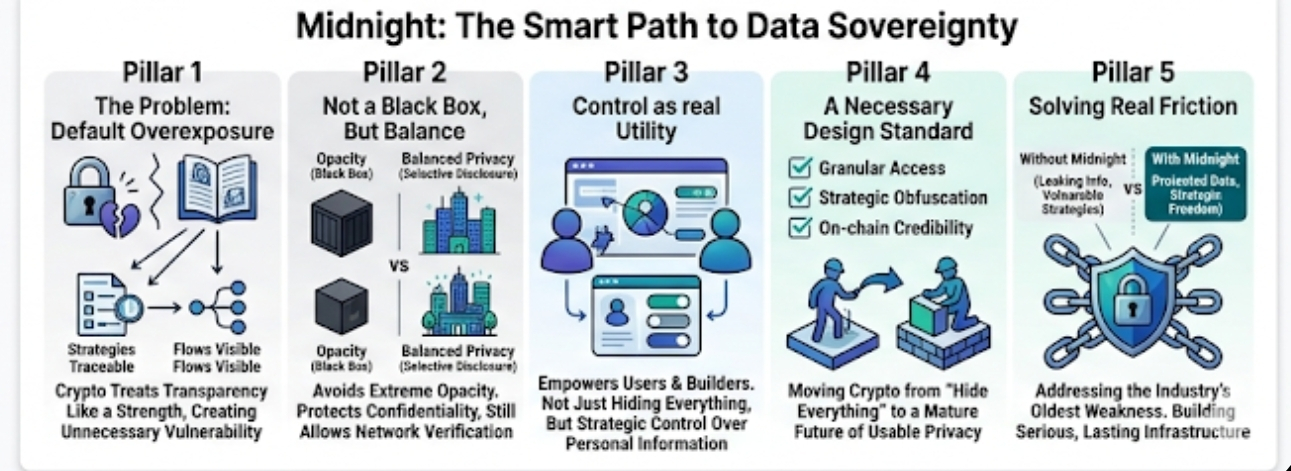
That is why Midnight feels more serious to me than most names passing through this cycle.
Not because it is louder.
Because it finally sounds like it understands the real problem.